
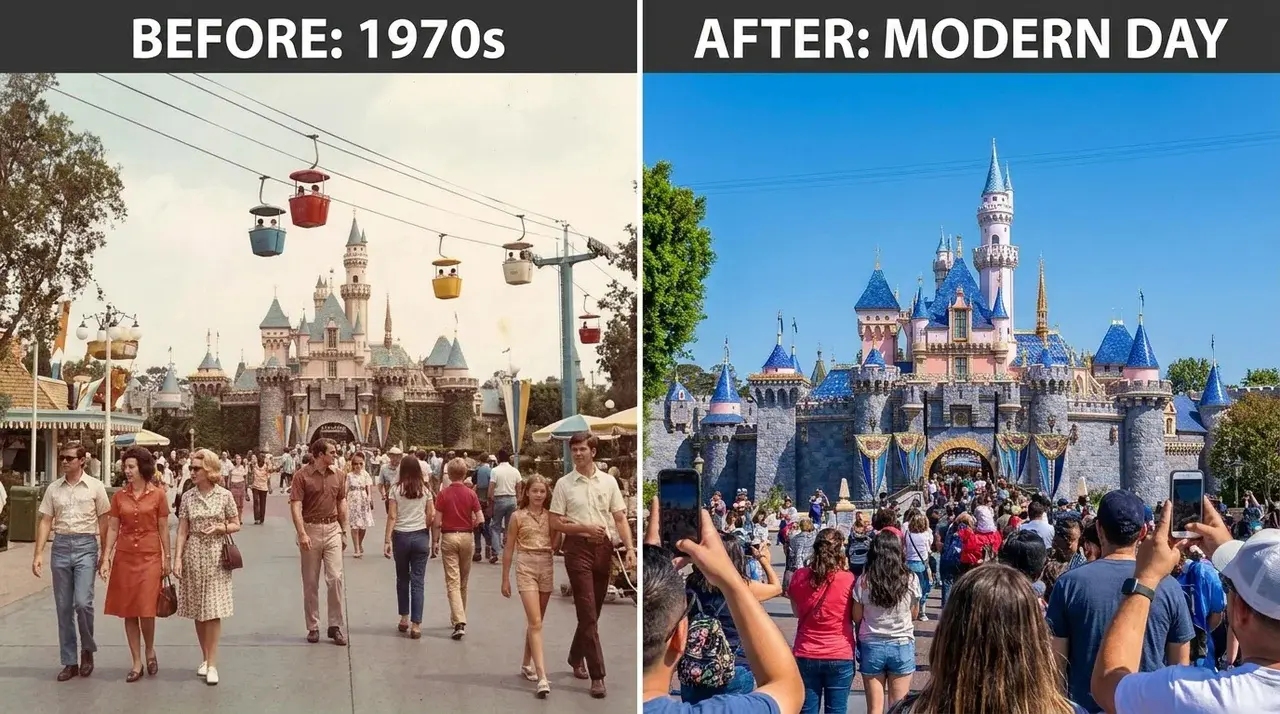
Last Updated on June 4, 2026
- 1975 gate admission: $6.00 (plus individual ride tickets)
- 2026 gate admission: $104 (cheapest tier) to $224 (peak day)
- 1975 family of four total day cost: roughly $80-$100 all-in
- 2026 family of four total day cost: $600-$1,200+ all-in
- E-Ticket (top ride) in 1975: $0.75-$0.85
- Lightning Lane Individual in 2026: $20-$30 per ride per person
- Main Street Electrical Parade: debuted 1972, beloved then, gone today
- Rides open in the 1970s that still run today: Haunted Mansion, Pirates, Matterhorn, It’s a Small World, Jungle Cruise
If you grew up going to Disneyland in the 1970s, you carry a specific version of the park in your memory. The smell of the Haunted Mansion queue on a warm evening. The weight of a ticket book in your pocket. Watching the Main Street Electrical Parade from a curb spot you claimed an hour early. Getting a corn dog for less than a dollar. Riding Space Mountain so many times the E-tickets ran out and you had to go buy more.
That park still exists in places. The bones are the same. But almost everything layered on top of those bones has changed, and the price of experiencing it has changed most of all.
This is not a complaint piece. The 1970s Disneyland had real limitations that people tend to forget. But it was also genuinely different in ways that matter, and comparing then to now reveals something true about what the park has become and what it has traded away to get here.
The Ticket Books: When Every Ride Had a Price Tag
Walk into Disneyland in 1975 and the first thing you did at the gate, after paying your $6 admission, was decide which ticket book to buy. The park ran on a lettered coupon system: A through E, with A being the smallest attractions and E being the headliners. A complete “Deluxe 15” ticket book for an adult ran about $8.50 in the mid-1970s on top of your gate admission. That got you a stack of colorful coupons you rationed through the day.
An E-ticket in 1975 cost $0.75 to $0.85 for a child, slightly more for an adult. The E-ticket rides were Haunted Mansion, Pirates of the Caribbean, the Matterhorn, Submarine Voyage, and the newly opened Space Mountain. You got a handful of E-tickets in your book. When they ran out, you either bought more or you didn’t ride those attractions again that day.
This system had real consequences for how families experienced the park. You made decisions. You saved your E-tickets for the rides you loved most. Kids who burned through theirs on the first pass through Tomorrowland spent the rest of the afternoon on B and C ticket rides while their parents quietly calculated whether to buy another book. The tickets made the value of each attraction visible in a way that today’s all-in admission completely erases.
Disney finally killed the ticket book system in 1982 and moved to an all-inclusive passport. By then, competitors like Magic Mountain had already shown that one-price unlimited access was what families wanted. The change simplified everything and almost certainly increased per-visit revenue. What it eliminated was the particular anxiety and joy of managing your ticket stack, which for an entire generation is one of the most vivid sensory memories of childhood trips to the park.
Today’s equivalent: The ticket book never came back, but Lightning Lane is its philosophical descendant. You pay admission and then pay again, per ride, for the right to skip the line on the best attractions. The framing is different. The mechanics are remarkably similar.
What a Day Actually Cost in the 1970s
Numbers are the most striking part of this comparison, but they require context. A raw price comparison without inflation adjustment is almost meaningless.
In 1975, Disneyland gate admission was $6.00 for adults. A complete Deluxe ticket book added roughly another $8.50. Parking was around $1.50. A corn dog cost about $0.75. A family of four, with two ticket books each for the adults and adjusted child pricing, plus food and parking, would realistically spend somewhere between $80 and $100 for a full day. That felt like a real commitment in 1975 dollars.
Adjusted for inflation to 2026, that $80-$100 day is roughly equivalent to $460-$580 today. Meaning the 1970s Disneyland was genuinely expensive for its era too. It was not the cheap family outing that nostalgia sometimes suggests. Families who went regularly in the 1970s were making a meaningful financial choice to do so.
And yet. A family of four visiting Disneyland today on a moderate weekend, with two-park hopper tickets at current Tier 3 pricing, Lightning Lane Multi Pass for all four guests, one sit-down meal, quick service lunch, snacks, and parking easily runs $900 to $1,200 for a single day. That same family going in peak summer hits $1,400 or more before anyone buys a souvenir. Even adjusting for inflation, today’s Disneyland costs roughly two to three times what it cost in the 1970s for the same family.
The gap is real, and it has widened significantly in just the last ten years. Disney’s own peak-day ticket went from $99 in 2014 to $224 in 2026. That is a 126% increase in twelve years, against inflation of roughly 35% over the same period. Prices have grown at nearly four times the rate of inflation during that window.
The Rides That Were There Then (And the Ones That Were Not)
Here is something that surprises people: the core ride lineup of 1970s Disneyland is not that different from what you ride today.
In 1975, Disneyland had Pirates of the Caribbean (opened 1967), Haunted Mansion (1969), the Matterhorn (1959), It’s a Small World (1966), Jungle Cruise (1955), the Submarine Voyage (1959), the Monorail (1959), Space Mountain (opened 1977), and a dozen other attractions spread across the lands. Many of those are still running. The Haunted Mansion you ride today is essentially the same experience, in the same building, with the same Doom Buggy system installed in 1969.
What the 1970s did not have: Star Wars: Galaxy’s Edge, Indiana Jones Adventure, Splash Mountain (now Tiana’s Bayou Adventure), the entire Disney California Adventure next door, Radiator Springs Racers, Rise of the Resistance, Guardians of the Galaxy Mission: Breakout, or any of the franchise-driven lands that now define the resort.
What the 1970s had that today does not: Mine Train Through Nature’s Wonderland, the PeopleMover (still running then), the Motor Boat Cruise, the Skyway gondola, America Sings, Mission to Mars, Country Bear Jamboree (since relocated), and the Main Street Electrical Parade as a nightly fixture rather than a periodic special event.
The honest summary is that the park is bigger and more technically impressive now. The rides of 2026 are more immersive, more sophisticated, and more expensive to produce than anything that existed in the 1970s. What the 1970s had was a kind of coherence. The park felt like a single vision. Every land was distinct and unhurried. There was space between things.
The Main Street Electrical Parade
If you want to understand the emotional core of why people who went to Disneyland in the 1970s carry it so differently than guests who go today, the Main Street Electrical Parade is the place to start.
It debuted on June 17, 1972. For the next 25 years, with some gaps, it was the nightly centerpiece of the park. You picked your curb spot on Main Street after dinner and you waited. When the lights went down and the opening synth notes of “Baroque Hoedown” started, something happened to the crowd that is genuinely hard to describe to someone who never experienced it. The floats moved slowly. Every surface was outlined in colored lights. The music was simple and the technology was primitive by modern standards. And it did not matter at all. It was perfect.
The parade ran its last regular Disneyland engagement in 1996. It has returned for limited runs since, most recently for the 50th and 60th anniversaries, but it no longer anchors the park the way it once did. Paint the Night, the current nighttime parade, is objectively more sophisticated. The lighting technology is incomparably better. The floats are larger and more detailed.
But it is not the same. It cannot be the same. Part of what made the Electrical Parade matter was that it was there every single night, and you planned your whole day around it, and when it finally moved down the street the air felt different. That specific combination of anticipation and payoff does not exist in the same form today.
Crowds and the Question of Reservations
In the 1970s, you drove to Disneyland, you parked, you paid at the gate, and you went in. There was no reservation system. There was no app. There was no virtual queue. There was no park capacity management beyond simply closing the gates when the lot filled up, which happened occasionally on the busiest summer days. On a typical weekday in October you could walk into Haunted Mansion with essentially no wait. The park absorbed you and you moved through it at whatever pace felt right.
Today you plan a Disneyland trip the way you once planned international travel. You book tickets months out. You study crowd calendars. You download the app before you arrive. You make dining reservations 60 days in advance for the restaurants you want. You decide the night before which Lightning Lane tier to buy. You set alarms for when individual Lightning Lane reservations open at 7am. You monitor wait times on your phone while standing in a different line.
This is not entirely Disney’s fault. The park draws more people now, serves more people now, and manages a vastly more complex operation than it did in 1972. The systems exist because without them, the chaos would be worse. But the cognitive load of a modern Disneyland visit is genuinely different from what families experienced fifty years ago, and the difference is rarely acknowledged in the park’s own marketing, which still leans heavily on the language of spontaneity and magic.
What the 1970s Park Did Less Well
Honest comparisons require honesty in both directions.
The 1970s Disneyland was less diverse, in every sense of the word. The representation across rides, characters, and stories was narrower. Tomorrowland’s vision of the future was mid-century American corporate optimism, already showing its age by the late 1970s. The food was simpler, which sounds charming until you remember that “simpler” mostly meant fewer options, lower quality, and less accommodation for dietary restrictions that were simply ignored.
The park was also less accessible. Guests with mobility limitations had fewer formal accommodations. The infrastructure that now supports guests with disabilities, from the DAS program to physical accessibility throughout the park, did not exist in its current form. You either managed or you did not go.
And the rides, while beloved, were often technically primitive. The animatronics that seemed miraculous in the 1960s looked increasingly dated by the late 1970s. Some attractions that hold enormous nostalgic weight were, measured objectively, not very good experiences. The PeopleMover, for all its cult following, was a slow ride that went nowhere in particular. The Skyway was a gondola. The appeal of both was almost entirely about atmosphere, not excitement.
The park of 2026 is, in many technical and experiential respects, better than the park of 1975. Rise of the Resistance is an achievement that simply did not exist on any planet in 1975. Galaxy’s Edge creates total environmental immersion in a way that none of the 1970s lands did. The food is better, the accessibility is better, and the park’s physical presentation is better maintained.
What the park of 2026 costs to experience is the trade-off that comes with all of that.
The Family Trip Then and Now
In the 1970s, a Disneyland trip was an event. SoCal families went once or twice a year if they could afford it. The drive to Anaheim, the parking lot tram, the smell of the Main Street bakery, the weight of your ticket book. These things were special because they did not happen constantly.
The modern Disneyland has Magic Key annual passholders who visit dozens of times a year. The park is designed, at the high end, for frequent repeat visitors with substantial disposable income. The tiers of the resort, from standard day tickets at $104 to Inspire Magic Keys at $1,899 to suite rooms at the Grand Californian, represent a deliberately stratified experience in a way that did not exist in the 1970s. You paid your $6 and got the same park as everyone else.
That stratification is not inherently wrong. Disney is a business and the business has grown enormously. But it does mean that the version of Disneyland that exists in the memory of people who went as children in the 1970s is structurally different from the park their own children experience. The emotional logic is the same. The financial logic is not.
What Has Not Changed
Some things are remarkably stable across 50 years. The Haunted Mansion still lowers you underground in an elevator disguised as a stretching room. Pirates still drops you down a waterfall in the dark before the bayou opens up. The Matterhorn still throws you through the mountain in the same bobsled cars that were installed in 1978. The Jungle Cruise skipper still delivers the same punishing puns to a captive audience in a boat that does not move as fast as anyone wishes it would.
Main Street still smells like vanilla and popcorn in the evening. The castle is still lit at night in a way that stops people. The Disneyland Railroad still circles the park. Walt’s apartment window above the firehouse still has its light on.
The park has a physical continuity that is genuinely rare in American commercial life. The bones laid down between 1955 and 1979 are still there, still working, still carrying guests through the same geography they carried the grandparents of today’s visitors. That is not nothing. In fact it is something that almost no other entertainment venue on earth can claim.
The question of whether the price of experiencing that continuity has gotten too high is one that every family answers for themselves, every year, when they decide whether to go.
Planning a Trip? Lock In Today’s Prices Before October
Disneyland raises ticket prices every October. Get Away Today offers multi-day tickets below Disney’s gate rate, valid through January 2027. Beat the next increase and get the best price on your trip.
Get My Free QuoteBest price guaranteed · Layaway plans · Disneyland specialists
The Bottom Line
Disneyland in the 1970s was not cheap, it was not perfect, and nostalgia has smoothed out plenty of its rough edges. But it was also a park where a middle-class SoCal family could drive down on a Saturday, pay at the gate, and spend a full day in a place that felt genuinely magical without planning it six months in advance or spending close to a thousand dollars.
That version of the park is gone. What replaced it is technically superior in almost every measurable way. Whether it is better is a question that depends entirely on which version of magic you are looking for, and whether you can afford to look for it.
For those who went as kids in the 1970s and are now bringing their own children, the good news is that the park they remember is still in there, underneath everything else. The same castle. The same smell. The same feeling when you walk under the tunnel at the end of Main Street and the whole park opens up in front of you. That part has not changed. It probably never will.
Plan Your Disneyland Visit
Whether you are returning for the first time in decades or planning a first trip for your own kids, the Enchanted Insider Disneyland Itinerary Guide covers how to make the most of a day in the park in 2026. For the best available prices on tickets and hotel packages, Get Away Today is our recommended travel partner.
Get the Best Price on Your Next Disneyland Trip
Get Away Today has been an authorized Disneyland partner since 1990. Multi-day tickets priced below Disney’s gate rate, with a layaway plan and best price guarantee.
Get My Free QuoteBest price guaranteed · Layaway plans · Disneyland specialists
FAQ
Gate admission at Disneyland was $6.00 in 1975 and $7.00 by 1979. However, most rides required separate tickets purchased in lettered “ticket books,” with E-ticket rides (the headliners like Space Mountain and Haunted Mansion) costing $0.75 to $0.85 each. A complete “Deluxe 15” ticket book ran about $8.50 on top of gate admission. A family of four with parking and food would realistically spend $80 to $100 for a full day, which adjusted for inflation is roughly $460 to $580 in 2026 dollars.
The 1970s were a formative decade for Disneyland. The park added Space Mountain in 1977 and Big Thunder Mountain Railroad in 1979, and the Main Street Electrical Parade debuted in 1972 as the park’s signature nighttime event. Guests used the A through E ticket book system for individual attractions rather than all-inclusive admission. There were no reservation requirements, no smartphone apps, and no Lightning Lane. You drove to the park, paid at the gate, and went in.
Many of Disneyland’s original rides are still operating. Pirates of the Caribbean (1967), the Haunted Mansion (1969), It’s a Small World (1966), the Matterhorn Bobsleds (1959), the Jungle Cruise (1955), the Disneyland Railroad (1955), Space Mountain (1977), and Big Thunder Mountain Railroad (1979) are all still running in 2026. The Haunted Mansion in particular uses the same Doom Buggy Omnimover system installed when the ride opened.
The Main Street Electrical Parade debuted at Disneyland on June 17, 1972 and ran as the park’s signature nightly event for most of the following two decades. It ended its regular Disneyland run in 1996, though it has returned for limited anniversary engagements since. The current nighttime parade at Disneyland is Paint the Night, which uses more advanced lighting technology but does not hold the same nightly anchor role the Electrical Parade had for the generation that grew up with it.
Yes, significantly. A family of four visiting Disneyland in the 1970s spent the equivalent of roughly $460 to $580 in today’s dollars for a full day including tickets, food, and parking. A comparable family visiting today on a moderate-traffic weekend realistically spends $900 to $1,200 or more, even before souvenirs. Disney’s peak single-day ticket price rose from $99 in 2014 to $224 in 2026, a 126% increase against inflation of roughly 35% over the same period.