
Last Updated on June 3, 2026
Disneyland looks finished. Clean edges, fresh paint, cast members everywhere making sure nothing feels out of place. But underneath the surface, the park is full of ghosts.
Not the ones in the Haunted Mansion. Real ones. Attractions that closed decades ago and never fully disappeared. Structures that still stand, still sit, still wait, right in the middle of a park with 50,000 people walking past them every day. Some are hiding overhead. Some are hidden in plain sight, repurposed into something else entirely. A few are inside attractions you ride every visit, without knowing what you’re looking at.
This is Disneyland’s ghost layer. Here is exactly where to find it.
1. The PeopleMover Track Floating Over Tomorrowland
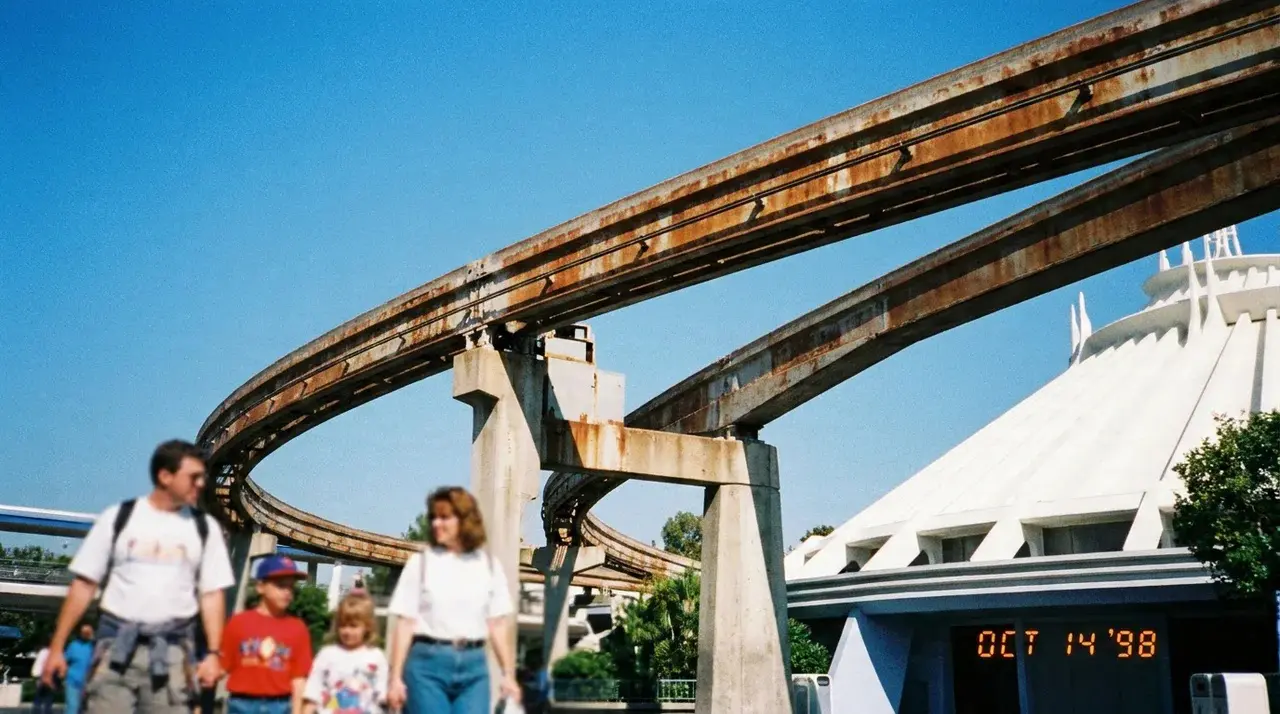
Look up in Tomorrowland. Between the Monorail beam and the Space Mountain dome, you will see a second elevated track looping through the land. The supports are weathered. No vehicles move on it. No one talks about it. But it is absolutely there, visible from the Autopia queue, from the walkway near Space Mountain, from just about anywhere in the land if you know to look up.
That is the PeopleMover track. It has been sitting empty since 1995.
The PeopleMover opened in 1967 as Disneyland’s vision of future urban transportation: a slow, silent, electric tram that glided guests around Tomorrowland on rotating friction wheels, threading through the Space Mountain show building and offering views the park had never provided before. It ran for 28 years before cost-cutting leadership closed it.
What followed was one of Disneyland’s great disasters. In 1998, the same track was repurposed for Rocket Rods, a high-speed replacement that was essentially asked to go five times faster on infrastructure never designed for the stress. Budget cuts meant Disney couldn’t afford to add banked curves. The cars had to brake at every turn, the repeated acceleration and deceleration shredded the system, and Rocket Rods closed after just two years of chronic breakdowns.
The track has been there ever since. Thirty-one years of rust and vines, hanging above a land that still calls itself the future. The Walt Disney World version of the PeopleMover never closed and still runs today, which makes Disneyland’s abandoned twin all the more eerie by comparison.
Where to see it: Stand in the Autopia queue or anywhere on the walking path between Space Mountain and the Monorail station and look up. The empty beams are impossible to miss once you know they’re there.
2. The Haunted Mansion Stretch Room Is Actually an Elevator
Most guests assume the Haunted Mansion stretch room is a visual trick. The ceiling appears to rise. The portraits elongate to reveal their sinister punchlines. The Ghost Host asks if you can “find a way out.” Then the doors open and you move on.
But the room is not just an illusion. It is a working elevator, and it is descending the entire time you stand in it.
Here is the engineering problem the Imagineers had to solve. The Haunted Mansion facade in New Orleans Square is not where the ride actually takes place. The real show building, the one that contains all the Doom Buggy track and every scene you experience, sits on the other side of the Disneyland Railroad tracks, outside the park perimeter. To get guests there, Imagineers needed to move them underground, below the train tracks, without anyone noticing.
The stretch room is the solution. While the Ghost Host narrates and the portraits do their work, the entire room is slowly descending two stories. The telescoping striped walls hide the movement. The thunderclap at the end masks the sound of the elevator stopping. When the exit doors open, you are below grade, and the long portrait corridor you walk through is a tunnel under the railroad. You emerge in the actual ride building without ever registering that you left the building you walked into.
Walt Disney World never needed this. They had open land and built their show building in front of the mansion entrance. Their stretch room ceiling just goes up. Only Disneyland’s is a functioning elevator, and it has been lowering guests underground since 1969.
What to notice on your next visit: Pay attention when the exit doors open. The corridor you enter feels slightly different from the entrance level. That is because it is. You are underground.
3. The Pipe Organ in Haunted Mansion Has Been There Since 1954
In the Haunted Mansion ballroom, a ghostly organist plays Grim Grinning Ghosts while spirits dance below. The pipe organ commanding that scene is not a prop built for the ride. It is a movie prop from 1954, and it has been at Disneyland for over 70 years.
The organ originally belonged to Captain Nemo. It was built for the 1954 Disney film 20,000 Leagues Under the Sea, where James Mason played it aboard the Nautilus. When the film wrapped, Disney put the actual prop on display in Tomorrowland as part of a walk-through 20,000 Leagues exhibit that ran from 1955 to 1966. When that exhibit closed, Imagineers working on the Haunted Mansion needed a ballroom organ. They repainted it, swapped the headboard for a bat-wing design, installed new pipes to fit the room’s dimensions, and it has been playing Grim Grinning Ghosts ever since.
Every Haunted Mansion at Disney World and Tokyo uses a replica. Only Disneyland has the original movie prop. It is the same physical object that James Mason touched on a film set in 1953, and you float past it on every ride.
Where to see it: In the Doom Buggy, as you enter the ballroom scene, look down and to the left. The ghostly organist sits at the far end. The console, keyboard, buttons, and knobs are exactly what appeared on screen over 70 years ago.
4. The Original 1959 Submarine Hulls Are Still in the Water
Finding Nemo Submarine Voyage is one of the most labor-intensive attractions at Disneyland. A dedicated team of scuba divers inspects the lagoon every night. The ride has a full maintenance infrastructure. What most guests do not know is that the vehicles they are riding are not modern rides at all. They are the original submarines from the 1959 Submarine Voyage, the same hulls that have been in that water for over 65 years.
The original Submarine Voyage opened in 1959 as part of the new Tomorrowland, framed as a Cold War-era adventure inspired by the USS Nautilus’s voyage beneath the Arctic ice cap. It ran for 39 years before closing in 1998. The lagoon sat empty and drained for years while Disney debated the attraction’s future. At one point, executives considered demolishing the submarines entirely. An Imagineer hired a naval engineering firm to inspect them. The firm concluded the hulls had 40 to 50 years of life remaining. That report saved them.
When Finding Nemo Submarine Voyage opened in 2007, Disney refurbished all eight original subs, converted them from diesel to electric power, and put them back in the same lagoon on the same track. The ride you take today uses the same steel hulls that guests rode in 1959. Eisenhower was president when these vehicles were commissioned. They are still running.
What to look for: The submarine loading dock faces the lagoon directly. Standing there, you are looking at the same water feature, the same rock formations, and the same general layout that opened 67 years ago. The ride has new show scenes inside. The infrastructure around you is original.
5. Rainbow Ridge Is Older Than Big Thunder Mountain
When you board Big Thunder Mountain Railroad and the ride pauses near the little ghost town at the loading area, you are looking at something that predates the roller coaster by over 20 years. That tiny Western village is Rainbow Ridge, and it was originally the loading station for a completely different attraction.
Mine Train Through Nature’s Wonderland ran from 1960 to 1977, a slow-moving train ride through animatronic wilderness scenes: beaver valleys, bear country, the Living Desert, waterfalls called Big Thunder. Rainbow Ridge was the mining town at the start of the route, where guests boarded the train. When Disney closed the Mine Train to build Big Thunder Mountain Railroad, the Imagineers did not tear Rainbow Ridge down. They moved it slightly and incorporated it into the new ride’s queue and loading area, where it remains today.
Disney’s own official attraction page acknowledges this directly, noting that the miniature ghost town predates Big Thunder Mountain Railroad and was originally named for the Mine Train attraction. Other Mine Train remnants are scattered throughout Frontierland: the old train tunnel is still visible along Big Thunder Trail, a walking path between Frontierland and the rest of the park. The jumping fish from the original Bear Country pond still animate near the Big Thunder area.
What to look for: When you are in the Big Thunder Mountain queue or loading area, the cluster of small Western buildings is what it looks like. The saloon, the hotel, the assayer’s office. Those buildings were standing on this property when Neil Armstrong was still in the Air Force.
6. The Motor Boat Cruise Dock Is a Seating Area Next to Edelweiss Snacks
There is a quiet waterside seating area tucked beside the Matterhorn, between the mountain and the path to It’s a Small World. A small lake sits there. The dock structure at the water’s edge is original construction from 1957. Most guests eat their pretzels there without any idea what they are sitting on.
The Motor Boat Cruise ran from 1957 to 1993, one of Disneyland’s original opening-era attractions. Guests steered small motorboats through canals winding around Fantasyland and Tomorrowland, past boulders and flowers, under the Monorail beam. The boats were on a hidden track, like Autopia on water. The ride received an ill-fated overlay in 1991 as the Motor Boat Cruise to Gummi Glen, themed to the Disney Afternoon animated series, which lasted less than two years before the whole thing closed permanently.
After closure, the loading dock became a designated smoking area, then a Halloween trick-or-treat stop during Mickey’s Halloween Party. At some point it became simply Fantasia Gardens, a quiet waterside seating spot. The dock structure, the water, and the general layout of the old canals around the Matterhorn are still there. As of early 2026, the area is behind construction walls as work proceeds nearby, but the history beneath those walls has been there for nearly 70 years.
What to look for: Next time you get food at Edelweiss Snacks, walk toward the water. The dock where boats once loaded is the same dock where guests now sit. The lake they look out at is the same lake the motorboats used to cruise through.
7. The Fantasyland Skyway Staircase Steps
From 1956 to 1994, a gondola ride called the Skyway connected Fantasyland and Tomorrowland. Guests loaded into sky buckets and glided above the park, passing directly through a hole in the Matterhorn. It was one of Walt’s original attractions, open for 38 years before safety concerns and maintenance costs finally ended it.
The Tomorrowland station was demolished almost immediately after closure. But the Fantasyland station stood for years in various states of abandonment before finally being taken down ahead of Star Wars: Galaxy’s Edge construction in 2016. The chalet building, designed to look like an Alpine station, was removed. The concrete platform was cleared. By the time Galaxy’s Edge opened, it was gone.
Almost gone. A few stone steps that led up to the Fantasyland Skyway station loading platform are still there. They are tucked behind the vendor stalls across from Red Rose Tavern, easy to miss and easy to walk past a hundred times without noticing. They are just steps. There is no sign. But they are the last physical fragment of a ride that flew guests over Fantasyland for four decades.
Where to look: Face the vendor carts across from Red Rose Tavern. The staircase remnant is in the area behind and beside those stalls. It does not look significant. That is why no one notices it.
8. The Big Thunder Trail Tunnel
Walking between Frontierland and the rest of the park along Big Thunder Trail, there is a stone tunnel in the rock face to your left. Most guests pass through the area without registering it. It is an original Mine Train Through Nature’s Wonderland tunnel, part of the 1960 ride’s route through Frontierland, still sitting on the property unchanged.
The Mine Train used multiple tunnels as it wound through its wilderness environments, taking guests from one themed zone to the next through blasted rock passages. When the Mine Train closed in 1977 and Big Thunder Mountain was built on the same land, these tunnels were not all removed. The one along Big Thunder Trail still stands with its original ballast and track visible.
It is easy to miss because it looks like park theming, which in a sense it is. But unlike most theming at Disneyland, this tunnel is not a recreation of history. It is history. The same rock, the same passage, the same track bed that mine train cars rolled through for 17 years.
Where to look: Take the Big Thunder Trail path between Frontierland and the Fantasyland-adjacent areas. The tunnel is cut into the rock face along that route. Stand at the entrance and you are standing at the mouth of a passage that predates Big Thunder Mountain Railroad by two decades.
The Park That Never Fully Forgets
Walt Disney said Disneyland would never be completed, and he was right in more ways than he intended. The park keeps adding. It also keeps old things, layered underneath and alongside the new. The PeopleMover track rusts quietly above crowds who never look up. The submarine hulls that launched in 1959 still dive through the same lagoon. A 70-year-old movie prop plays the same song every few minutes inside one of the park’s most beloved rides.
Knowing this does not change the park. It deepens it. Every time you ride Big Thunder Mountain, you are sitting in a queue designed around a loading platform from a ride you never got to take. Every time you float past the Haunted Mansion ballroom, you are a few feet from the same keyboard Captain Nemo played in a film made before Disneyland existed.
These things are all still there. You just have to know where to look.
Plan Your Disneyland Visit
For a full guide to making the most of your time at the resort, including how to sequence your day and what not to miss, visit the Enchanted Insider Disneyland Itinerary Guide. For tickets and hotel packages at the best available rates, Get Away Today is our recommended travel partner.
Ready to See Disneyland Differently?
Get Away Today offers discounted Disneyland tickets and hotel packages. Best price guaranteed with layaway plans available.
Get My Free QuoteBest price guaranteed · Layaway plans · Disneyland specialists
FAQ
Yes. Several closed attractions left behind physical remnants that are still visible today. The most prominent is the PeopleMover track in Tomorrowland, which has been sitting empty since 1995 and is clearly visible overhead from multiple locations in the land. Other remnants include the Motor Boat Cruise dock, the Mine Train tunnel along Big Thunder Trail, and the staircase steps from the Fantasyland Skyway station.
Yes, at Disneyland specifically. The stretch room at the Disneyland Haunted Mansion is a functioning elevator that lowers guests two stories underground to move them beneath the Disneyland Railroad tracks and into the actual show building, which sits outside the park perimeter. The Walt Disney World version does not descend because the ride’s layout did not require it. Only Disneyland’s stretch room physically drops guests underground.
Yes. The eight submarines currently operating on Finding Nemo Submarine Voyage are the same hulls commissioned for the original Submarine Voyage that opened in 1959. They were refurbished and converted from diesel to electric power before the Finding Nemo re-theme opened in 2007. A naval engineering firm inspected them in the early 2000s and determined they had 40 to 50 years of structural life remaining, which is what saved them from demolition.
Rainbow Ridge is the cluster of miniature Western buildings in the Big Thunder Mountain Railroad loading area. It predates the roller coaster by over 20 years. The town was originally built as the boarding station for Mine Train Through Nature’s Wonderland, a slow-moving train ride that operated from 1960 to 1977. When Big Thunder Mountain Railroad was built on the same land, Imagineers preserved and incorporated Rainbow Ridge into the new attraction’s queue rather than demolishing it. Disney’s official attraction page acknowledges this history directly.
The pipe organ in the Haunted Mansion ballroom is the actual prop organ built for the 1954 Disney film 20,000 Leagues Under the Sea, where it was played by actor James Mason as Captain Nemo. After the film, the prop was put on display in Disneyland’s Tomorrowland in a walk-through exhibit that ran from 1955 to 1966. When that exhibit closed, Imagineers repainted it, modified the headboard, and installed it in the Haunted Mansion in time for the ride’s 1969 opening. It is the only original; all other Disney parks use replicas.