
Last Updated on October 15, 2026
Updated April 2026 — Everything about the Haunted Mansion at Disneyland Park: the full ride experience, hidden secrets, the Hatbox Ghost, Haunted Mansion Holiday, tips for first-timers, and the fascinating history behind one of Disney’s most iconic attractions.
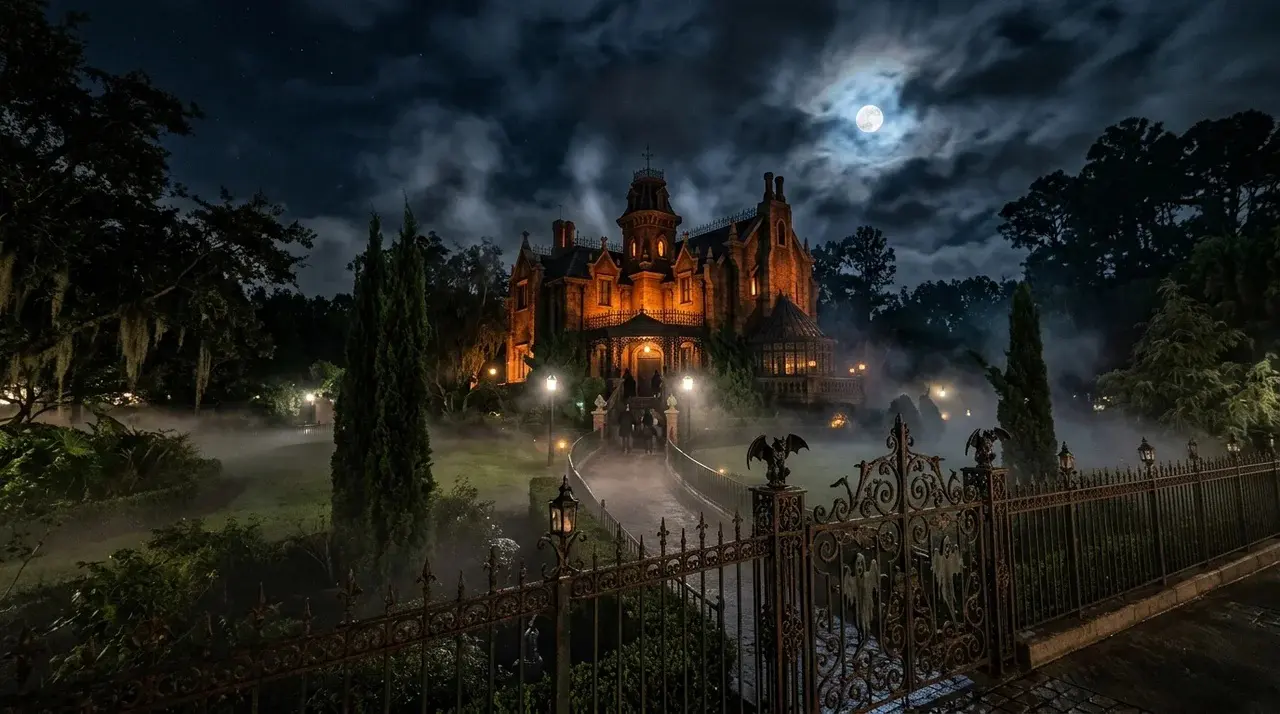
The Haunted Mansion is the most beloved attraction at Disneyland Park. Opened in 1969 in New Orleans Square, it has entertained more guests than almost any other ride in Disney history — and unlike most attractions that show their age over time, the Haunted Mansion only seems to deepen in richness with each passing decade. It is simultaneously a masterpiece of theme park design, a genuine piece of entertainment history, and the source of more secrets, Easter eggs, and fan obsession than any other ride at the resort. This guide covers everything.
Quick Facts — Haunted Mansion Disneyland
| Detail | Info |
|---|---|
| Location | New Orleans Square, Disneyland Park |
| Opened | August 9, 1969 |
| Ride type | Dark ride — Omnimover Doom Buggy system |
| Duration | Approximately 8 minutes |
| Height requirement | None — all ages welcome |
| Lightning Lane | Available via Lightning Lane Multi Pass |
| Is it scary? | Mildly — dark, spooky atmosphere but no gore or jump scares |
| Number of “happy haunts” | 999 (but there’s always room for one more) |
| Seasonal overlay | Haunted Mansion Holiday (Nightmare Before Christmas) — September through early January |
| Ghost Host voice | Paul Frees (original recording, still used today) |
The History of the Haunted Mansion at Disneyland
The idea for a haunted attraction at Disneyland was first proposed in the 1950s — before the park even opened. Walt Disney himself was involved in early conceptual discussions, and the exterior of the Haunted Mansion was actually completed and visible to park guests as early as 1963. For six years, the beautiful antebellum mansion sat in New Orleans Square with a “coming soon” sign while Imagineers debated what should go inside.
The delay was partly caused by the 1964 New York World’s Fair, which diverted significant Imagineering resources. Walt Disney also famously insisted on the exterior remaining well-maintained despite the “haunted” theme — when designers proposed letting the façade appear rundown and spooky, Walt reportedly said: “We’ll take care of the outside, and let the ghosts take care of the inside.” The result is the elegant, aristocratic exterior that looks almost inviting despite what it contains.
The mansion finally opened on August 9, 1969 — seven months after Walt Disney’s death in December 1966. It was the first major new attraction at Disneyland to open without Walt’s direct involvement in its completion. The ride has operated continuously since, with periodic refurbishments and the beloved annual seasonal overlay.
The exterior design was inspired by the Shipley-Lydecker House — a real antebellum estate built in Baltimore in 1803. The architectural style places the mansion stylistically in the American South, consistent with the New Orleans Square neighborhood it anchors.
The Full Ride Experience — What Happens Inside
The Queue
The Haunted Mansion queue is one of the most detailed in Disneyland Park. The outdoor cemetery section is filled with pun-laden epitaphs on tombstones — each one a small joke worth reading. Many are tributes to the Imagineers who built the original attraction, hidden in plain sight in the form of character names and dates. The interactive queue added in recent years includes musical instruments that guests can play, a mausoleum with riddles, and the Dread Family busts — each with a riddle that, when solved together, reveals a murder mystery hidden in the queue story.
Before entering the mansion proper, look for Madame Leota’s tombstone — her eyes will open as you pass by. This is your first of three encounters with Leota during the experience.
The Stretching Room
Guests enter the Portrait Chamber — a room with four floor-to-ceiling portraits of seemingly ordinary subjects. The Ghost Host (voiced by the late Paul Frees in the original 1969 recording still used today) welcomes you to “the most ghoulish of Disneyland adventures.” The walls begin to stretch, revealing increasingly sinister reveals in each portrait. The ceiling appears to rise — or the floor appears to descend — as the room elongates.
The honest secret: the room actually descends. The stretching room is an elevator that lowers guests underground, below the railroad tracks at the park’s perimeter, to the actual show building which sits behind and below the mansion facade. The room you see from outside is not where the ride takes place — the true ride building is a massive structure concealed behind the mansion’s exterior.
At the conclusion of the stretching room, the lights cut out entirely, lightning flashes reveal a hanging figure above — the Ghost Host’s fate — and a hidden door opens for guests to proceed to the loading area.
The Doom Buggies
Guests board the Omnimover ride system — individual “Doom Buggies” on a continuously moving conveyor that rotates to direct your attention toward specific scenes. The Doom Buggy design was originally created for the 1964 New York World’s Fair and adapted for the Haunted Mansion. The system allows for precise control of what each guest sees and when — the ride is choreographed as deliberately as a film.
The Portrait Corridor
The first indoor section features a hallway of portraits that change as lightning flashes — a serene subject transforming into something sinister. A knight becomes a dragon, a young woman transforms into a witch. The ghost busts lining the corridor appear to follow your gaze — this is achieved through an optical illusion using concave rather than convex facial molds, tricking your depth perception into perceiving motion where there is none.
The Library and Music Room
A ghostly piano plays on its own in the music room. Look at the floor as your Doom Buggy rolls past — the shadow cast on the floor is of a seated figure playing the piano, even though no figure is visible in the chair. The shadow is projected independently of the piano to create the illusion of an invisible ghost performer.
The Conservatory
A casket rattles as its occupant attempts to escape. A raven appears — this recurring figure is spotted multiple times throughout the ride and was originally intended to be the ride’s narrator before the Ghost Host concept was developed.
Madame Leota’s Séance Room
The most iconic scene in the Haunted Mansion. Madame Leota — a disembodied head floating in a crystal ball — conducts a séance surrounded by levitating musical instruments, floating furniture, and spectral faces emerging from the walls. The face in the crystal ball is that of Leota Toombs, an Imagineer who worked on the attraction. Her voice, however, belongs to actress Eleanor Audley. Leota Toombs later appeared as Mary the ghost in the attic scene.
This is your second encounter with Leota. Your third occurs in the graveyard — a small tombstone bearing her name with blinking eyes.
The Grand Ballroom
The most technically impressive scene in the ride. Dozens of ghostly figures waltz, eat, and celebrate in an elaborate ballroom below — visible through a balcony as your Doom Buggy glides past. The ghosts are produced using Pepper’s Ghost — a 19th century theatrical illusion technique that uses angled glass and reflected images to create the appearance of transparent figures in a space. There are no projectors involved. The actual ballroom figures are physical set pieces reflected in the glass panels between you and the scene.
The pipe organ in the ballroom scene is the actual prop organ from the 1954 Disney film 20,000 Leagues Under the Sea — the only version of the Haunted Mansion to use the original. Disney World uses a replica. The bullet hole from a 1974 incident — when a guest actually fired a .22 caliber gun into the ballroom — was covered with a painted spider and web rather than replaced, as repairing the massive glass panel would have been prohibitively complex.
The Attic
The Attic scene features the Bride — a glowing-eyed figure holding a candle whose heartbeat sound effect pulses through the entire scene. The Bride’s story has evolved through multiple versions of the ride over the years. The current Disneyland version features Constance Hatchaway, the “Black Widow Bride,” whose past husbands appear in portrait form — each portrait showing a couple, then just the bride as the husband’s head disappears. Constance’s ax appears at her side in the final portrait.
The Hatbox Ghost
One of the most celebrated figures in Disneyland history. The Hatbox Ghost was present at the Haunted Mansion’s opening in 1969 — a figure whose head was designed to appear to vanish from its shoulders and reappear inside the hatbox it held. The special effect failed to work convincingly and the figure was removed, either before opening or in the first few weeks of operation, becoming a ghost in a different sense — an attraction legend that existed primarily in promotional materials for decades.
In 2015, as part of Disneyland’s 60th Anniversary celebration, the Hatbox Ghost was reinstalled using modern technology that finally achieved the original effect convincingly. Disneyland is the only Haunted Mansion in the world with the Hatbox Ghost. He is located in the attic scene — look for him as your Doom Buggy exits the bride’s area.
The Graveyard
The longest and most musically rich section of the ride. The cemetery comes alive with singing busts, performing ghosts, and a full musical revue of “Grim Grinning Ghosts” — the Haunted Mansion’s iconic theme song, written by Buddy Baker with lyrics by X Atencio. The five singing busts in the center represent real people: one is modeled after Thurl Ravenscroft, the voice of Tony the Tiger, who sang bass in the original chorus.
Look for a small statue of Mr. Toad in the pet cemetery near the graveyard exit — a tribute to Mr. Toad’s Wild Ride, which closed at Disneyland in 1998 to make way for Winnie the Pooh. The inclusion is a beloved piece of Disney fan service that’s easy to miss at speed.
The Hitchhiking Ghosts
At the end of the ride, a mirror reveals that one of three hitchhiking ghosts — Gus, Ezra, or Phineas — has joined you in your Doom Buggy. Modern technology now creates individualized effects visible in the mirror using camera tracking, replacing the original static effect with something that appears to respond to each specific vehicle.
Haunted Mansion Holiday — The Nightmare Before Christmas Overlay
Every year from early September through early January, the Haunted Mansion transforms into Haunted Mansion Holiday — a seasonal overlay themed to Tim Burton’s The Nightmare Before Christmas in which Jack Skellington has taken over the holiday season. This overlay has become one of the most anticipated seasonal events at the resort.
The overlay replaces nearly every scene in the ride with Nightmare Before Christmas imagery while preserving the Haunted Mansion structure. The Grand Ballroom becomes a Christmas party, the graveyard fills with Halloweentown residents, and Jack Skellington’s voice joins the Ghost Host’s narration. The queue features interactive holiday additions and a massive gingerbread house is constructed inside the mansion itself — rebuilt from scratch each year by Disneyland chefs.
Haunted Mansion Holiday typically opens with Oogie Boogie Bash in late August or early September and runs through the first week of January. The regular classic version returns after a brief refurbishment. Many guests consider the holiday overlay a separate must-do experience from the original — visiting both in the same year is entirely reasonable.
Hidden Secrets Worth Looking For
Madame Leota’s tombstone. In the outdoor queue, look for a small stone bearing the name “Leota” with eyes that open as you pass. Easy to miss when you’re focused on moving through the line.
The raven. Appears multiple times throughout the ride — in the conservatory, above the staircase, in the attic. Originally planned as the ride’s narrator before the Ghost Host concept was developed.
The Dread Family murder mystery. The interactive tombstones in the outdoor queue contain riddles from the Dread family busts that, when solved in sequence, reveal a murder mystery — which family member killed which, and with what weapon. A genuinely clever layered story hiding in plain sight.
The painting that follows you. The concave face busts in the portrait corridor create an optical illusion of following your gaze. They are not animatronic. Understanding the trick makes it no less effective.
The piano shadow. In the music room, the floor shadow is of a seated figure playing piano, cast independently of the visible piano. Look down as you pass.
The bullet hole spider. In the Grand Ballroom, a spider and web covers the spot where a guest fired a .22 caliber bullet in 1974. Visible primarily during the brighter lighting of the Haunted Mansion Holiday overlay.
Mr. Toad in the pet cemetery. A small statue near the graveyard exit — blink and you’ll miss it. A tribute to the Fantasyland attraction that closed in 1998.
The Hatbox Ghost. In the attic — Disneyland exclusive. His head disappears from his shoulders and reappears in the hatbox. One of the most technically impressive effects in the attraction.
The secret door in the stretching room. After the lights cut out, the exit door that opens for guests is the “secret” passage — stand near the portrait of the woman with the parasol to be among the first through.
Is the Haunted Mansion Scary?
The Haunted Mansion is spooky in atmosphere but not frightening in the jump-scare or gore sense. Disney’s own description calls it “dark with mildly frightening scenes” — accurate characterization. There is no gore, no sudden screams, and no violent content.
What the ride does have: sustained darkness, slightly unsettling imagery (the hanging figure silhouette in the stretching room, the bride’s glowing eyes in the attic), and an atmospheric spookiness that can affect young children who are sensitive to dark environments. The ride moves slowly and is never threatening in a physical sense.
Most children over 4 or 5 handle the Haunted Mansion comfortably. Children who have difficulty with Pirates of the Caribbean’s darker moments may similarly find the Haunted Mansion’s atmosphere uncomfortable. For children on the fence, sitting in the middle of the Doom Buggy (rather than the outside edge nearest the scenes) reduces the intensity slightly.
For adults: this is one of the most delightful attractions at Disneyland — not scary in the least. The humor woven throughout (“there’s always room for one more”) and the extraordinary craftsmanship make it the kind of ride that rewards repeat visits over years of increasing appreciation.
Tips for the Best Haunted Mansion Experience
Ride it more than once. The Haunted Mansion rewards repeat visits in a way few attractions do. First rides are spent absorbing the atmosphere; subsequent rides reveal details missed the first time. On a multi-day trip, plan one daytime ride and one nighttime ride — the exterior and queue atmosphere are dramatically different after dark.
Read every tombstone in the queue. The epitaphs are genuinely funny — clever wordplay and dark humor that’s worth slowing down for. Most guests rush through the queue; the ones who linger enjoy the experience more.
Look for Madame Leota’s tombstone before you enter. It’s easy to miss when you’re watching the line move. Her eyes open — catch it.
Lightning Lane is available but often unnecessary. The Haunted Mansion has a high ride capacity and the line moves faster than the posted wait time suggests. On non-peak days, a 30-minute posted wait often moves in 15-20 minutes. Save Lightning Lane for Indiana Jones and Mickey & Minnie’s Runaway Railway first.
Ride Haunted Mansion Holiday if you’re visiting in the fall or early winter. The Nightmare Before Christmas overlay is a genuinely different experience from the classic version — running from early September through early January. Both versions are worth experiencing if your visit dates allow.
Sit on the left side of the Doom Buggy for the best Hatbox Ghost view. The Hatbox Ghost is positioned on the left side of the attic scene. Riders on the left side of the vehicle get the clearest view.
Planning your full Disneyland visit around the best rides, shows, and hidden experiences? Download the Enchanted Insider Disneyland Itinerary Guide — complete day-by-day plans with Lightning Lane strategy, updated for 2026.