
Last Updated on April 17, 2026
Updated April 2026 — Complete stats, speed, height requirement, and ride experience guide for Space Mountain at Disneyland Park.
Space Mountain is one of the most iconic attractions in theme park history — and one of the most misunderstood in terms of what it actually does. Most guests who ride it believe they’re going much faster than they are. The darkness, the soundtrack, the disorienting turns, and the rushing “starfield” effects all conspire to make Space Mountain feel like a high-speed thrill ride when the actual top speed is closer to what you’d drive through a school zone. That gap between perception and reality is one of the most impressive achievements in Imagineering history — and understanding it makes the ride even more remarkable.
How Fast Does Space Mountain Go at Disneyland?
Space Mountain at Disneyland reaches a top speed of approximately 32-35 mph — fast enough to feel genuinely exciting, but significantly slower than most guests estimate while riding. For reference, that’s roughly the speed of a car driving through a residential neighborhood.
This surprises almost everyone who hears it. The combination of complete darkness, disorienting track layout, tight turns, sudden dips, and an immersive soundtrack creates a sensation of speed that the ride doesn’t actually achieve. Your brain, unable to use visual cues to judge velocity, fills in the blanks with “very fast” — and Disney’s Imagineers designed the experience to maximize exactly that perception.
With the lights on — as guests have occasionally witnessed during ride stoppages — Space Mountain reveals itself as a relatively modest roller coaster navigating gentle spirals and small dips in a compact building. The track is completely visible, the turns are not particularly sharp by coaster standards, and the experience would be quite tame. The darkness is not just theming — it is the ride.
Space Mountain Disneyland — Full Stats
| Stat | Number |
|---|---|
| Top speed | ~32-35 mph |
| Track length | 3,452 feet (approximately 0.65 miles) |
| Ride duration | Approximately 2 minutes 30 seconds |
| Height requirement | 40 inches (102 cm) minimum |
| Inversions | None |
| Big drops | None — small dips only |
| Launch type | Chain lift hill — traditional roller coaster ascent |
| Seating | Single-file rockets, 1 rider per row |
| Restraint | Lap bar |
| Lightning Lane | Available via Lightning Lane Multi Pass |
| Opened at Disneyland | May 27, 1977 |
| Location | Tomorrowland, Disneyland Park |
Why Space Mountain Feels So Much Faster Than It Is
This is the most interesting thing about Space Mountain — and understanding it genuinely enhances the experience rather than diminishing it.
Complete darkness eliminates visual speed reference. When you can see the world around you, your brain unconsciously uses passing scenery to calibrate speed. Trees, buildings, and ground whipping past give you precise information about how fast you’re moving. In complete darkness, that reference disappears entirely — and your brain defaults to interpreting any sensation of motion as faster than it is.
The track layout maximizes disorientation. Space Mountain’s track is designed to spiral and turn in ways that make it difficult to predict what’s coming. Unlike outdoor coasters where you can see the next drop or turn approaching, every change of direction in Space Mountain is a surprise. Surprise amplifies perceived speed — your body braces for the unknown, which registers as intensity.
The rushing starfield creates visual acceleration cues. The “stars” rushing past in the show building are calibrated to create the specific visual sensation of high-speed travel through space. Even though your eyes can’t see the track, they’re receiving visual information that says “you are moving very fast.” The brain integrates this with the physical sensations and concludes: fast.
The soundtrack is designed to escalate tension. The electronic score builds in intensity throughout the ride, particularly on the ascent and during faster sections. Music that communicates urgency makes physical sensations feel more intense — a well-documented psychological effect that Disney uses deliberately.
Fans create a wind sensation. Strategically placed fans throughout the show building create airflow that simulates the wind of high-speed travel. At 35 mph, you wouldn’t feel significant wind resistance — the fans compensate for this, adding a physical component that reinforces the perception of speed.
The result is a ride that genuinely feels like 60+ mph to most riders despite topping out at roughly 35. It is, in many ways, a more impressive achievement than simply building a faster coaster.
Is Space Mountain Scary?
Space Mountain is a mild to moderate thrill ride — genuinely exciting but without the intensity of major roller coasters. Here’s how to think about it for different guests:
For young children (40-48 inches, roughly ages 4-6): The height requirement is 40 inches, making it accessible to young children. The primary concern is the darkness — Space Mountain is nearly completely dark for most of the ride, and young children who are uncomfortable in dark spaces may find this distressing regardless of the ride’s actual intensity. The ride itself is smooth, has no large drops, and no inversions. Children who are comfortable with darkness generally enjoy it.
For guests who dislike drops: Space Mountain has no significant drops. The ride ascends a chain lift hill and then navigates spirals and gentle dips — the sensation is of twisting and turning rather than falling. If you can handle a merry-go-round and a gentle hill, you can handle Space Mountain’s actual physical demands.
For guests with motion sickness: The constant turning in darkness is the most likely trigger for motion sensitivity. The disorientation that makes the ride feel fast can also make guests who are prone to motion sickness uncomfortable. Sitting in the front of the rocket (where you can see slightly more of the show elements ahead) is marginally better than the back for motion-sensitive guests.
For guests who have ridden outdoor coasters: Space Mountain will feel tame in terms of physical intensity compared to most outdoor roller coasters. The speed, drop height, and G-forces are all modest by coaster standards. The experience is impressive because of the theming, not because of the raw thrill.
Disneyland vs. Disney World Space Mountain
Both parks have a Space Mountain, but they are meaningfully different rides:
| Disneyland Space Mountain | Disney World Space Mountain | |
|---|---|---|
| Top speed | ~32-35 mph | ~28 mph |
| Track length | 3,452 feet | ~3,196 feet (two tracks: Alpha and Omega) |
| Seating | Single-file, 1 per row | Inline 2-person rockets |
| Tracks | One track | Two tracks (Alpha and Omega) |
| Opened | 1977 | 1975 |
| Smoothness | Smoother, more modern feel | Slightly rougher, more classic |
| Verdict | Faster, generally considered the better ride | More historic — first Space Mountain ever built |
Disneyland’s Space Mountain is generally considered the superior version — it’s faster, longer, and received a significant renovation in 2005 that modernized the track and ride system. Disney World’s version has the historical distinction of being the original Space Mountain, opening two years before Disneyland’s.
How Does Space Mountain Compare to Other Disneyland Rides?
| Ride | Top Speed | Park | Scarier Than Space Mountain? |
|---|---|---|---|
| Incredicoaster | 55 mph | DCA | Yes — significantly |
| Radiator Springs Racers | ~40 mph | DCA | Comparable — outdoor, bright |
| Tiana’s Bayou Adventure | ~40 mph (drop) | Disneyland | Comparable — has a big drop |
| Space Mountain | ~32-35 mph | Disneyland | — |
| Big Thunder Mountain Railroad | ~30-35 mph | Disneyland | Less — outdoor, visible track |
| Matterhorn Bobsleds | ~27 mph | Disneyland | Comparable — rougher ride |
| Guardians: Mission BREAKOUT! | ~39 mph (drop) | DCA | Yes — drops are sudden |
The History of Space Mountain at Disneyland
Walt Disney himself conceived the original idea for Space Mountain in the 1960s, inspired by the success of the Matterhorn Bobsleds — a “Wild Mouse” style coaster that relied on sharp turns rather than big drops. Walt envisioned a similar concept set in outer space, in complete darkness. He died in 1966 before the ride was built.
The concept was revived for Disney World, where Space Mountain opened on January 15, 1975 — the first Space Mountain ever built, and the first indoor roller coaster in Florida. Disneyland’s version followed on May 27, 1977, adapted for Tomorrowland’s specific footprint.
Disneyland’s Space Mountain underwent a significant refurbishment in 2003-2005, reopening with a modernized track system, updated show elements, and improved smoothness. The renovation effectively created a new ride experience while preserving the classic character.
The attraction has also hosted seasonal overlays over the years — most notably Hyperspace Mountain, a Star Wars-themed version featuring X-wings, TIE fighters, and John Williams’ score that has returned for limited engagements during Star Wars events at the resort.
Tips for Riding Space Mountain
Rope drop is the best strategy. Space Mountain is located in Tomorrowland near the park entrance, making it one of the fastest rope drop targets at Disneyland Park. Walk-on or near-walk-on waits at opening often stretch to 45-60 minutes by 10am. See our complete rope drop guide for how to position yourself for the shortest possible wait.
Sit in the front rocket for the most immersive experience. Front-row riders get the clearest view of the show elements ahead — the rushing stars and lighting effects that create the speed illusion are most effective from the front position. The front row can be requested in the standby line in most cases.
Lightning Lane is available but not always necessary. Space Mountain has a high ride capacity and the queue moves efficiently. On non-peak days a posted 30-minute wait often clears in 20. Save Lightning Lane for Indiana Jones Adventure and Mickey & Minnie’s Runaway Railway first — those have lower capacity and more demand.
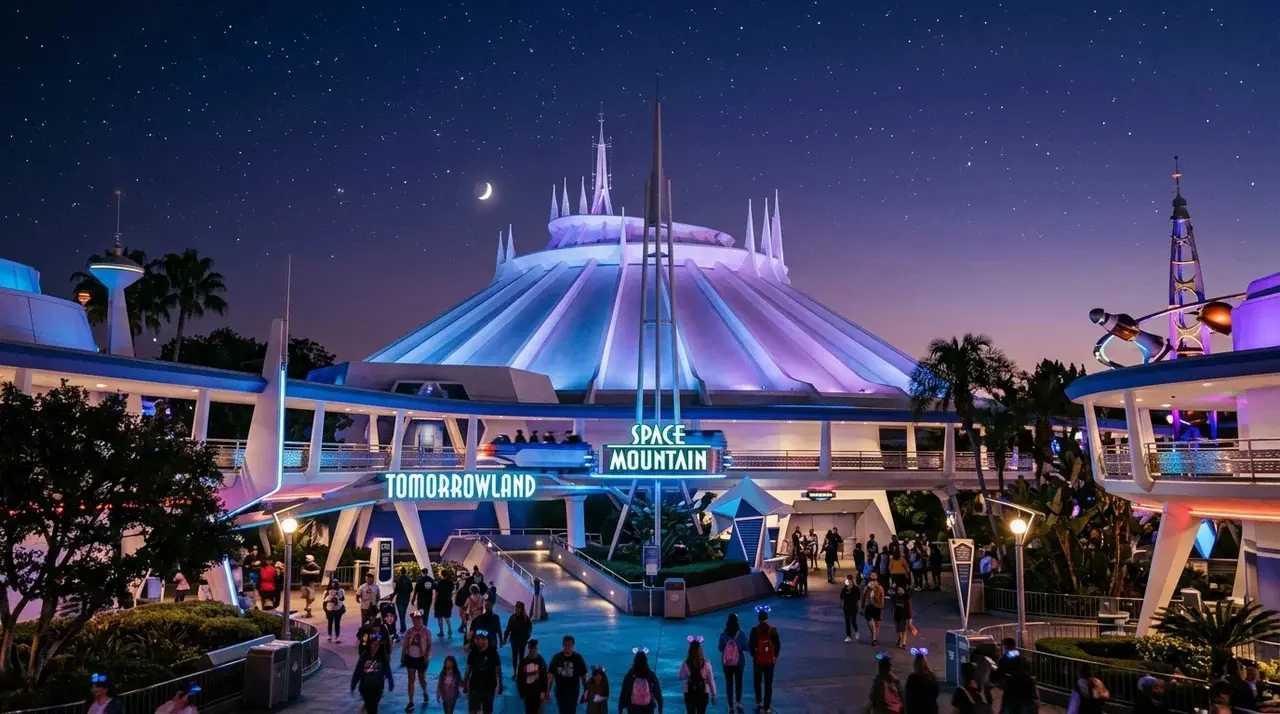
Ride it at night. Space Mountain’s exterior is spectacular after dark, and the atmosphere in Tomorrowland at night enhances the pre-ride experience. The ride itself is identical regardless of time, but the theatrical effect of emerging from complete darkness into Tomorrowland’s blue-lit nighttime atmosphere is distinctly satisfying.
If a child is hesitant, explain that it’s dark but not scary. The most common reason children who meet the height requirement don’t want to ride Space Mountain is fear of the dark. Describing what will happen — you go up a hill, it gets dark, you twist and turn, then it ends — removes the uncertainty that causes most pre-ride anxiety. The ride itself is almost always less intense than the anticipation.
Want a complete plan for which Disneyland rides to hit first, when, and in what order? Download the Enchanted Insider Disneyland Itinerary Guide — 1, 2, and 3-day plans with full Lightning Lane strategy, updated for 2026.