
Last Updated on October 15, 2026
Disneyland is loud, bright, crowded, and unpredictable. For neurodivergent guests, those four things can turn a dream vacation into an overwhelming experience fast. But the resort also has more accommodations, more quiet zones, and more planning tools available than most guests realize. The difference between a difficult day and a great one almost always comes down to preparation.
This guide covers everything neurodivergent visitors and their families need to plan a Disneyland trip in 2026: the Disability Access Service and the major policy changes that took effect in 2024, every quiet spot in both Disneyland Park and Disney California Adventure, the rides that work best for sensory-sensitive guests, what to pack, when to visit, and how to build a day that has enough breathing room to actually enjoy.
Disability Access Service (DAS): What It Is and How It Works in 2026
DAS is Disney’s primary accommodation for guests who cannot wait in a conventional queue for an extended period of time due to a developmental disability such as autism. It does not provide immediate access to rides. Instead, it allows the registered guest to request a return time for a specific attraction that is comparable to the current standby wait. While waiting for your return time, you can be anywhere in the park rather than standing in the physical queue.
DAS underwent a major policy overhaul in 2024 that significantly changed who qualifies, how you register, and how many people can use it. Here is the current state of the program.
Who Qualifies
DAS is now specifically intended for guests with a developmental disability such as autism or similar who are unable to wait in a conventional queue for an extended period of time. This is a narrower eligibility than the pre-2024 policy, which served a broader range of disabilities. Physical disabilities and mobility issues alone do not qualify for DAS. Disney offers other accommodations for those guests, including wheelchair-accessible queues and attraction transfer assistance.
There is no published list of specific qualifying conditions. Eligibility is determined on a case-by-case basis during a video chat with a Disney Cast Member and a contracted health care professional.
How to Register
Registration is done via live video chat. You can complete the video chat 2 to 60 days before your visit through the Disneyland website or app, or in person at the designated accessibility windows at the Esplanade between the two park entrances. The guest requesting DAS must be present and visible on the video call. Have your park tickets linked to your account before starting the call.
The video chat process involves describing how your disability affects your ability to wait in a conventional queue. You do not need to provide a medical diagnosis or documentation, but you do need to clearly explain the functional limitation. Be specific and honest. The Cast Member and health care professional will ask follow-up questions and make a determination during the call.
If approved, DAS is valid for the length of your ticket or up to one year, whichever is shorter. The registered guest plus up to three additional people (four total) can use the DAS return times. For immediate family groups larger than four, the additional family members must wait in the standby queue.
If You Are Denied
The 2024 policy change resulted in many guests who previously qualified being denied under the new criteria. This has been a source of significant frustration and ongoing public debate. If you are denied DAS, the Cast Member should offer alternative accommodations, which may include return-to-queue options or other arrangements depending on your specific needs. You can also visit Guest Relations in person at the park to discuss additional options.
DAS issued at Disneyland Resort is not valid at Walt Disney World, and vice versa. Each resort requires a separate registration.
Quiet Spots at Disneyland Park
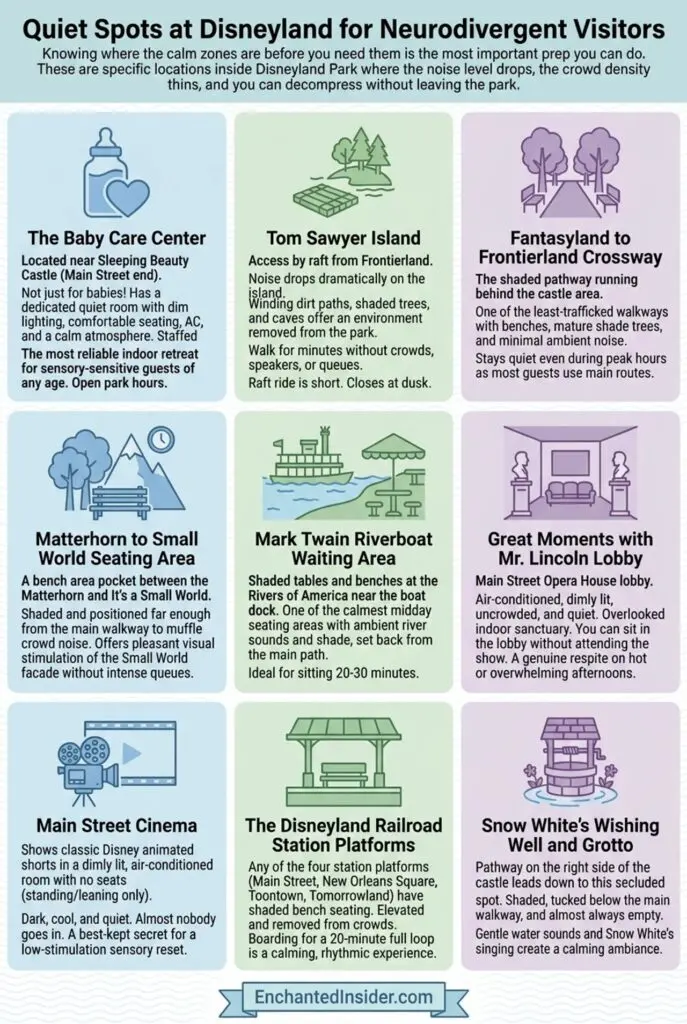
Knowing where the calm zones are before you need them is the most important prep you can do. These are specific locations inside Disneyland Park where the noise level drops, the crowd density thins, and you can decompress without leaving the park.
The Baby Care Center
Located near Sleeping Beauty Castle at the end of Main Street, the Baby Care Center is not just for babies. It has a dedicated quiet room with dim lighting, comfortable seating, and a calm atmosphere.
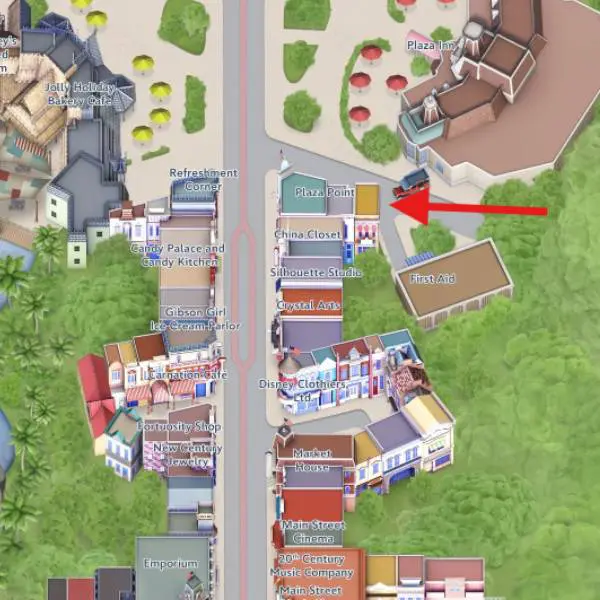
It is air-conditioned, clean, and staffed. For sensory-sensitive guests of any age who need a genuine retreat from stimulation, this is the most reliable option in the park. It is open during all park hours.
Tom Sawyer Island
Access by raft from Frontierland. Once you are on the island, the noise of the park drops dramatically. The winding dirt paths, shaded trees, caves, and rustic structures create an environment that feels physically removed from the rest of Disneyland.
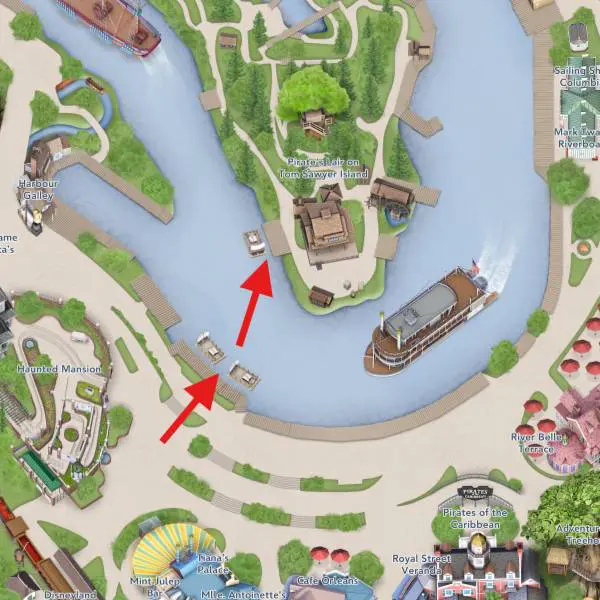
It is one of the only places in the park where you can walk for several minutes without encountering a crowd, a speaker, or a queue. The raft ride itself is short and calm. The island closes at dusk.
The Fantasyland to Frontierland Crossway
The shaded pathway that connects Fantasyland to Frontierland runs behind the castle area and is one of the least-trafficked walkways in the park.
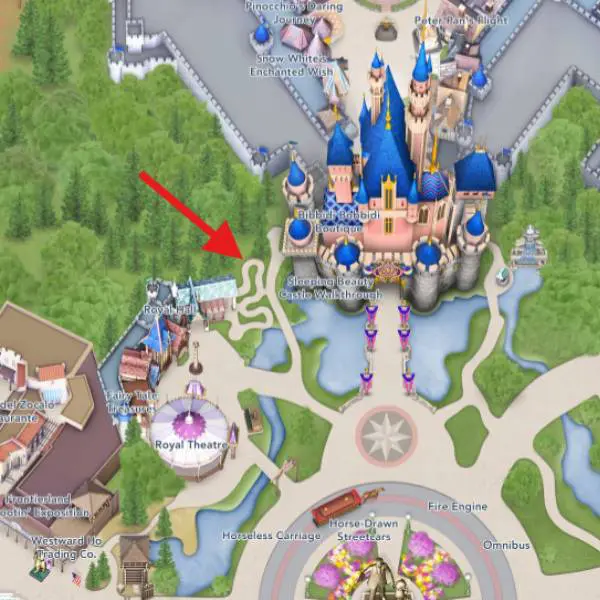
There are benches along the path, mature trees providing shade, and minimal ambient noise compared to the lands on either side. Most guests do not use this path because they take the main routes, which means it stays quiet even during peak hours.
The Matterhorn to Small World Seating Area
The bench area between the Matterhorn and It’s a Small World sits in a small pocket that most guests walk past on their way to one ride or the other.
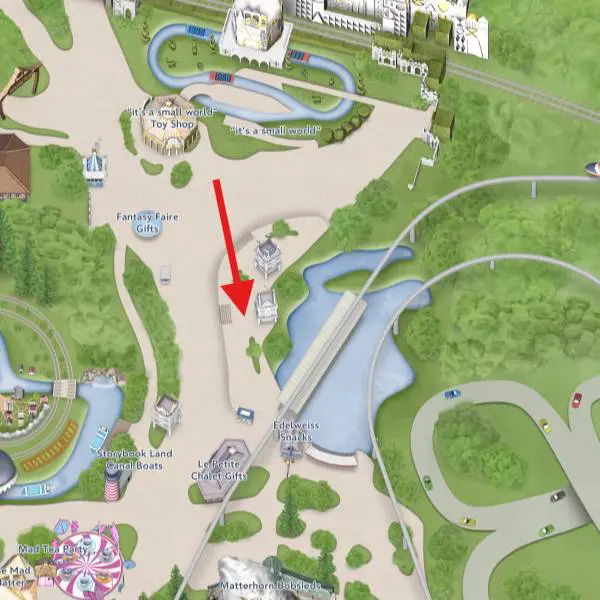
It is shaded, relatively quiet, and positioned far enough from the main walkway that the crowd noise is muffled. There is a clear sight line to the Small World facade, which provides pleasant visual stimulation without the intensity of a queue or attraction interior.
The Mark Twain Riverboat Waiting Area
The shaded tables and benches at the Rivers of America near the Mark Twain Riverboat dock are one of the calmest seating areas in the park during midday.
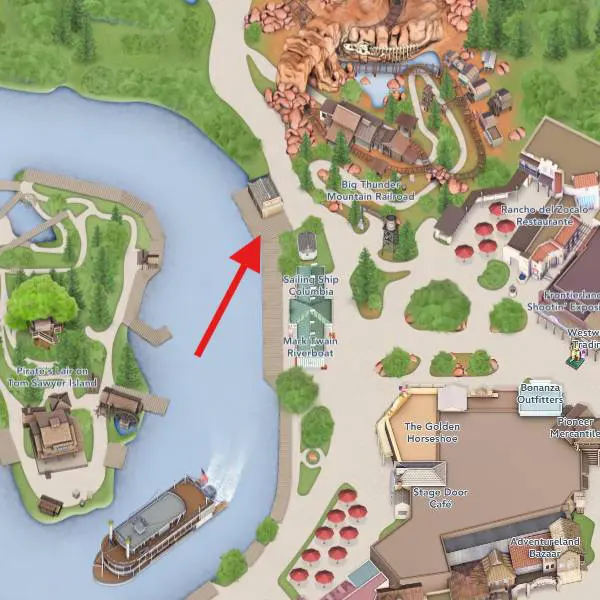
The river provides ambient water sound, the trees provide shade, and the area is set back from the Frontierland main pathway. You can sit here for 20 to 30 minutes without being in anyone’s way.
Great Moments with Mr. Lincoln Lobby
The lobby of the Main Street Opera House, home to the Great Moments with Mr. Lincoln show and the Walt Disney: A Magical Life exhibition, is air-conditioned, dimly lit, uncrowded, and quiet.
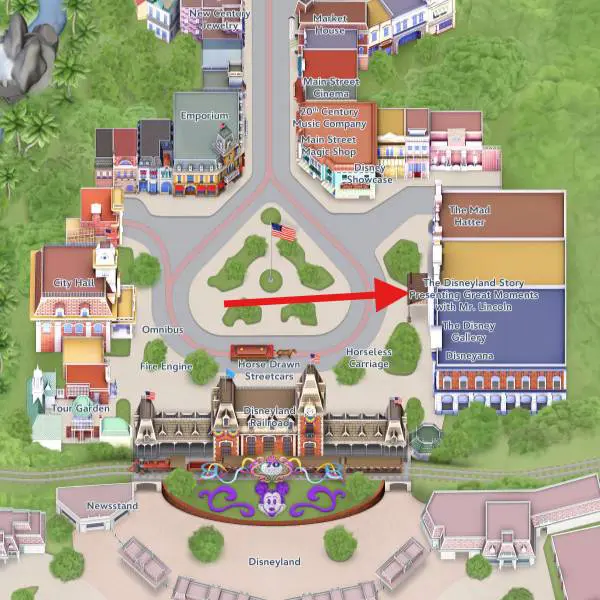
It is one of the most overlooked indoor spaces in the park. You can sit in the lobby without attending the show, and most guests walk past it entirely. On hot or overwhelming afternoons, this is a genuine sanctuary.
Main Street Cinema
The Main Street Cinema shows classic Disney animated shorts in a dimly lit, air-conditioned room with no seats (standing only, but you can lean against the walls).
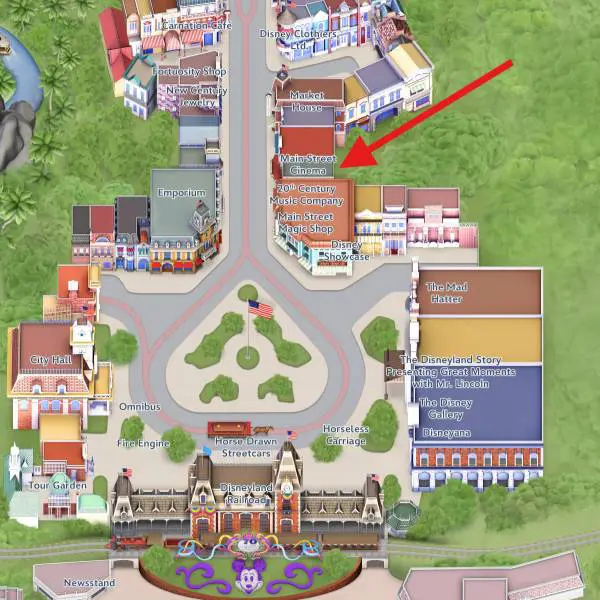
It is dark, cool, and quiet. Almost nobody goes in. For guests who need a sensory reset in a low-stimulation environment, it is one of the best-kept secrets on Main Street.
The Disneyland Railroad Station Platforms
Any of the four railroad station platforms (Main Street, New Orleans Square, Mickey’s Toontown, Tomorrowland) have shaded bench seating where you can sit and wait for the next train.
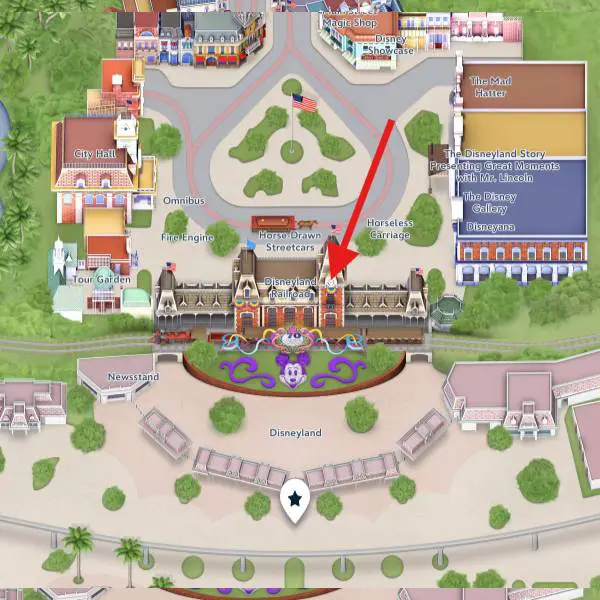
The platforms are elevated above the walkways and feel removed from the crowd. Boarding the train for a 20-minute full loop is itself a calming experience with rhythmic motion, changing scenery, and no interactive demands.
Snow White’s Wishing Well and Grotto
On the right side of the castle (facing from Main Street), a pathway leads down to Snow White’s Wishing Well. It is tucked below the main walkway, shaded, and almost always empty.
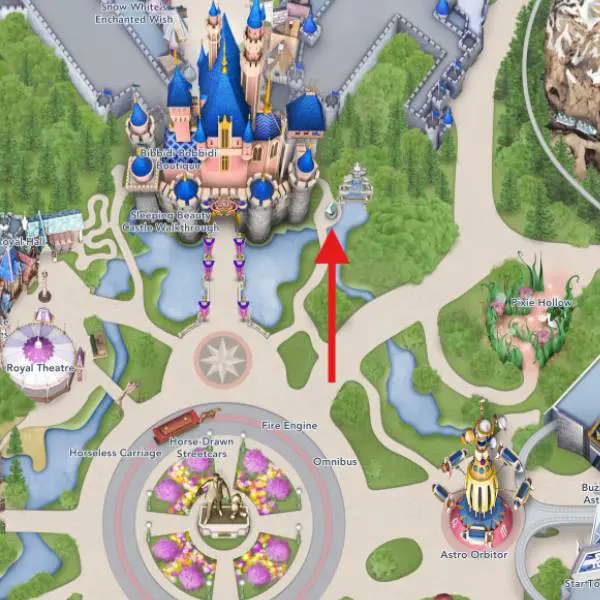
The gentle sound of water and Snow White’s voice singing from the well create a calming ambient environment. It is one of the quietest spots in the park and rarely has more than a handful of guests at any time.
Quiet Spots at Disney California Adventure
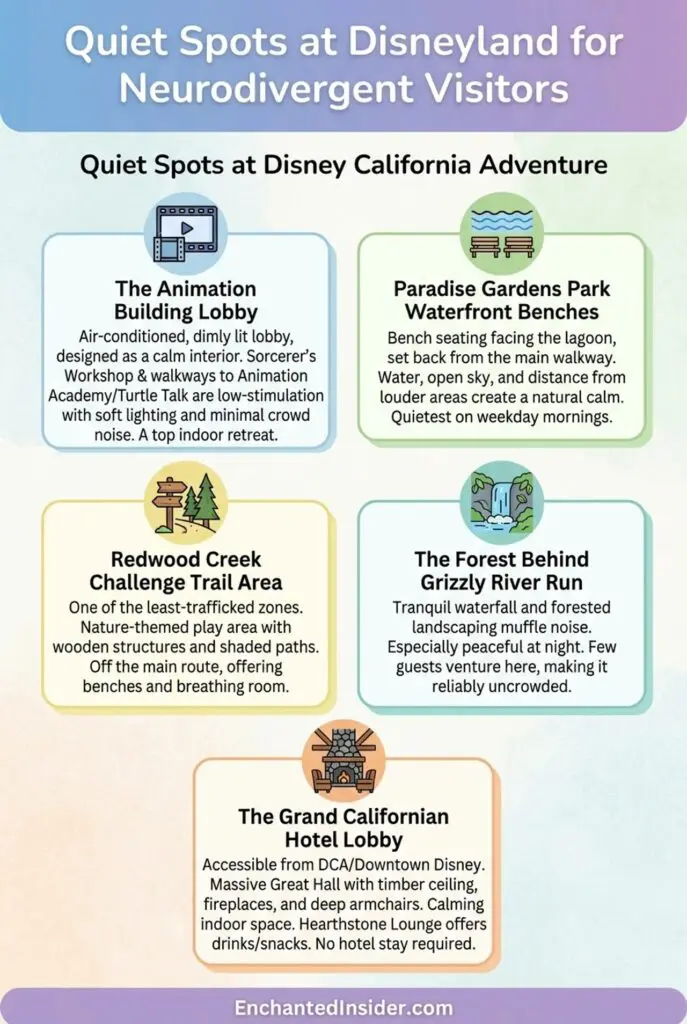
The Animation Building Lobby
Inside the Disney Animation Building in Hollywood Land, the lobby is air-conditioned, dimly lit, and designed as a calm interior space.
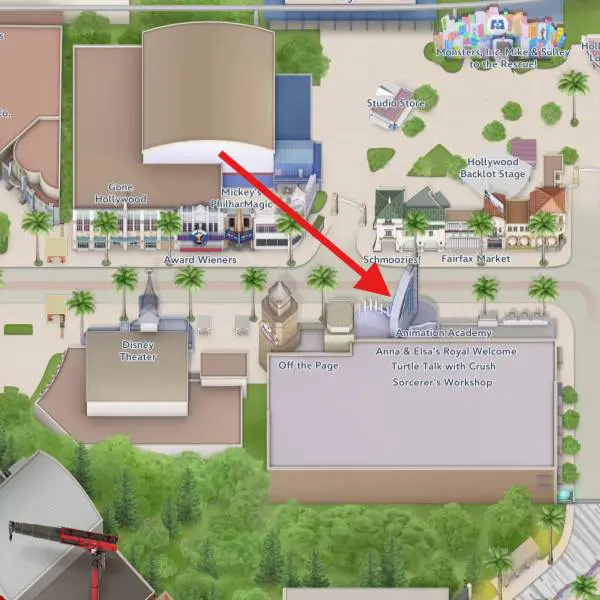
The Sorcerer’s Workshop area and the walkways between the Animation Academy and Turtle Talk with Crush are all low-stimulation environments with soft lighting and minimal crowd noise. This building is one of the best indoor retreats at either park.
Paradise Gardens Park Waterfront Benches
The bench seating along the waterfront in Paradise Gardens Park, near The Little Mermaid attraction, faces the lagoon and is set back from the main walkway.
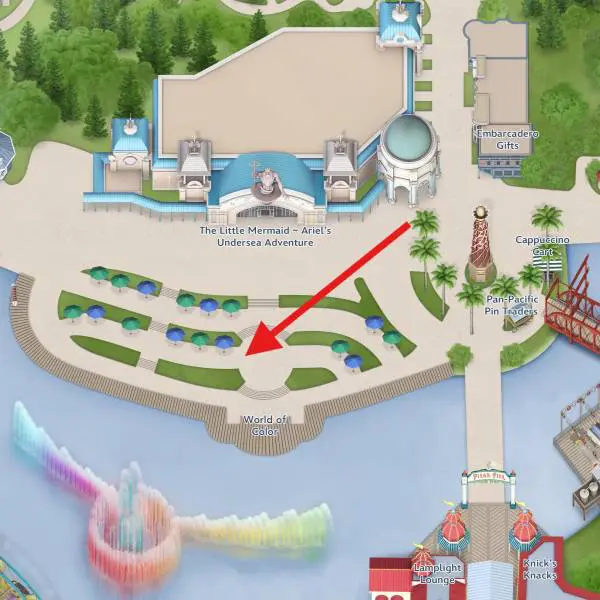
The water, the open sky, and the distance from the louder areas of the park create a natural calm zone. On weekday mornings this area is nearly empty.
Redwood Creek Challenge Trail Area
The area around Redwood Creek Challenge Trail in Grizzly Peak is one of the least-trafficked zones in DCA. The trail itself is a nature-themed play area with wooden structures and shaded paths.
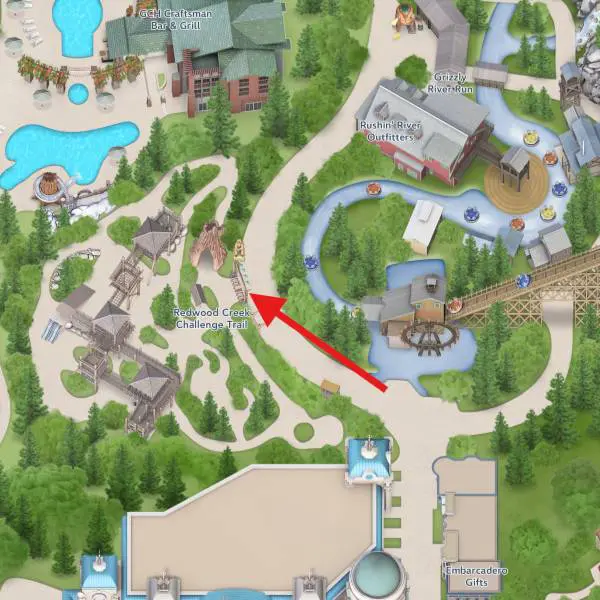
Even during busy days, this area stays relatively quiet because it is not on the main route between popular attractions. The surrounding benches and pathways offer shade and breathing room.
The Forest Behind Grizzly River Run
The viewing area and pathway behind Grizzly River Run features a tranquil waterfall and forested landscaping that muffles the noise from the rest of the park.
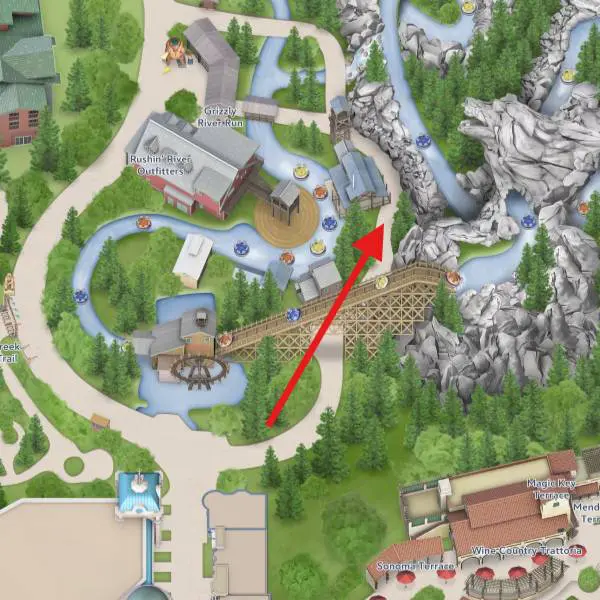
At night especially, this is one of the most peaceful spots at the entire resort. Few guests venture back here, making it reliably uncrowded.
The Grand Californian Hotel Lobby
While technically outside the parks, the Grand Californian Hotel lobby is accessible from both Downtown Disney and the DCA private entrance area.
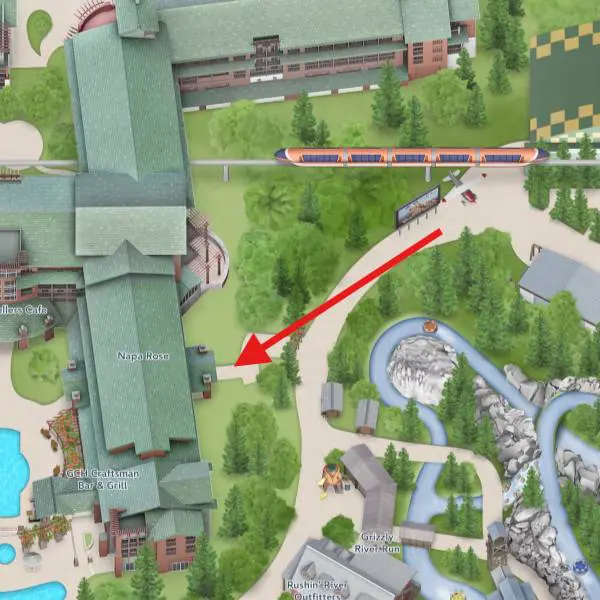
The Great Hall with its six-story timber ceiling, massive stone fireplaces, and deep armchairs is one of the most calming large indoor spaces at the resort. You do not need to be a hotel guest to sit in the lobby. The Hearthstone Lounge area offers the same calm atmosphere with the option to order a drink or snack.
Sensory-Friendly Rides and Experiences
Not all Disneyland rides are loud, dark, and fast. Several attractions are genuinely well-suited for sensory-sensitive guests because of their predictable pacing, gentle motion, controlled environments, and low stimulation levels.
It’s a Small World. Slow, predictable boat ride. Air-conditioned. Soft lighting. Repetitive music (which can be either soothing or overstimulating depending on the individual). The ride is 15 minutes long and has no sudden movements, drops, or darkness. One of the most reliably calm attractions in the park.
The Disneyland Railroad. A 20-minute train ride around the park perimeter. Open-air, rhythmic motion, changing scenery. Two dark tunnel sections (Grand Canyon and Primeval World dioramas) that are brief and predictable. The steady clacking of the wheels creates a white-noise effect that many sensory-sensitive guests find calming.
Storybook Land Canal Boats. A slow outdoor boat tour past miniature Disney film scenes. Quiet, gentle, and unhurried. The Cast Member narrates softly. There is no darkness, no enclosed space, and no sudden motion.
The Enchanted Tiki Room. An indoor, air-conditioned show with padded seating. The show is 15 minutes with predictable musical numbers and animatronic birds. The environment is controlled and the content does not change between shows, making it fully predictable after one viewing.
Main Street Cinema. Dark, cool, quiet, standing-room environment showing classic Disney shorts. No narration, no interactive elements, minimal other guests. A pure low-stimulation environment.
Turtle Talk with Crush (DCA). An interactive show in an air-conditioned theater. Crush from Finding Nemo speaks directly to the audience. The interaction is voluntary. Guests can watch without participating, and the theater is dim and calm. The show runs 15 minutes with a predictable structure.
What to Know About Ride Sensory Details
Disney publishes accessibility and sensory information for every attraction on the Disneyland website and in the Disneyland app. For each ride, you can find whether it includes loud sounds, darkness, flashing or strobe lights, small enclosed spaces, sudden drops, spinning, strong scents, or water effects.
Before your visit, go through the full attraction list on the Disneyland website accessibility section and flag which rides have sensory elements that may be difficult for your specific needs. Build your day plan around the rides that work and identify which ones to skip or approach with caution. This 30-minute exercise at home prevents in-park surprises.
YouTube is also a practical tool. Nearly every Disneyland ride has full POV (point-of-view) ride-through videos that show exactly what you will see, hear, and experience. Watching these before your visit removes the unpredictability and lets you or your family member decide in advance whether a ride is a good fit.
When to Visit for the Calmest Experience
Timing matters more for sensory-sensitive guests than for almost any other group. The difference between a Tuesday in February and a Saturday in July is enormous in terms of crowd density, noise level, and overall stimulation.
The calmest days of the week are Tuesday, Wednesday, and Thursday. Weekends are significantly busier and louder. The calmest seasons are mid-January through mid-March (excluding Presidents’ Day week) and mid-September through mid-November (excluding Halloween party nights). Summer, spring break, and the weeks between Thanksgiving and New Year’s are the most stimulating periods at the resort.
Within any given day, the calmest hours are the first 90 minutes after park open and the last hour before park close. The peak stimulation window is 11:00 AM to 3:00 PM, when crowds are densest, noise is highest, the sun is strongest, and wait times are longest. If you can, plan your highest-priority rides for the first 90 minutes and build a midday break into your schedule.
Fireworks and nighttime spectaculars are the loudest experiences at the resort. If loud, sudden sounds are a concern, either skip the fireworks, watch from a distance (the far end of Main Street or the Esplanade between the parks), or wear noise-cancelling headphones.
What to Pack: A Sensory Kit for Disneyland
A small bag with the right items makes the difference between managing a sensory spike and being overwhelmed by one. Here is what to bring, specific to Disneyland.
Noise-cancelling headphones or high-quality earplugs. Fireworks, parades, ride queues, and ambient park noise can all trigger sensory overload. Headphones that reduce volume without eliminating it entirely (like Loop earplugs) let you stay engaged without the full sensory assault. For fireworks specifically, full noise-cancelling over-ear headphones are worth bringing.
Sunglasses. Anaheim sun is strong, and the bright outdoor queue areas, the white concrete of Tomorrowland, and the reflective surfaces throughout the park amplify it. Sunglasses reduce visual overstimulation in addition to protecting your eyes.
A portable phone charger. The Disneyland app is your lifeline for checking wait times (avoiding unexpectedly long queues), finding quiet spots on the map, and managing DAS return times. A dead phone removes your best planning tool at the worst possible moment.
Familiar comfort snacks. Disneyland allows outside food. Having a reliable snack that you know works for you eliminates the stress of navigating food lines, unfamiliar menus, and crowded restaurants when you are already overstimulated. Pack what you know.
A fidget tool or tactile comfort item. Something small and pocket-sized that provides grounding sensory input when the environment becomes too much. This is personal to the individual. Whatever works at home will work at the park.
A written or visual schedule. For guests who benefit from predictability, print or write out your planned ride order, break times, and meal stops. Having a visible plan reduces the cognitive load of making decisions in a stimulating environment. Update it in real time as your day shifts.
Planning the Day: Structure Reduces Stress
The single best thing you can do for a sensory-sensitive Disneyland day is build deliberate breaks into the schedule before you need them. Do not wait until overstimulation hits to find a quiet spot. Schedule a 20 to 30 minute break every two to three hours, choose the quiet location in advance, and treat it as a non-negotiable part of the itinerary.
A sample structure: Arrive at rope drop. Ride two to three priority attractions in the first 90 minutes while crowds are light. Take a planned break at 10:00 AM (Baby Care Center, Main Street Cinema, or the Fantasyland-Frontierland crossway benches). Do two more rides or a character meet. Eat lunch at 11:30 AM before the rush. Take a longer midday break from 12:30 to 2:00 PM, either back at the hotel or at a quiet in-park location. Return for the afternoon with lower crowds and ride two to three more attractions. Take a final break before deciding whether to stay for evening entertainment or head out.
This structure gives you six to eight rides, a character meet, a meal, and three breaks in a single day. That is a full, rich Disneyland day for a sensory-sensitive guest, and it is sustainable without burnout.
Hotels for Sensory-Sensitive Guests
Where you stay affects how quickly you can leave the park when you need to, and how restful your midday break actually is.
Best Western Plus Park Place Inn is 400 feet from the Disneyland entrance. You can be from a ride exit to your hotel room in 10 minutes. For guests who need the option to leave quickly and return to a quiet, familiar space, nothing off-property comes close. Request an interior-facing room for the quietest sleep environment.
Disney’s Grand Californian Hotel and Spa has the private DCA entrance, which allows fast, low-crowd exits from Disney California Adventure directly into the hotel. The lobby itself is one of the calmest large indoor spaces at the resort. The proximity and the controlled re-entry make it the premium option for guests who need fast transitions between park stimulation and hotel calm. Read our full review.
For the best rates on hotels near the resort, Get Away Today is the travel partner we use and recommend for Disneyland Resort vacation packages.
Plan the Rest of Your Trip
For the complete Disneyland day strategy including rope drop timing, ride priorities, and how to build breaks into a full itinerary, the Enchanted Insider Disneyland Itinerary Guide covers everything you need.
FAQ
Disability Access Service (DAS) is Disney’s accommodation for guests who, due to a developmental disability such as autism or similar, are unable to wait in a conventional queue for an extended period of time. It allows the registered guest to request a return time for one attraction at a time, comparable to the current standby wait. Eligibility is determined via a live video chat with a Disney Cast Member and a contracted health care professional. You can register 2 to 60 days before your visit through the Disneyland website or app.
The calmest locations inside Disneyland Park include the Baby Care Center near Sleeping Beauty Castle (dedicated quiet room), Tom Sawyer Island (physically removed from park noise), the Fantasyland to Frontierland crossway (shaded benches, low foot traffic), the Great Moments with Mr. Lincoln lobby (air-conditioned, uncrowded), the Main Street Cinema (dark, cool, nearly empty), and Snow White’s Wishing Well and Grotto (tucked below the main walkway, shaded, rarely visited).
The most sensory-friendly rides at Disneyland include It’s a Small World (slow, predictable, air-conditioned, no darkness or drops), the Disneyland Railroad (rhythmic motion, open air, 20 minutes), Storybook Land Canal Boats (quiet, outdoor, gentle), and the Enchanted Tiki Room (controlled indoor show, padded seating, fully predictable). At Disney California Adventure, Turtle Talk with Crush offers a calm, dim, air-conditioned theater with voluntary audience interaction.
The calmest days are Tuesday, Wednesday, and Thursday. The calmest seasons are mid-January through mid-March and mid-September through mid-November, excluding holiday weeks. Within any day, the first 90 minutes after park open and the last hour before close are the lowest-stimulation windows. The peak crowd and noise period is 11:00 AM to 3:00 PM.
Yes. Disneyland allows guests to bring personal items including noise-cancelling headphones, earplugs, sunglasses, fidget tools, comfort items, and outside food and drinks (no glass or loose ice). Building a small sensory kit with these items before your visit gives you tools to manage overstimulation throughout the day without depending on in-park accommodations alone.