
Last Updated on May 17, 2026
Sodium estimates based on confirmed figures from Disney, copycat recipe testing, and comparable restaurant nutrition data. Disneyland does not publish official nutrition facts for most of its food.
Before we get into the list, one important reality check: Disneyland does not publish nutritional information for most of its food. The resort’s official position is that they cannot provide guests with calorie counts, sodium figures, or other nutrition data. Disney is actually exempt from California’s menu labeling laws that require chain restaurants to post this information. The sodium figures in this article come from confirmed sources where available (including a number Disney’s own communications team provided years ago and that have been widely reported since), along with estimates based on comparable restaurant dishes and copycat recipe testing.
This is not exact. But it is the most accurate picture available, and if you are managing blood pressure, heart disease, kidney disease, a sodium-restricted diet from your doctor, or simply trying to avoid that puffy, waterlogged feeling that hits after a long park day, this guide gives you a real framework to work from.
The FDA recommends no more than 2,300 milligrams of sodium per day for most adults. People with hypertension are often advised to stay under 1,500 milligrams. Keep both numbers in mind as you read through this list.
📊 Stop Guessing: Try Our Free Disneyland Nutrition Calculator!
While this guide gives you the strategy for choosing the right meals, tracking your exact numbers inside the parks can be impossible since Disney doesn’t publish official nutrition facts.
To solve this, we built the 2026 Disneyland Nutrition Calculator! You can search over 400 park items—from classic Dole Whips and Bengal BBQ skewers to seasonal treats—and instantly get estimated calories, protein, carbs, and sodium counts.
Before you head to your next mobile order, open up our Disneyland Nutrition Tracker in a new tab to map out your macros for the day!
The Highest Sodium Foods at Disneyland
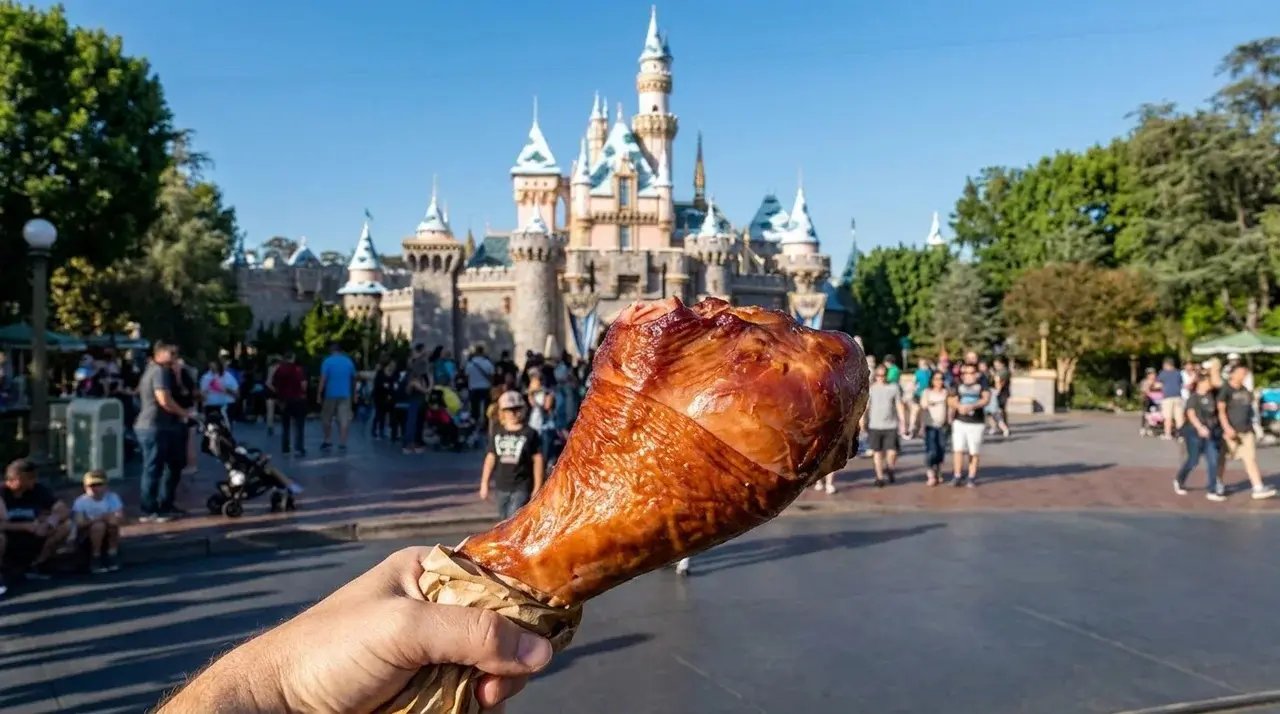
The Turkey Leg: Approximately 5,284mg of Sodium
Nothing else at Disneyland comes close to the turkey leg. One turkey leg contains approximately 5,284 milligrams of sodium. That figure comes directly from Lisa Haines, then-VP of Communications at Walt Disney World, and has been widely cited and verified since. It represents more than double the FDA’s daily recommended limit in a single food item. For someone on a 1,500mg sodium restriction, one turkey leg is three and a half days of sodium.
The reason is the preparation. Turkey legs at Disneyland are brined before smoking. The brine is a solution of salt, brown sugar, and curing salt (sodium nitrite, the same compound that cures ham and hot dogs). The meat soaks in this solution long enough to take on that signature pink color and salty-sweet flavor that people love. It does not taste like plain turkey. It tastes like ham. That is the salt talking.
The turkey leg also contains approximately 1,093 calories and 54 grams of fat. It is a substantial piece of food by any measure. For guests who are not managing a sodium restriction and just want an iconic park snack, it is a legitimate choice. For anyone watching sodium, it is the single most important item on this list to avoid or share.
If you want the turkey leg experience but need to limit sodium, share one with the group. Split between two people you are cutting the sodium impact roughly in half, and the turkey leg is large enough that two people eating half each will both feel like they had a real meal. Drink extra water alongside it.
The Monte Cristo Sandwich at Cafe Orleans: Approximately 2,000mg+
The Monte Cristo at Cafe Orleans in New Orleans Square is one of the most beloved dishes at Disneyland. It is a ham and turkey sandwich dipped in a thick egg batter, deep-fried until golden, dusted with powdered sugar, and served with raspberry jam. It is extraordinary. It is also a sodium event.
Confirmed nutrition data for the exact Cafe Orleans version does not exist publicly, but based on the original D23 recipe, detailed copycat testing by home cooks, and comparable diner-style Monte Cristo sandwiches at other restaurants, the sodium content sits somewhere in the range of 2,000 to 2,500 milligrams per serving. The combination of cured ham, turkey deli meat, Swiss cheese, and a salted batter stacks sodium at every layer.
For context, that is roughly a full day’s sodium in one sandwich, before you touch the pomme frites that come alongside it.
The swap: Cafe Orleans also serves roasted chicken that is significantly lighter on sodium. Ask your server about the current protein options and request sauce on the side. The chicken here is genuinely good. It is not the Monte Cristo, but it will not ruin your afternoon either.
The Corn Dog from the Little Red Wagon: Approximately 800-1,100mg
The Main Street corn dog is another Disneyland icon. The Little Red Wagon on Main Street has been selling these since the 1950s and they are a rite of passage. One corn dog contains a hot dog (already a significant sodium source on its own, typically 400 to 600mg before cooking) wrapped in a thick cornbread batter and deep-fried. Estimates from comparable corn dog nutrition data put a full Disneyland corn dog somewhere in the 800 to 1,100mg range depending on the hot dog brand and batter recipe.
That is still a lot of sodium for a snack item. The corn dog is more manageable than the turkey leg or Monte Cristo, but it is not a casual snack for someone on a sodium-restricted diet.
The swap: if you want something from the Main Street area with lower sodium, the fruit stands and Jolly Holiday Bakery Cafe offer options that will not gut your daily sodium budget before noon. A turkey sandwich on the kids menu at Jolly Holiday (the Disney Check meal) comes with fresh fruit and is a genuinely lower-sodium alternative.
Deli Meats and Processed Sandwiches
Any sandwich built on cured or processed meats (ham, turkey deli slices, salami, pepperoni) at any Disneyland location is going to be sodium-heavy before anything else is added. Deli-style turkey breast runs approximately 400 to 500mg per two-ounce serving. Ham runs 500 to 700mg per two-ounce serving. By the time you add cheese, condiments, and bread, a single deli sandwich can easily reach 1,500 to 2,000mg.
This category catches people off guard because sandwiches feel healthier than a fried item. At most Disneyland locations the protein in a sandwich has already been processed and salted before it reaches the kitchen. If sodium is your primary concern, a plain grilled chicken item will almost always be lower sodium than a deli meat sandwich regardless of how it looks on the menu.
Soups and Stews
Soups are sodium traps at theme parks and restaurants everywhere. Broth-based soups and stews are heavily salted because salt is what makes them taste good and what preserves them at scale. A single bowl of soup at a quick-service restaurant typically runs 800 to 1,500mg of sodium depending on the recipe. Cream-based soups run even higher.
At Disneyland specifically, the seasonal soups at locations like Rancho del Zocalo and Harbor Galley are comforting and popular, but they should be treated as high-sodium items. If soup is appealing because of a sensitive stomach or because you just want something warm and light, ask the chef at a table-service restaurant whether they can prepare something low-sodium. Quick-service soup is harder to modify.
Loaded Fries and Nachos
Any dish that combines salty chips or fries with processed cheese sauce, chili, sour cream, and cured meat toppings is going to be extremely high in sodium. Galaxy’s Edge, Tomorrowland, and DCA’s Hollywood Land all have loaded fry and nacho variations. These are shareable snacks by design, but their sodium content is not designed with any particular limit in mind.
The cheese sauce alone in a standard loaded nacho dish typically runs 400 to 600mg per serving, and that assumes restaurant-portion serving sizes which are always larger than what is listed on food packaging. Nacho cheese sauce plus seasoned meat plus sour cream plus chips can easily reach 2,000mg in a single shareable basket.
Soy-Based Sauces and Marinades
This one is less obvious. Several of Disneyland’s most popular dishes in Galaxy’s Edge and DCA use soy-based sauces and teriyaki-style marinades. Soy sauce is extremely high in sodium, around 900 to 1,000mg per tablespoon. A marinade or glaze that contains soy sauce as a primary ingredient can add 400 to 700mg of sodium to an otherwise lean protein dish before it even reaches your tray.
Grilled chicken that sounds like a healthy choice on the menu can be surprisingly high in sodium if it is marinated in a soy-based sauce. If sodium is your priority, ask whether the protein can be prepared without marinade or sauce. Most kitchens can do a plain grilled preparation on request.
Sodium You Might Not Expect
Beyond the obvious high-sodium items, a few Disneyland foods catch sodium-conscious guests off guard because they do not taste or look particularly salty.
The Dole Whip is one of the lowest-sodium items in the park. Plain pineapple Dole Whip has essentially no sodium to speak of. This is one of the reasons it appears across so many dietary guides for Disneyland: it is the rare park treat that is low-calorie, dairy-free, gluten-free, vegan, and low-sodium all at once.
Pickles, olives, and fermented garnishes found on several dishes at Docking Bay 7 and other locations are very high in sodium despite their small size. A single large dill pickle can run 800 to 1,000mg. If you are eating a salad at Docking Bay 7 and the dish comes with olives, note that those are contributing to your sodium count even though they taste like a health food.
Churros are lower in sodium than you might expect. The corn dog and the turkey leg are far worse. A standard theme park churro runs approximately 250 to 400mg of sodium. That is still not nothing, but it is much more manageable than most people assume given how salty they taste.
Pretzels from the carts on Main Street and throughout the parks run 400 to 600mg of sodium, which is significant for what feels like a casual snack. The pretzel itself is coated in coarse salt, which you can see, so the sodium content is not surprising once you think about it.
What to Order Instead: The Lowest Sodium Options at Disneyland
Here is what actually works if you need to keep sodium low across a full park day.
Fresh fruit is your best friend. The fruit stands throughout both parks sell mango spears, pineapple spears, grapes, and whole fruit with essentially no sodium. Dole Whip at the Tiki Juice Bar in Adventureland is another zero-sodium option. Fresh and frozen fruit items are the cleanest sodium choice in either park.
Plain grilled protein without marinade or sauce is the most reliable approach at quick-service restaurants. Bengal Barbecue’s chicken skewers are marinated, but the seasoning is lighter than soy-heavy preparations. Ask for skewers without sauce on top. At any burger location, a plain beef patty without processed cheese or condiments will be lower sodium than almost any other full entree option. Ask for the patty plain with lettuce and tomato on the side.
The hummus trio at Bengal Barbecue is a reasonable sodium option. Hummus itself contains some sodium from tahini and salt, but the portion at Bengal Barbecue paired with raw vegetables is significantly lower sodium than most entree options in the park. It is a good bridge snack that keeps you full without a sodium spike.
Salads with dressing on the side at Galactic Grill, Docking Bay 7, and Galley Grill are serviceable low-sodium choices if you request the dressing separately and use very little. The key is the dressing: most restaurant salad dressings run 200 to 400mg per two-tablespoon serving, and restaurants apply significantly more than two tablespoons. Always ask for it on the side.
Table-service restaurants give you the most control. At Carthay Circle, Napa Rose, Blue Bayou, Cafe Orleans, and River Belle Terrace, you can ask the chef or server about low-sodium preparations. A chef at a table-service restaurant can prepare grilled fish or chicken with no added salt, steam vegetables in water rather than salted water, and build a plate that fits a sodium restriction in a way that quick-service kitchens simply cannot do. If sodium management is serious for you medically, table-service dining is the right choice. Mention your restriction when you arrive and ask to speak with a chef.
Eggs prepared simply at breakfast locations are naturally lower in sodium. A plain scrambled or fried egg runs about 60 to 70mg on its own. The sodium comes from what you add: cheese, processed breakfast meats, hash browns seasoned in the kitchen, and toast with butter. At Pym Test Kitchen in Avengers Campus or Red Rose Taverne in Fantasyland, egg-based breakfast dishes can be made with lower sodium on request by holding the cheese and processed meat.
Bring your own low-sodium snacks. Disneyland allows outside food and non-alcoholic beverages. If sodium is a strict medical restriction, packing your own snacks is the most reliable strategy. Unsalted nuts, fresh-cut vegetables, low-sodium protein bars (check labels), unsalted rice cakes, and fresh fruit travel well in a soft-sided cooler bag and pass through security without issue. Having a base of safe snacks in your bag means you are not entirely dependent on park food when hunger hits between meals.
Hydration and Sodium: The Water Strategy
If you do consume higher-sodium foods during your park day (or even if you are eating carefully), staying well-hydrated is the most important thing you can do. Drinking water consistently helps your kidneys process and excrete excess sodium. The recommended approach is sipping steadily throughout the day rather than drinking large amounts at once.
Free ice water is available at any quick-service restaurant that serves fountain drinks. You do not need to buy food. Just walk up and ask. Several locations like Galactic Grill and Rancho del Zocalo have filtered water stations where you can refill a cup or bottle as many times as you want. Bottled water from carts and kiosks runs $4 to $7 at Disneyland. There is no reason to pay for it.
Avoid using sports drinks or electrolyte beverages as a sodium-offset strategy. Most sports drinks contain significant sodium themselves (150 to 300mg per bottle). If you want electrolytes without the sodium, bring your own low-sodium electrolyte powder packets to add to your free water.
Talking to Cast Members About Sodium
At table-service restaurants and most quick-service locations, you can ask to speak with a special diets-trained cast member about your sodium restriction. Disney does accommodate low-sodium requests and will try to identify dishes that work or suggest modifications. They cannot give you exact sodium figures, but they can tell you which items are more likely to be lower sodium and which preparations to avoid.
When you arrive at a table-service restaurant, mention to your server that you are on a low-sodium diet. Ask whether they can flag your order to the kitchen. At quick-service locations, ask at the register for a special diets cast member. The quality of help you get will vary by location and by how experienced the specific cast member is, but it is always worth asking.
Email dl.special.diets@disney.com before your visit if your sodium restriction is medically serious. Disney’s special diets team can provide guidance specific to your visit and help you plan meals across specific restaurants. This is the same process used for serious food allergies, and it works for medical dietary restrictions as well.
Quick Reference: Sodium Estimates by Food
| Food Item | Location | Estimated Sodium | Notes |
|---|---|---|---|
| Turkey Leg | Multiple carts, both parks | ~5,284mg | Confirmed figure from Disney VP Communications. Brined before smoking. |
| Monte Cristo Sandwich | Cafe Orleans, Disneyland Park | ~2,000-2,500mg | Estimate based on original recipe and comparable dishes. Ham, turkey, Swiss cheese, salted batter. |
| Loaded Nachos or Fries | Various locations | ~1,500-2,000mg | Varies by toppings. Cheese sauce, chili, and cured meat toppings all add significant sodium. |
| Deli Meat Sandwich | Various locations | ~1,200-2,000mg | Processed ham and turkey are among the highest-sodium proteins. Cheese and condiments add more. |
| Soup or Stew | Rancho del Zocalo, Harbor Galley, others | ~800-1,500mg | Broth-based soups are heavily salted. Cream soups run higher. |
| Corn Dog | Little Red Wagon, Main Street | ~800-1,100mg | Hot dog plus salted batter. Iconic but sodium-heavy. |
| Pretzel | Various carts | ~400-600mg | Coarse salt coating is visible. Significant for a snack item. |
| Churro | Various carts, both parks | ~250-400mg | Lower sodium than most people expect. Still adds up over a full day. |
| Plain grilled chicken (no sauce) | Various locations | ~200-400mg | Varies by preparation. Request no marinade or sauce for lowest sodium. |
| Bengal Barbecue chicken skewer | Adventureland, Disneyland Park | ~300-500mg | Marinated but lighter than soy-heavy preparations. One of the better quick-service options. |
| Fresh fruit (mango, pineapple spears) | Fruit stands, both parks | ~0-5mg | Essentially sodium-free. Best low-sodium snack in the park. |
| Dole Whip (plain) | Tiki Juice Bar, Adventureland | ~5-15mg | Essentially sodium-free. One of the lowest-sodium treats available. |
The Bottom Line
The turkey leg is in a category by itself. Nothing else at Disneyland comes close to 5,284mg of sodium in a single item. If you are managing a sodium restriction, that one item is the thing to skip or share above all others.
Beyond the turkey leg, the pattern is consistent with any theme park or restaurant: cured meats, processed cheeses, fried sandwiches, soups, and sauced preparations are where the sodium accumulates. Plain grilled proteins, fresh fruit, and unadorned vegetables are where you find the lowest numbers.
The fact that Disneyland does not publish nutritional information makes planning harder than it needs to be. The best tools you have are the specific knowledge in this guide, the willingness to ask cast members for low-sodium preparations, and the option to bring your own snacks to supplement what the park offers.
Plan Your Disneyland Visit
For the full strategy on dining, timing, and building your day around both parks, the Enchanted Insider Disneyland Itinerary Guide covers everything. For the best rates on hotel and ticket packages near the resort, Get Away Today is the travel partner we use and recommend for Disneyland Resort vacations.
FAQ
The Disneyland turkey leg contains approximately 5,284 milligrams of sodium, a figure confirmed by Disney’s own VP of Communications. That is more than double the FDA’s recommended daily limit of 2,300mg for most adults. The turkey leg is brined in a salt solution before smoking, which is what gives it that distinctive salty, ham-like flavor.
No. Disneyland does not publish official nutrition facts including calorie counts, sodium content, or macronutrient data for most of its food. Disney is exempt from California’s menu labeling laws. Guests who need nutrition information for medical reasons can email dl.special.diets@disney.com before their visit or request to speak with a special diets-trained cast member at any dining location.
Fresh fruit from the fruit stands throughout both parks is essentially sodium-free. Dole Whip from the Tiki Juice Bar in Adventureland is also nearly sodium-free and is one of the lowest-sodium treats available anywhere at the resort. Plain grilled chicken prepared without marinade or sauce is the lowest-sodium hot food option at most locations.
Yes. Based on the original recipe and comparable restaurant dishes, the Monte Cristo at Cafe Orleans contains an estimated 2,000 to 2,500 milligrams of sodium per serving. The combination of cured ham, turkey deli meat, Swiss cheese, and a salted frying batter stacks sodium at every layer, making it one of the highest-sodium full meals at Disneyland.
Guests on a low-sodium diet should focus on fresh fruit from park stands, Dole Whip, plain grilled proteins without marinade or sauce, and salads with dressing on the side. At table-service restaurants like Carthay Circle or Napa Rose, asking the chef for a low-sodium preparation is the most reliable approach. Bringing your own unsalted snacks is also permitted at Disneyland and is the safest strategy for strict sodium restrictions.