
Last Updated on October 15, 2026
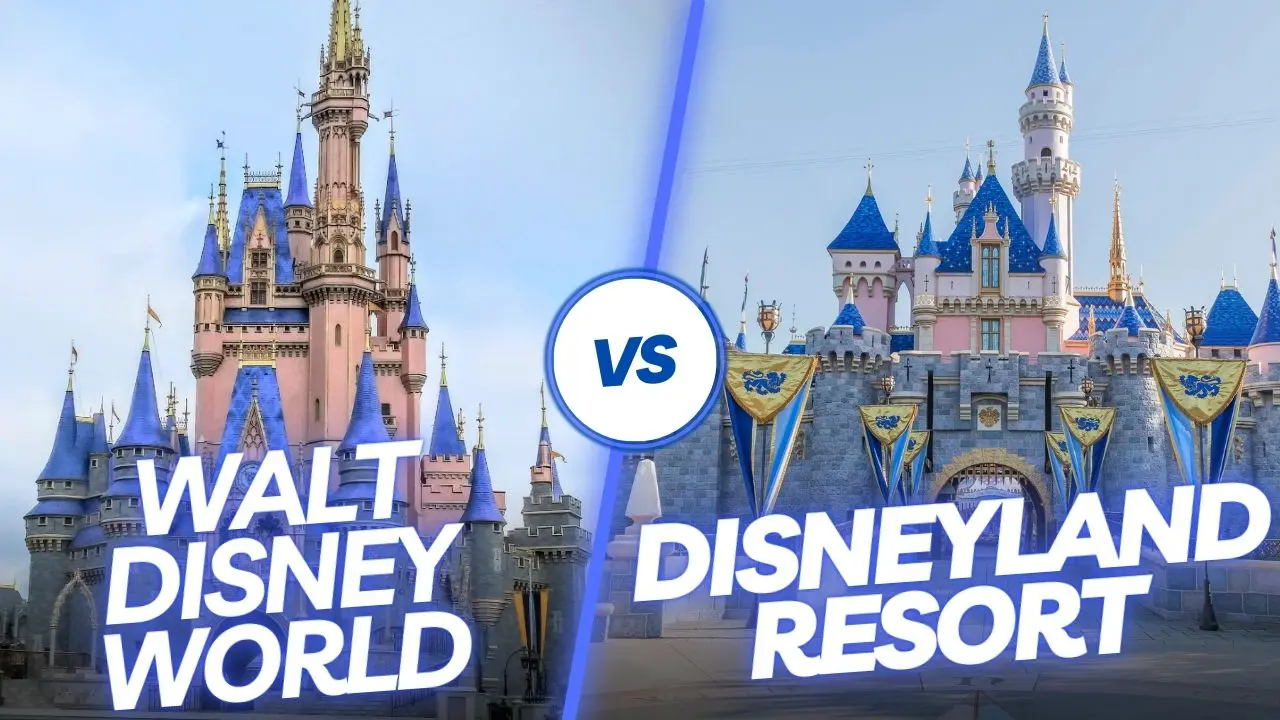
Updated October 11, 2026. A complete comparison of Walt Disney World and Disneyland Resort — size, parks, cost, planning, dining, and which one is actually the right choice for your trip.
This is the question every Disney fan eventually faces. Both resorts deliver the magic. Both have incredible rides, impeccable theming, and the kind of attention to detail that makes Disney parks unlike anything else on earth. But they are fundamentally different experiences — different in scale, different in feel, different in what they demand from you as a guest — and choosing the wrong one for your trip can lead to a vacation that feels overwhelming, rushed, or just slightly off from what you were hoping for.
Here is an honest, detailed breakdown of everything that separates the two resorts so you can make the right call for your group.
Key Differences at a Glance
2026 systems note (Sep 12, 2026, Disneyland-specific): Hotel Early Entry ended January 5, 2026 at Disneyland Resort and was replaced by one Complimentary Lightning Lane Multi Pass entry per on-property guest per stay. Genie+ is Lightning Lane Multi Pass at both coasts (rename). Park reservations remain part of planning — windows differ by ticket vs Magic Key; verify in-app. Deep Disneyland planning: tips hub · Lightning Lane guide · Magic Key worth-it.
Choose the coast with systems, not nostalgia. Disneyland Resort: Early Entry ended January 5, 2026 → Comp Lightning Lane for on-property hotels (perks hub); Genie+ is Multi Pass (rename); park reservations still matter (DL park reservations). Walt Disney World keeps its own Lightning Lane / hotel Early Entry rules — do not copy-paste DL Comp LL assumptions to Florida.
2026 systems comparison (planning table)
| Factor | Disneyland Resort | Walt Disney World |
|---|---|---|
| Scale / walking | Compact — more rides per mile | Huge — transport planning required |
| Hotel morning perk (2026) | Comp LL (1×/guest/stay); EE ended Jan 5, 2026 | Confirm current WDW Early Entry / LL rules on Disney site |
| Paid LL naming | Multi / Single / Premier — DL LL guide | Multi / Single / Premier (WDW) — verify app |
| Fall unique edge | Oogie Boogie Bash hard-ticket nights — worth-it | MNSSHP / other parties — separate tickets |
| Pass / local product | Magic Key tiers — MK worth-it | Incredi-Pass / dates — verify Disney World |
Build a DL trip with tips · 60-day dining · family cost · closures hub · map guide.
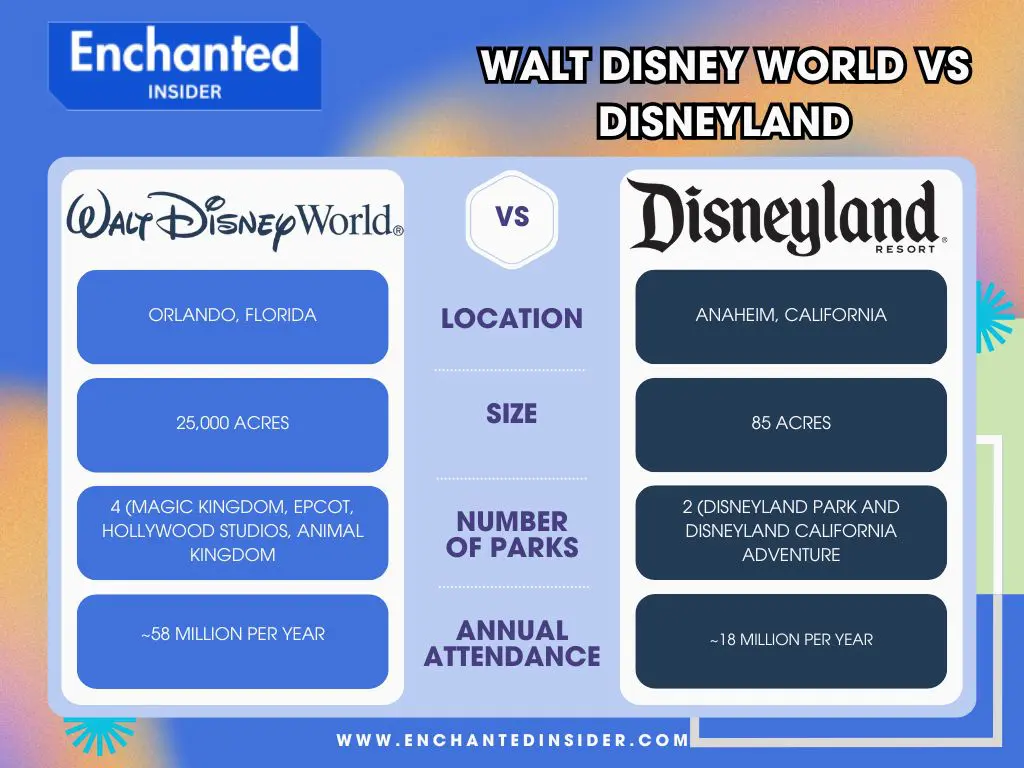
The single biggest difference between Walt Disney World and Disneyland is scale, and it is not close. Walt Disney World covers approximately 43 square miles — roughly the size of San Francisco — making it one of the largest entertainment complexes in the world. Disneyland Resort sits on about 500 acres in Anaheim, California. That is not a small park by any measure, but it is a fraction of the Florida property.
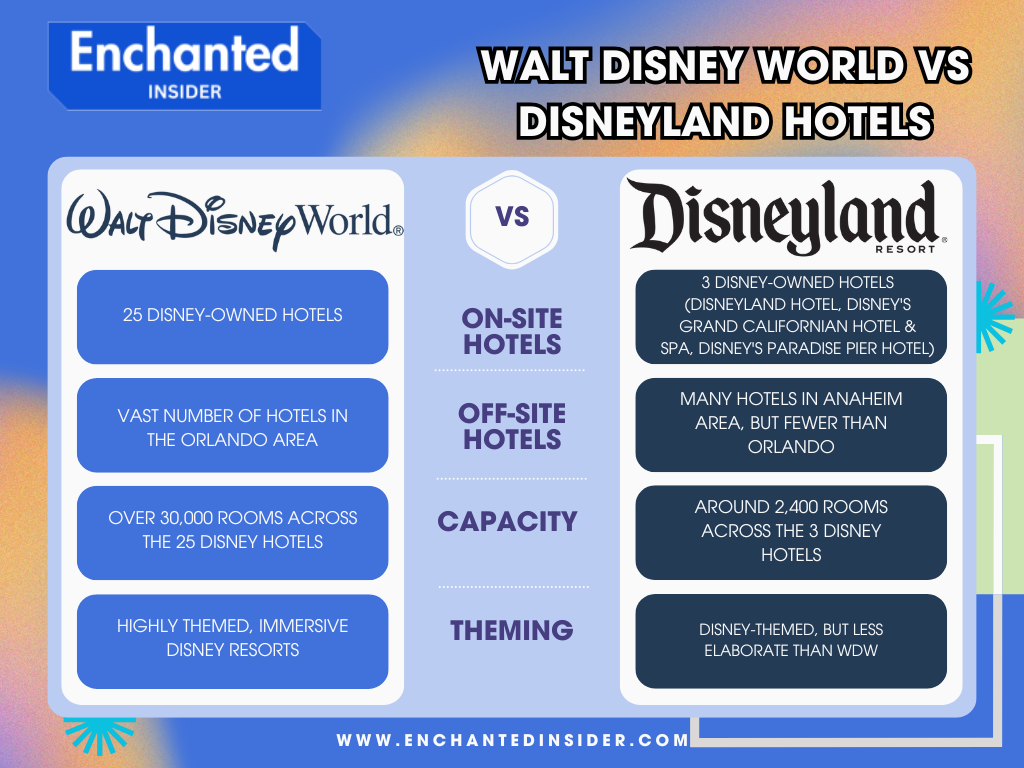
That size difference cascades into almost every other comparison you can make. Disney World has four theme parks, two water parks, a massive shopping and entertainment district, more than 25 on-property hotels, and a transportation network that functions like a small city. Disneyland has two theme parks, three official hotels, a more compact Downtown Disney District, and the unusual advantage that you can walk to off-property restaurants, hotels, and attractions from the front gate.
Disney World rewards longer trips and more planning. Disneyland rewards guests who want a more manageable, spontaneous, and in many ways more intimate experience. Neither is better. They are just different in ways that matter depending on what you are looking for.
Location and Accessibility
Walt Disney World
Walt Disney World is located in Orlando, Florida, and the resort’s sheer size means it exists somewhat independently of the surrounding city. Once you are on Disney property, you are in the Disney bubble — a self-contained world with its own transportation system, its own hotels, its own dining, and its own entertainment. For many guests that immersion is a feature, not a limitation. You do not have to think about anything outside Disney if you do not want to.
Most guests fly into Orlando International Airport (MCO), which is about 25 to 30 minutes from the resort. Disney’s Magical Express shuttle service no longer operates as of 2022, so you will need to plan transportation — rideshare, rental car, or a paid shuttle service. Once on property, Disney’s complimentary transportation system handles everything between parks, hotels, and Disney Springs via buses, monorail, boats, and the Disney Skyliner gondola system. A rental car is optional but useful if you plan to leave the resort bubble at any point.
Florida weather is worth factoring in. Summers are hot and humid with near-daily afternoon thunderstorms from June through September. Hurricane season runs June through November. The most comfortable times to visit are January through early March and late October through early December. Crowds and weather tend to be inversely related — the most comfortable weather windows often align with lower crowd levels, which makes them the best overall times to visit.
Disneyland
Disneyland is in Anaheim, California, embedded in a dense urban area rather than isolated from it. The resort’s footprint is compact enough that you can walk from the front gate to off-property restaurants, hotels, and shops in minutes. That accessibility changes the math on everything from where to stay to where to eat to how you structure your day.
The two closest airports are John Wayne Airport (SNA) in Orange County, about 15 minutes away, and Los Angeles International (LAX), which is 35 to 45 minutes away depending on traffic. Long Beach Airport (LGB) is another solid option — smaller, easier to navigate, and often underpriced compared to LAX for the same routes. A rental car is not necessary for a Disneyland trip if you are staying within walking distance of the resort, which dozens of hotels are. To cut Disneyland’s side of that bill, see cheap Disneyland tickets.
Southern California’s Mediterranean climate is one of Disneyland’s underrated advantages. Year-round temperatures are mild, humidity is low, and rain is rare outside of brief winter wet seasons. Summer mornings are comfortable before afternoon heat builds, and the park’s layout — with plenty of shade, indoor attractions, and air-conditioned spaces — handles warm days well. There is no hurricane season and no thunderstorm season. Weather is rarely a meaningful factor in planning a Disneyland trip.
Disney World vs Disneyland Breakdown
Walt Disney World Parks
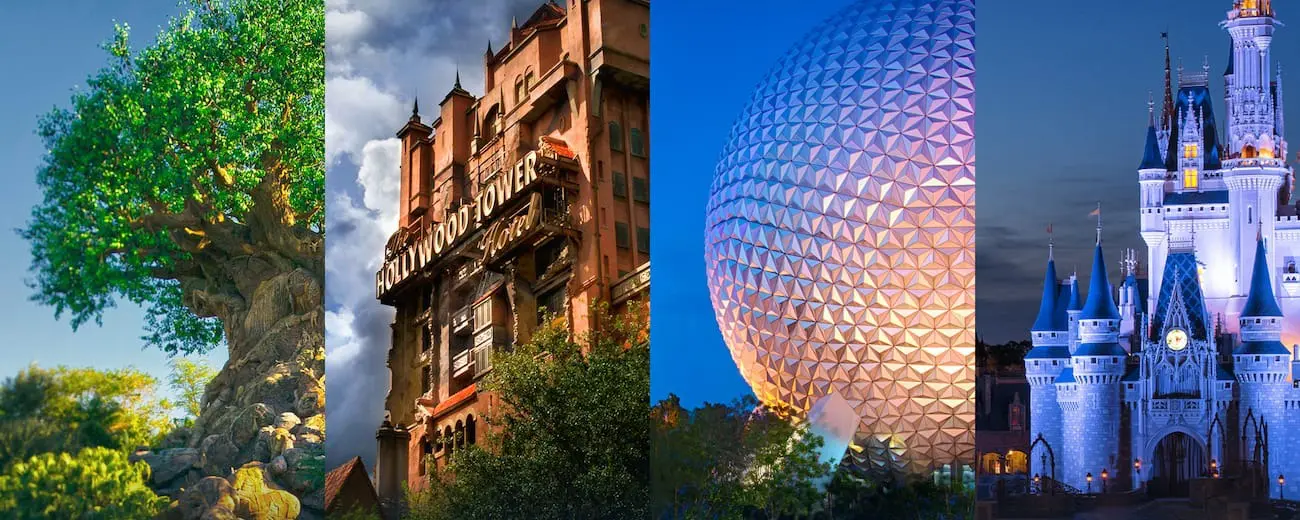
Walt Disney World has four theme parks, each with a distinct identity. Magic Kingdom is the flagship — the castle park, the character park, the closest equivalent to what Disneyland Park is in California. It is larger and has a few unique attractions like Seven Dwarfs Mine Train and the Tron Lightcycle Run that opened in 2023, but the overall experience will feel familiar to Disneyland visitors.
EPCOT is unique to Disney World and unlike anything at Disneyland. The park is divided between a forward-looking Future World section — home to Guardians of the Galaxy: Cosmic Rewind and Test Track — and World Showcase, a ring of pavilions representing eleven countries with authentic food, entertainment, and experiences. EPCOT hosts four major annual festivals including the International Food and Wine Festival in the fall and the International Flower and Garden Festival in spring. For adult guests and food-focused travelers, EPCOT alone can justify a Disney World trip.
Hollywood Studios is home to Star Wars: Galaxy’s Edge — shared with Disneyland — as well as Tower of Terror, Slinky Dog Dash, and the immersive Star Wars hotel experience that, while no longer operating, transformed into new experiences on that footprint. The park leans heavily toward intellectual property immersion and is particularly strong for Star Wars and Toy Story fans.
Animal Kingdom is unlike any other Disney park in the world. It operates as a genuine zoological park with real animals alongside its themed lands, and Pandora: The World of Avatar contains Flight of Passage — consistently ranked among the best theme park attractions anywhere. The park closes earlier than the others and is best experienced in the morning when animals are most active and temperatures are cooler.
Disneyland Parks
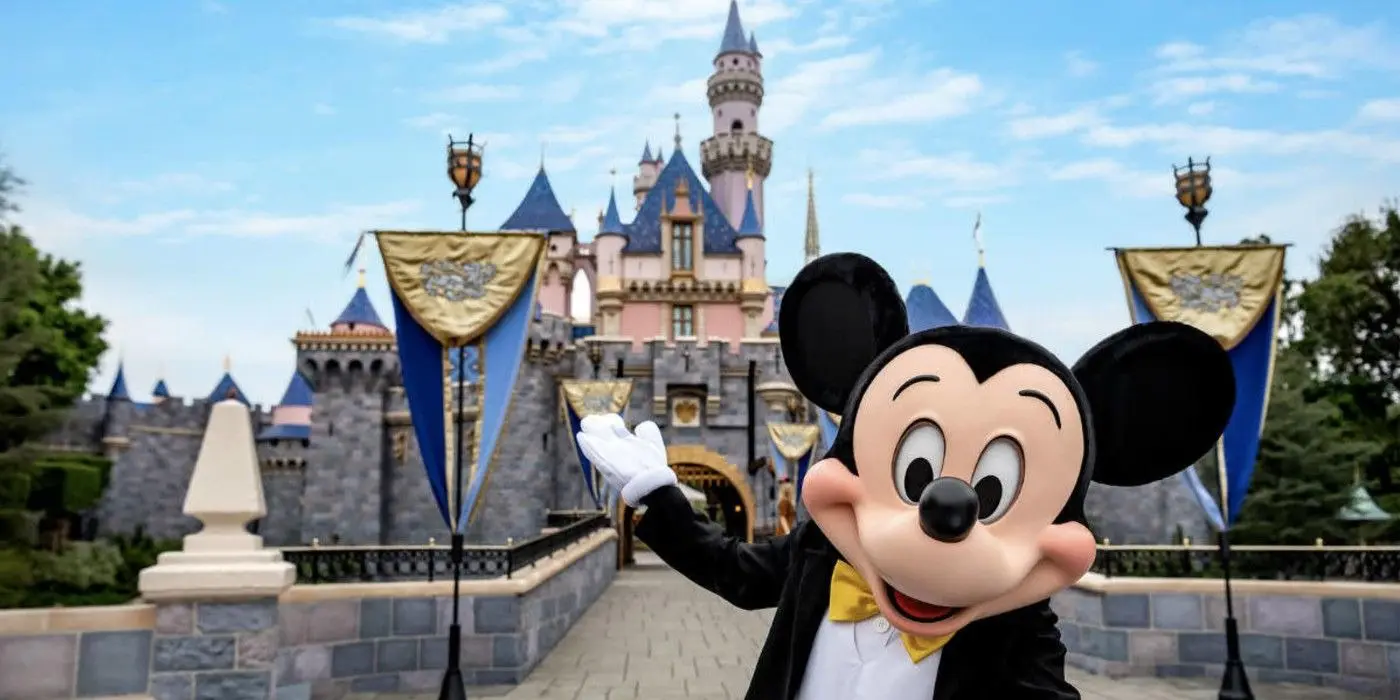
Disneyland Park is the original — opened by Walt Disney himself in 1955 — and that history is palpable throughout. The park is denser than Magic Kingdom, with more attractions packed into a smaller footprint. Walk times between lands are short, the layout is intuitive, and the overall pace feels less exhausting than its Florida counterpart.
Several attractions exist only here: the Matterhorn Bobsleds, Indiana Jones Adventure, the original Pirates of the Caribbean in its classic form, and the Disneyland-exclusive version of Haunted Mansion. Walt Disney’s personal influence on the design of this park is evident in ways that later parks simply cannot replicate.
Disney California Adventure opened in 2001 and has been significantly expanded and improved since its early years.
It is now a genuinely excellent park in its own right. Highlights include Cars Land, which is widely considered one of the best themed areas ever built — Avengers Campus, Pixar Pier, and Buena Vista Street, which recreates the Los Angeles of Walt Disney’s early years. World of Color, the nighttime water and projection show, is one of the best after-dark experiences at either resort.
The park also runs the Disney California Adventure Food and Wine Festival in spring, a direct competitor to EPCOT’s version and surprisingly strong in its own right.
Accommodations and Staying On-Property
Walt Disney World Resort Hotels
Disney World has more than 25 Disney-operated hotels spread across four pricing tiers. Deluxe resorts like the Grand Floridian, the Polynesian Village, the Contemporary, and Animal Kingdom Lodge offer full-service amenities, signature dining, and the most immersive theming.
Moderate resorts including Port Orleans, Caribbean Beach, and Coronado Springs hit a middle price point with solid amenities and good transportation access.
Value resorts like Pop Century, Art of Animation, and the All-Star properties are the entry-level option — clean, well-run, and genuinely good for families who plan to spend most of their time in the parks anyway.
Staying on-property at Disney World comes with meaningful perks. Early Theme Park Entry — 30 minutes before the park opens to general guests — is available to all Disney resort hotel guests and is one of the most valuable time-saving tools available.
Extended Evening Hours, available to guests at Deluxe and Deluxe Villa resorts, provide additional after-hours access on select nights. On-property guests also get access to the full complimentary transportation system without needing a rental car.
Disneyland Hotels
Disneyland has three official Disney-operated hotels. The Grand Californian Hotel and Spa is the crown jewel — a stunning Arts and Crafts lodge with its own private entrance directly into Disney California Adventure, two pools, multiple restaurants including Napa Rose, and the closest proximity to both parks of any hotel on property.
The Disneyland Hotel is a classic that underwent a significant renovation in 2023 and reopened with updated rooms and a new Fantasy Tower.
The Pixar Place Hotel, formerly the Paradise Pier Hotel, is the most affordable of the three and the simplest option for guests who primarily want proximity without resort amenities.
Beyond the three official hotels, Disneyland’s urban location means dozens of Good Neighbor hotels sit within walking distance — some as close as five minutes from the main gate.
This is a meaningful advantage over Disney World, where off-property options require a car and add commute time to every park day.
A guest staying at a Good Neighbor hotel near Disneyland loses almost nothing compared to an on-property guest, whereas an off-property Disney World guest gives up a significant amount of convenience and spontaneity.
Planning and Vacation Length
Walt Disney World
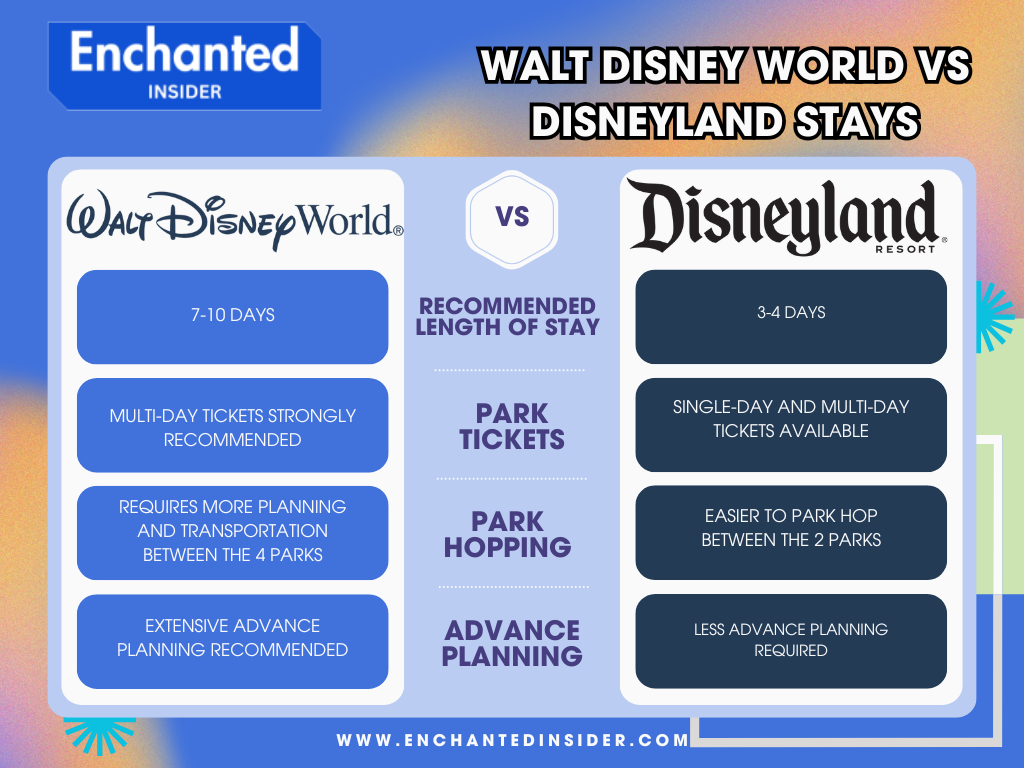
Disney World is a planning-intensive vacation. To see all four parks with reasonable depth, budget five to seven days minimum. Eight to ten days is more comfortable if you want to revisit favorites, spend time at Disney Springs, or build in a rest day.
Dining reservations open 60 days in advance and the most popular restaurants — Be Our Guest, Cinderella’s Royal Table, California Grill — book up within hours of the window opening. Lightning Lane Multi Pass and Lightning Lane Single Pass require daily management and benefit from early-morning planning before the park opens.
The upside of all that planning is that Disney World rewards guests who do their homework.
A well-planned Disney World trip in a shoulder season with smart Lightning Lane usage and early dining reservations can produce an experience that feels almost crowd-free even during moderately busy periods. The complexity has a ceiling, and experienced guests navigate it efficiently.
Disneyland
Disneyland is significantly more manageable. A thorough two-park visit requires three to four days for most guests — two days to cover both parks at a relaxed pace, a third day to revisit highlights and catch anything missed. Dining reservations are still recommended for table-service restaurants but are less critical than at Disney World, and walk-up availability at most venues is a realistic option.
The Lightning Lane system mirrors Disney World’s but operates across a smaller footprint, which makes daily management less demanding.
The compact layout also makes spontaneous decision-making easier. If Rise of the Resistance breaks down, you are never more than a few minutes from another major attraction. If you finish Tomorrowland earlier than expected, you can be in Fantasyland in four minutes on foot.
That flexibility is something Disney World simply cannot offer given its scale.
Weather and Seasonal Considerations
Walt Disney World
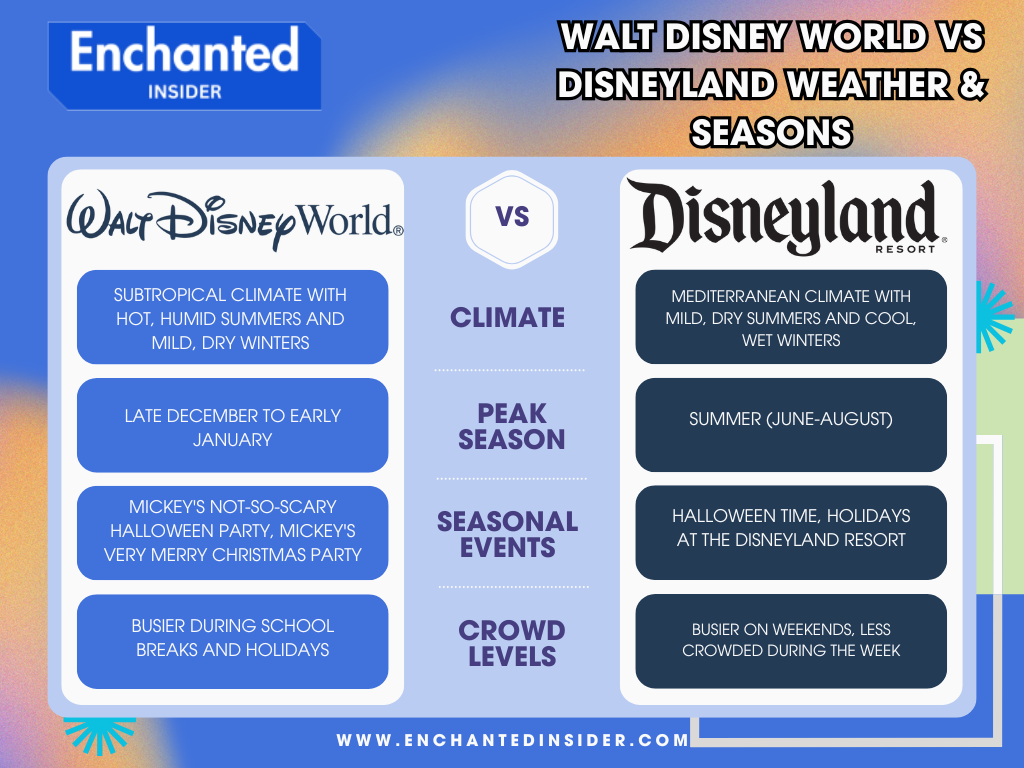
Florida’s climate is the most significant logistical variable for Disney World guests. Summer visits (June through August) mean temperatures in the low 90s with high humidity and near-daily afternoon thunderstorms that can close outdoor attractions for 30 to 60 minutes at a time.
They also bring the heaviest crowds, particularly from families with school-age children. September and October offer meaningfully lower crowds after Labor Day while temperatures begin to moderate, though hurricane season is still technically active. November through early
January is the sweet spot for many guests: comfortable temperatures, lower crowds outside of Thanksgiving and Christmas week, and the resort fully decorated for the holidays. January and February are the lowest-crowd months of the year and often the most affordable, with mild temperatures and minimal rain.
Disneyland
Disneyland’s Southern California location provides far more consistent weather year-round. Average temperatures range from the low 60s in winter mornings to the mid-80s on summer afternoons, with low humidity throughout. Rain is uncommon outside of brief winter storms, and even then rarely lasts a full day.
The most crowded periods at Disneyland are summer, spring break, and the holiday stretch from Thanksgiving through New Year’s. The best crowd windows are January through early March on weekdays, and September through early November before holiday decorations bring families back.
Unlike Disney World, weather is almost never a reason to change plans at Disneyland.
Cost Comparison
A Disney World vacation is almost always more expensive than a Disneyland vacation when total trip cost is considered. The primary drivers are trip length, hotel nights, and transportation. A Disney World trip that properly covers all four parks requires five to seven days, which means five to seven nights of hotel accommodation and five to seven days of park tickets. A complete Disneyland trip can be done in three to four days.
That difference alone accounts for a significant cost gap before any other variable is considered.
Single-day park ticket prices at both resorts are demand-based and fluctuate by date, but they are broadly comparable at the gate level. Disney World’s Lightning Lane Multi Pass and Lightning Lane Single Pass costs can add $30 to $50 or more per person per day depending on the park and season. Disneyland’s system runs similarly. Dining costs are comparable between the two resorts at equivalent restaurant categories.
The Disneyland cost advantage comes from proximity to off-property alternatives. Guests who stay in a Good Neighbor hotel within walking distance of Disneyland can book rooms at two-thirds or less the cost of comparable on-property Disney World hotels.
Meals outside the resort are available within a short walk, which provides a meaningful relief valve on daily food spending. For families on a budget, the Disneyland trip structure allows for much more flexibility in how and where money is spent.
For the best value on either trip — tickets, hotels, or packages that bundle both — Get Away Today consistently offers discounted rates for both Disneyland and Disney World packages that are worth checking before you book directly.
Food and Dining
Walt Disney World Dining
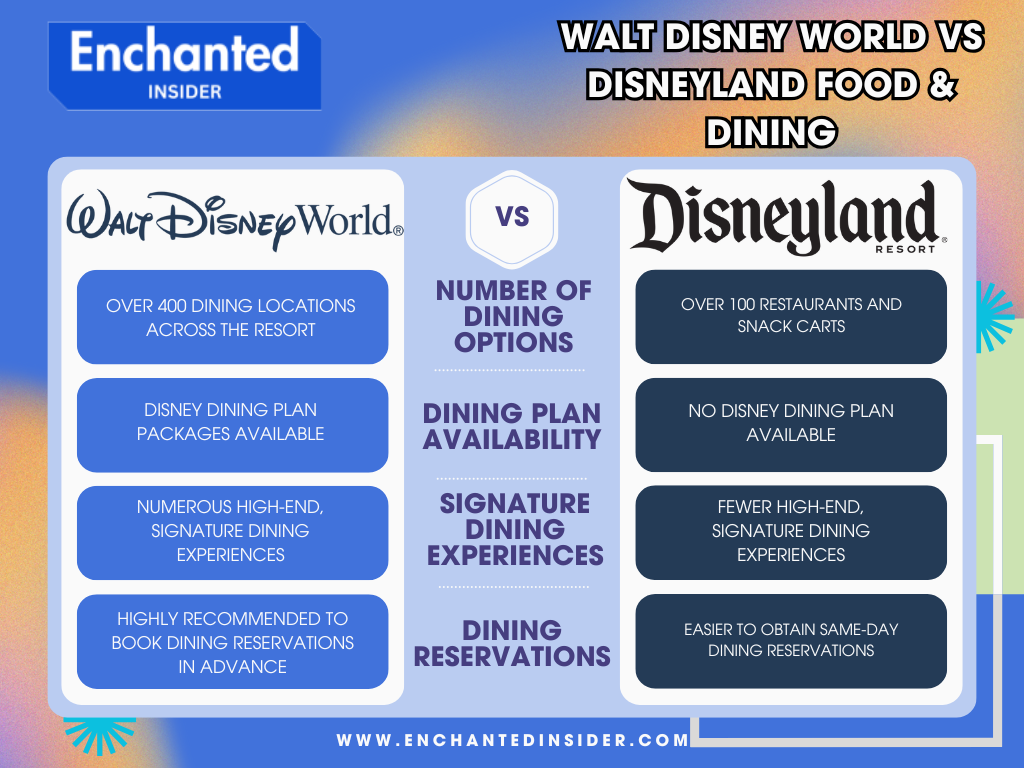
Disney World’s dining ecosystem is enormous. With more than 200 dining locations across the resort, the variety covers everything from quick-service windows to multi-course signature restaurants.
EPCOT’s World Showcase alone functions as a food and beverage destination in its own right, with authentic offerings from eleven countries and some of the best casual international dining in the Orlando area.
Signature dining options like Victoria and Albert’s — one of only a handful of restaurants in Florida to hold an AAA Five Diamond rating — represent the top end of what Disney’s culinary program can produce. The California Grill atop the Contemporary Resort offers one of the best dining experiences in the entire Disney ecosystem, with views of Magic Kingdom fireworks visible from the dining room.
The tradeoff is planning pressure. Popular restaurants at Disney World book up weeks in advance and the reservation system requires active management.
Walk-in availability at desirable venues is inconsistent and cannot be relied upon, particularly during busy seasons.
Disneyland Dining
Disneyland has fewer dining options than Disney World but punches above its weight on quality. Blue Bayou remains one of the most atmospheric dining experiences in any theme park in the world — a full-service restaurant built literally inside the Pirates of the Caribbean attraction, where you dine on the bayou while boats float past.
Napa Rose at the Grand Californian is a legitimately excellent fine dining restaurant that can stand alongside good restaurants anywhere in Southern California.
The park’s quick-service options are generally considered stronger than Disney World’s equivalent tier, with standouts like the Felucian Garden Spread at Docking Bay 7 in Galaxy’s Edge and the Monte Cristo sandwich at the Blue Bayou lunch menu.
Disneyland’s biggest dining advantage is proximity. The concentration of restaurants within walking distance of the resort means guests are never limited to park food if they want an alternative.
Downtown Disney provides additional options and the surrounding Anaheim streets have dozens of restaurants at every price point within a short walk or rideshare from the main gate.
Extra Activities and Adventures
Walt Disney World
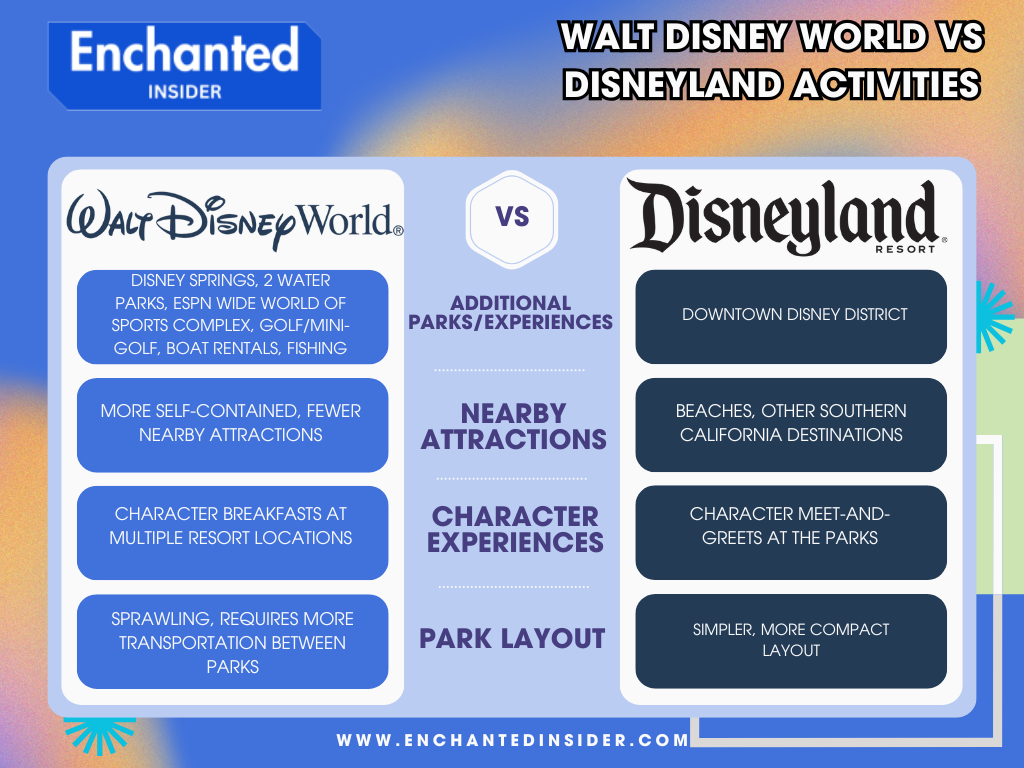
Beyond the four theme parks, Disney World offers an activity ecosystem that most guests never fully exhaust. Typhoon Lagoon and Blizzard Beach are two full-scale water parks included in some ticket packages and worth a dedicated half-day each, particularly in summer.
Disney Springs is a 120-acre shopping and entertainment district with restaurants, live entertainment, a bowling alley, a movie theater, and a range of retail from everyday shops to high-end boutiques. Golf, boat rentals, fishing excursions, mini-golf, spa services, and resort pool complexes round out the non-park options.
Disney World’s scale means that guests who want to fill seven days without repeating experiences can genuinely do so.
Disneyland
Disneyland’s off-park options are more modest on property but more expansive off it. Downtown Disney provides dining and shopping in a walkable outdoor setting adjacent to the resort.
Beyond that, Disneyland’s location in Southern California positions it perfectly as one stop on a larger regional trip. Disneyland is 30 minutes from the beach, 45 minutes from Los Angeles, and within a day’s drive of San Diego, Santa Barbara, Joshua Tree, and the broader California coast.
Families who want to combine Disneyland with broader California sightseeing have an enormous amount to work with in a week-long trip that a Disney World vacation simply cannot compete with geographically.
Best For Different Types of Travelers
Walt Disney World is Better For:
First-time Disney visitors who want the complete Disney resort experience will find Disney World delivers something closer to total immersion. The sheer variety of parks, hotels, and entertainment means you never need to leave the bubble if you do not want to, and the range of experiences across four parks ensures that every member of a mixed-interest group finds something compelling.
Guests planning longer trips of five days or more get significantly more value at Disney World simply because there is more to do. EPCOT alone can absorb a full day for the right guest, and Animal Kingdom is worth more time than most first-timers budget for it.
Food and culture travelers — particularly those drawn to EPCOT’s World Showcase and its annual festivals — will find Disney World has experiences Disneyland cannot match. The International Food and Wine Festival, which runs from late summer through November, is one of the best food events in Florida.
Families with very young children who want the widest range of character experiences, princess dining, and gentle attractions also tend to find Disney World’s variety serves them better, particularly across four parks with different theming and age-appropriate options.
Disneyland is Better For:
Disney history enthusiasts will find something at Disneyland that no other park on earth can offer: the original. Walt Disney walked these paths. The layout of Disneyland Park reflects his personal vision in ways that later parks, designed by committee and built on different continents, cannot. The Matterhorn was built at his direction. New Orleans Square was his idea. Disneyland’s 70th Anniversary celebration ran from May 16, 2025 through August 9, 2026, and its Paint the Night parade and Wondrous Journeys fireworks played their final shows on August 20. The anniversary is over, but walking the park Walt built is still worth doing in person for anyone who cares about the history of the medium. This fall the nighttime headliners are seasonal instead: Halloween Screams fireworks run through October 31, and the Holidays season runs November 13, 2026 through January 6, 2027.
Weekend and short-trip travelers get a better return at Disneyland. Three days is enough to do both parks thoroughly and leave without a sense of things missed. Three days at Disney World barely scratches the surface.
West Coast visitors and California residents have the obvious practical advantage of proximity, but beyond that, Disneyland makes more sense as a regional base for a broader California trip than Disney World does for a Florida-only vacation.
Ride enthusiasts who care about attractions per square foot and walking time between rides will find Disneyland the more efficient experience. More attractions are reachable in a shorter physical distance, and the rope drop strategy at a compact park like Disneyland can produce results — five to seven major attractions in the first two hours — that Disney World’s sprawl simply cannot match.
Special Events and Seasonal Celebrations
Both resorts run strong seasonal event programs, and they are worth factoring into your timing decision if a specific event is part of your trip motivation.
At Disney World, Mickey’s Not-So-Scary Halloween Party and Mickey’s Very Merry Christmas Party at Magic Kingdom are separately ticketed after-hours events that draw significant demand and sell out well in advance. EPCOT’s four annual festivals — Food and Wine, Flower and Garden, Festival of the Arts, and Festival of the Holidays — are included with regular park admission and are among the best ongoing additions Disney has made to the resort in the last decade.
At Disneyland, Oogie Boogie Bash at Disney California Adventure is the Halloween equivalent — separately ticketed, themed, and beloved. For Christmas, Holidays at the Disneyland Resort is included with admission (November 13, 2026 through January 6, 2027); check Disney’s events calendar for any separately ticketed holiday nights.
The Lunar New Year Celebration at California Adventure is one of the most culturally rich seasonal events at any Disney park worldwide, and the Disneyland After Dark series adds separately ticketed after-hours nights during the year, with themes such as Sweethearts’ Nite, Star Wars Nite and Pride Nite. Check Disney’s events calendar for current dates.
Making Your Decision
The clearest framework for choosing between the two resorts is time. If you have three to four days, Disneyland is almost always the right call — it is completable, manageable, and delivers the core Disney experience without requiring the level of planning and logistics that Disney World demands. If you have five or more days and want a full resort vacation rather than a theme park trip, Disney World’s breadth justifies the additional complexity and cost.
Budget is the second filter. A Disneyland trip can be structured far more affordably than a Disney World trip, particularly for families who are cost-conscious about hotels and dining. Off-property hotel options near Disneyland are plentiful and genuinely good. Off-property Disney World options require a car and add time to every park day, which tends to push guests toward on-property accommodations and their higher price points.
Geography matters more than people admit. If you are on the West Coast or planning a California trip, Disneyland is the obvious choice. If you are on the East Coast or in the Midwest, Disney World is likely your most accessible Disney option and worth embracing on its own terms rather than as a consolation for not being closer to Anaheim.
And if you genuinely cannot decide — visit both eventually. They are different enough that experiencing one does not substitute for the other, and most guests who visit both ultimately have a clear preference based on what they value in a theme park experience. Finding out which one that is for your family is one of the more enjoyable pieces of research you will ever do.
Tips for Either Destination
Regardless of which resort you choose, a few universal strategies apply. At both parks, arriving at rope drop is the single highest-leverage move available to any guest. The first 90 minutes after opening, when crowds are lightest and wait times are shortest, can accomplish more than the next four hours combined. Getting there early consistently outperforms any paid skip-the-line product in terms of overall ride count.
Lightning Lane Multi Pass and Lightning Lane Single Pass — Disney’s paid queue management systems, which replaced Genie+ in 2024 (what changed) — are worth using at both resorts but require some understanding to use well. At Disney World, Lightning Lane Single Pass purchases for the highest-demand attractions like Tron, Guardians of the Galaxy, and Star Wars: Rise of the Resistance are often worth the additional cost. At Disneyland, the system is simpler and the compact layout makes managing it less stressful.
Dining reservations should be made as early as your booking window allows for any table-service restaurant you have a specific interest in, at either resort. The 60-day window is the same for both. Popular restaurants at Disney World fill within hours of the window opening. Popular restaurants at Disneyland are more forgiving but still benefit from advance booking, particularly for weekend evenings and holiday periods.
Visiting during off-peak periods — January through early March, the weeks between Labor Day and Halloween, and the stretch between Thanksgiving and Christmas week — dramatically changes the experience at either resort. Crowd levels, wait times, and ambient stress all drop, and the parks become easier to enjoy at a relaxed pace. If your schedule has any flexibility at all, building your trip around an off-peak window is worth prioritizing over a more convenient but busier date.
For the best prices on hotel and ticket packages at either resort, check Get Away Today before booking directly. They consistently offer discounted rates on both Disneyland and Disney World packages and are one of the most reliable authorized Disney vacation sellers available.
Final Thoughts
There is no wrong answer here. Walt Disney World and Disneyland are two of the most carefully designed, consistently maintained, and genuinely magical places on earth, and visiting either one is a worthwhile decision. The question is not which one is better in some abstract sense — it is which one is better for your specific trip, your group, your budget, and your timeline.
Disney World rewards commitment. It asks for more days, more planning, more money, and more logistical patience, and it returns that investment with a breadth of experience that no other theme park destination in the world can match. If you are willing to give it what it asks, it delivers.
Disneyland rewards presence. It is smaller, faster, and more forgiving, and it carries something that Disney World — for all its scale — cannot replicate: the weight of being the original. The park where it all started. There is something in the layout of Main Street at Disneyland, in the sight lines to the castle from the end of that street, in the specific density of things to do and see in a compact and walkable space, that feels different from every other Disney park in the world. Not better than Disney World. Just irreplaceable in its own way.
Planning either trip? The
Disneyland tips · Lightning Lane complete guide · Genie+ → Multi Pass rename · Hotel perks after Early Entry ended · Magic Key 2026 worth-it · Park reservations · Dining reservations (60-day) · Family-of-4 trip cost · Closures / refurb hub · Oogie Boogie Bash worth-itRelated planning hubs (nav pillars)
FAQ
Walt Disney World covers approximately 43 square miles, making it roughly 40 times larger than Disneyland Resort, which sits on about 500 acres. Disney World has four theme parks, two water parks, and more than 25 hotels. Disneyland has two theme parks and three official hotels.
It depends on how much time you have. First-time visitors with three to four days get a more complete experience at Disneyland because both parks are fully coverable in that window. First-time visitors with five or more days who want the full Disney resort experience — including EPCOT and Animal Kingdom — are better served by Disney World.
Generally yes. A complete Disneyland trip requires fewer park days, fewer hotel nights, and benefits from affordable off-property hotel options within walking distance of the resort. Disney World’s scale pushes most guests toward longer stays and on-property hotels, which significantly increases total trip cost.
Disneyland can be done thoroughly in three to four days covering both parks. Disney World requires a minimum of five to seven days to see all four parks with any depth, and eight to ten days is more comfortable if you want to revisit favorites or build in rest time.
Yes. Dozens of hotels sit within walking distance of the Disneyland Resort front gate, some as close as five minutes on foot. This is one of Disneyland’s biggest practical advantages over Disney World, where off-property hotels require a car or paid transportation to reach the parks.