
Last Updated on April 24, 2026
Updated April 2026. Disneyland has rolled out facial recognition technology at the entrances to both Disneyland Park and Disney California Adventure. Here is exactly how it works, what happens to your data, and how to opt out if you do not want to participate.
If you have visited Disneyland in recent months and noticed something different at the entry gates, you were not imagining it. Disneyland Resort has quietly rolled out facial recognition technology at the entrances to both Disneyland Park and Disney California Adventure, and as of this week the system has moved from a limited test to a full broad deployment across the Esplanade. Signs are now posted at both ends of the Esplanade and at Mickey’s Friends Parking Structure notifying guests that the technology is in use.
The rollout is happening fast and most guests have not heard about it yet. Here is everything you need to know before your next visit.
What the Technology Actually Does
The system works by capturing an image of your face at the park entrance gate and comparing it to the photo taken when your ticket or Magic Key pass was first activated. Both images are converted into unique numerical values — not stored as photographs — and those values are compared to verify a match. If they match, you are through the gate.
Disney says the purpose is twofold: to speed up reentry into the parks and to prevent ticket fraud. On the fraud prevention side, the logic is straightforward — if a ticket is linked to a face and that face does not match the person presenting the ticket, the system flags it. On the speed side, the goal is to reduce the time spent at the gate validating tickets, particularly for returning guests re-entering the park mid-day.
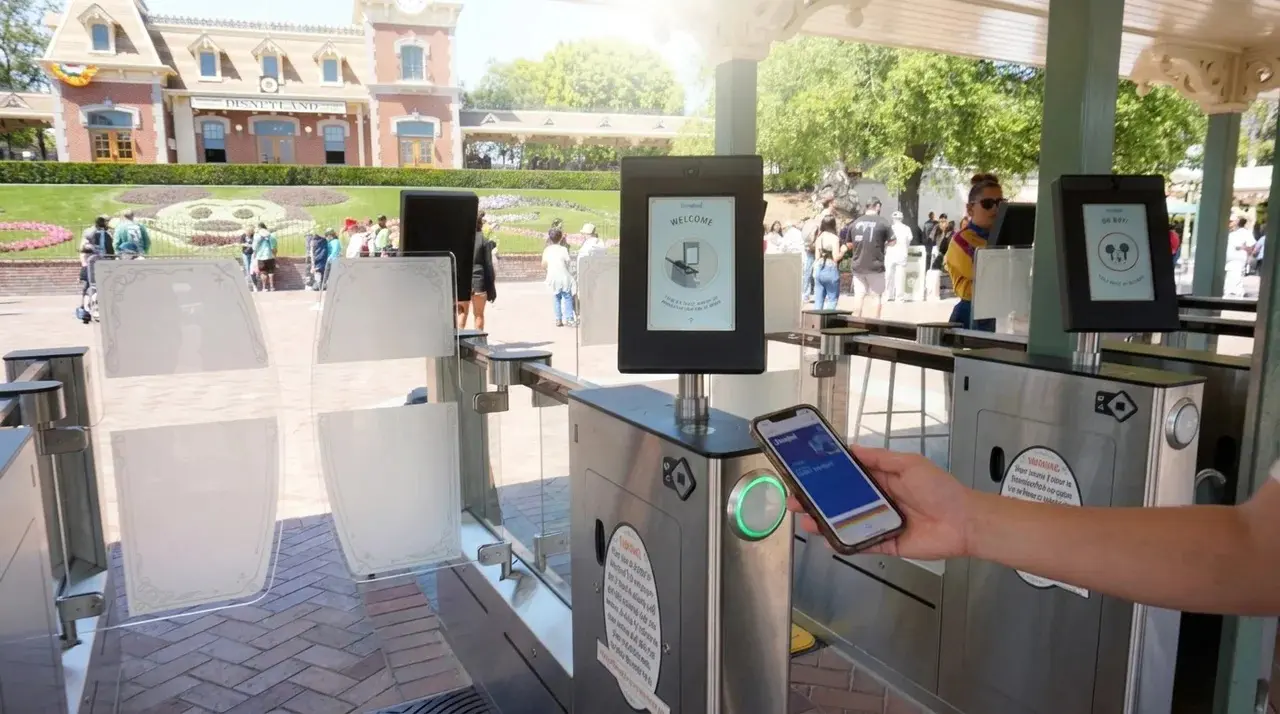
The gates themselves have also been updated as part of this rollout. All entry gates are now ADA-compliant, opening automatically after a ticket is scanned and a photo is taken. The new gates include MagicBand+ tap access points and are wide enough to accommodate wheelchairs, ECVs, and strollers without requiring a separate accessible lane. Cast members remain stationed at the entrances to assist guests and validate tickets as needed.
What Happens to Your Data
This is the part that matters most for privacy-conscious guests. According to Disney, the numerical values generated from your facial image are deleted within 30 days of creation. The company states that deletion may be delayed only in cases where data must be retained for legal or fraud prevention purposes.
Importantly, the system does not store photographs of your face. What it stores are numerical values derived from your facial geometry — a mathematical representation, not an image file. Disney’s position is that this distinction matters for privacy because the numerical values cannot be reverse-engineered back into a recognizable photograph.
Whether that framing satisfies your personal privacy threshold is a judgment call. The underlying reality is that your biometric data is being processed and temporarily retained by one of the largest entertainment companies in the world. For guests who are comfortable with that — and for context, the same technology is already in use at Universal Studios Florida, Universal Islands of Adventure, Universal Epic Universe, and at TSA checkpoints at several major airports including LAX, SFO, and Orange County — the system is a genuine convenience improvement. For guests who are not comfortable with it, opting out is straightforward.
How to Opt Out
Opting out requires nothing more than choosing the right lane. The new signage at the Esplanade entrance clearly identifies which lanes use facial recognition and which do not. Guests who do not wish to participate should look for the overhead signage designating the non-facial recognition lanes and enter through those instead.
In the non-participating lanes, cast members manually validate your ticket in the traditional way. Disney has confirmed that standard ticket validation remains available to all guests who prefer it. There is no penalty, no additional wait, and no requirement to explain your preference. You simply choose the lane and proceed.
One important nuance: Disney’s disclosure notes that images may still be captured in the opt-out lanes, but those images will not be converted into numerical values for biometric processing. In other words, a photo may still be taken at the gate — as has been the case for years as part of ticket validation — but the facial recognition comparison step does not occur in those lanes.
The signage currently reads: “Disneyland Resort park entries use facial recognition technology. Use of these lanes is optional. If you do not wish to participate, please enter the lane with the following overhead signage.” The opt-out lane signage is clearly marked and cast members can direct you if you are uncertain which lane to use.
How This Compares to What Other Parks Are Doing
Disneyland is not doing anything unusual here relative to where the theme park industry is heading. Universal has been running facial recognition at its Florida parks for some time, including at Express Pass lane entrances at Epic Universe. The technology has also been tested at Disney World in the past, and its arrival at Disneyland was more a question of when than if.
The broader travel industry has moved the same direction. TSA’s Touchless Identity Solution, which uses facial recognition to verify identity at airport security checkpoints without requiring guests to show a boarding pass or ID, is currently available at John Wayne Airport, LAX, San Francisco, and Orlando among others. For frequent travelers who have already opted into that program, Disneyland’s system will feel familiar and low-friction.
The distinction that matters for guests is that all of these systems — Disneyland, Universal, TSA — are positioned as opt-in or opt-out rather than mandatory. That framing is deliberate and, in California specifically, has legal weight. California’s biometric privacy laws require meaningful consent for the collection of biometric data, which is part of why Disney has been careful to make opt-out clearly available and clearly communicated via signage at multiple points before guests reach the gates.
What Changed Between the March Test and the April Rollout
The March 2026 test was framed as an opt-in experience. Signage in the test lane notified guests that a test was occurring and gave them the choice to use that lane or not. The language was test-specific and the rollout was limited to a single lane.
The April 2026 deployment flipped the framing. Instead of opt-in signage in a single test lane, the technology is now present across the standard entry lanes with opt-out signage directing guests who do not wish to participate to alternative lanes. That shift — from opt-in to opt-out — is the meaningful change. The default experience for guests who simply follow normal park entry procedure now involves facial recognition unless they actively choose otherwise.
That shift is worth understanding before you visit. If you walk through a standard entry lane without looking for opt-out signage, you are participating in the facial recognition system. If you want to opt out, you need to look for the designated lanes before you reach the gate.
What This Means for Your Visit
For the majority of guests, the practical day-to-day impact of this change is minimal. Entry will be slightly faster, particularly for repeat entries mid-day. Ticket fraud — where one person uses another person’s ticket — becomes harder to pull off. The gate experience is otherwise the same.
For guests who want to opt out, the process is simple but requires a small amount of attention at the Esplanade. Look for the opt-out signage before you reach the gates, choose the designated lane, and proceed with standard ticket validation. It takes no longer than the standard process and requires no paperwork, no explanation, and no interaction beyond normal gate entry.
For guests traveling with children, it is worth knowing that the system applies to all guests with tickets — children included. If you prefer that your child’s biometric data not be processed, selecting the opt-out lane covers the entire group traveling together.
The bottom line: Disneyland is now a facial recognition park by default. Opting out is easy and clearly supported. Knowing that the option exists before you arrive is the most useful thing this article can tell you.
Planning your Disneyland visit and want to know what else has changed in 2026? The Enchanted Insider Disneyland Itinerary Guide covers both parks with up-to-date planning for the full year. For hotel and ticket packages, check Get Away Today before you book.
FAQ
Look for the opt-out signage posted at the Esplanade entrance before you reach the gates. Choose the designated non-facial recognition lane and your ticket will be validated by a cast member in the traditional way. No explanation or paperwork is required — you simply choose the correct lane.
Disneyland does not store photographs of your face. The system converts facial images into unique numerical values, which are deleted within 30 days of creation. Deletion may be delayed only in cases involving legal or fraud prevention requirements, according to Disney’s disclosure.
Yes. The March 2026 test used opt-in signage in a single lane. The April 2026 full rollout flipped to an opt-out model — facial recognition is now the default in standard entry lanes, with separate opt-out lanes available for guests who do not wish to participate. Guests who walk through a standard lane without seeking out opt-out signage are participating in the system.
Yes. The system applies to all guests with tickets, including children. If you prefer that your child’s biometric data not be processed, selecting the opt-out lane covers your entire group.