

Last Updated on June 12, 2026
Using Disney’s most recent SEC filings and fiscal year 2025 earnings data, we estimate how much Disneyland Resort generates in daily revenue and daily operating income, and break down exactly where that money comes from.
How much does Disneyland make per day? It is one of the most searched questions about the park, and for good reason. Disneyland is not just a theme park. It is one of the most profitable entertainment properties on earth, generating revenue from tickets, hotels, food, merchandise, parking, and a growing lineup of premium events. Disney does not publish individual park financials, but using the company’s own SEC filings and Disneyland’s historical attendance share of the global Disney Parks business, we can produce a well-grounded estimate. As of April 2026, we estimate Disneyland Resort generates $22.17 million per day in total revenue.
Here is what the most current data tells us, updated through Disney’s fiscal year 2025 results released in November 2025.
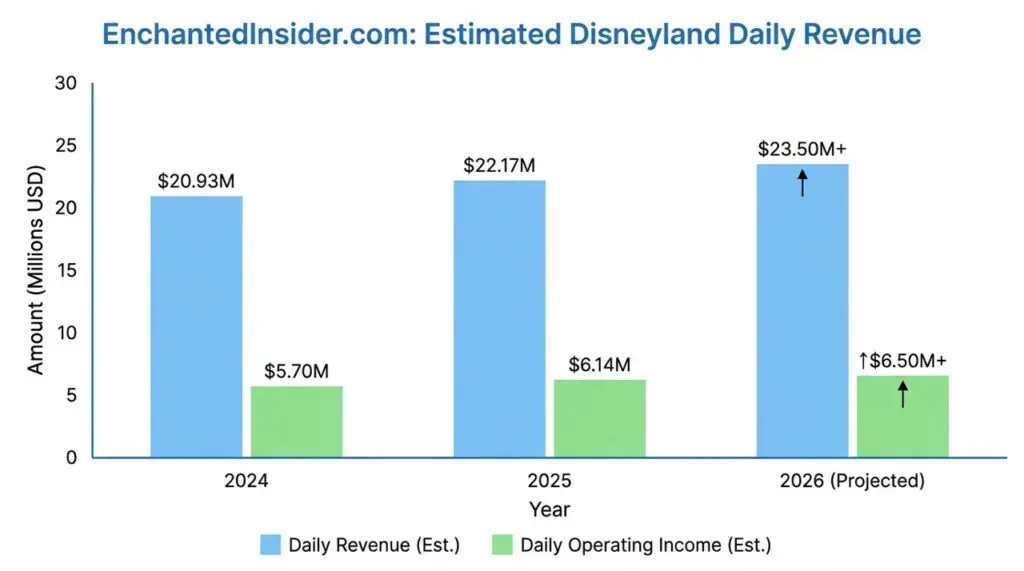
| Year | Daily Revenue (Est.) | Daily Operating Income (Est.) |
| 2024 | $20.93 Million | $5.70 Million |
| 2025 | $22.17 Million | $6.14 Million |
| 2026 (Projected) | $23.50 Million+ | $6.50 Million+ |
How Much Does Disneyland Make Per Day in 2025?
Based on Disney’s fiscal year 2025 SEC filings and Disneyland Resort’s consistent 22.37% share of global Disney park attendance, our estimates are as follows.
Disneyland estimated daily revenue: approximately $22.17 million
Disneyland estimated daily operating income: approximately $6.14 million
Both figures are all-time highs, reflecting the record-breaking performance the Disney Experiences segment posted in fiscal year 2025. Here is how we arrive at those numbers.
While Disney makes millions a day, you don’t have to spend that to enjoy Disneyland. Check the current lowest-priced ticket dates here.
The Data Behind the Estimate
Disney’s fiscal year 2025 ran from September 29, 2024 through September 27, 2025. In its full-year earnings report, Disney disclosed that the Experiences segment, which includes all Disney parks worldwide, cruise lines, and consumer products, posted record full-year revenue of $36.16 billion and record operating income of $10.0 billion. Both figures were up significantly from fiscal year 2024, when the segment posted $34.15 billion in revenue and $9.28 billion in operating income. The underlying data is drawn from Disney’s Form 8-K filing with the SEC, released November 13, 2025.
To estimate Disneyland’s specific contribution, we apply the resort’s historical attendance proportion. Disneyland Resort has consistently accounted for approximately 22.37% of Disney’s global theme park attendance based on industry tracking data across the past decade. Applying that share to the segment totals produces the following:
Revenue: 22.37% of $36.16 billion = $8.09 billion annually for Disneyland Resort. Divided by 365 days = approximately $22.17 million per day.
Operating income: 22.37% of $10.0 billion = $2.24 billion annually. Divided by 365 days = approximately $6.14 million per day.
How Much Does Disneyland Make Per Day: Year-Over-Year Comparison
Disneyland’s estimated daily revenue has grown every year since the post-pandemic recovery stabilized. Using the same methodology applied consistently to each year’s Disney SEC filings, here is how the numbers have tracked.
2022: Approximately $17.21 million daily revenue / $4.47 million daily operating income
2023: Approximately $19.95 million daily revenue / $5.49 million daily operating income
2024: Approximately $20.93 million daily revenue / $5.70 million daily operating income
2025: Approximately $22.17 million daily revenue / $6.14 million daily operating income
Revenue is up approximately 6% from 2024 and operating income is up approximately 8%, consistent with the headline numbers Disney reported for the full Experiences division. The trend line has moved upward without interruption since 2022.
How Much Does Disneyland Make Per Hour?
Breaking the daily estimate down further: if Disneyland generates approximately $22.17 million on an average operating day, and the park runs for roughly 16 hours on a standard day, that works out to approximately $1.39 million per hour.
On peak days, such as holiday weekends, Star Wars Nite, or sold-out Magic Key days in peak summer, the hourly figure would be meaningfully higher than the daily average because per-capita spending rises alongside attendance. On days when Disneyland After Dark events run, the park layers additional revenue from separately ticketed after-hours admission at $159 to $185 per ticket on top of normal daytime income. Those events are among the highest-margin activities the resort operates because they generate significant ticket revenue during hours when daytime operational costs have already been absorbed.
How Much Does Disneyland Make Per Year?
Scaling the daily estimate to an annual figure: Disneyland Resort is estimated to generate approximately $8.09 billion in annual revenue and approximately $2.24 billion in annual operating income for fiscal year 2025. That makes Disneyland Resort one of the highest-grossing individual entertainment destinations on earth, all from a property occupying roughly 500 acres in Anaheim, California.
Where Disneyland’s Daily Revenue Comes From
The $22 million daily estimate covers several distinct revenue streams, not just front-gate ticket sales. Disney’s Experiences segment breaks its revenue into categories in each annual SEC filing, and Disneyland contributes meaningfully to all of them.
Theme Park Admissions
Ticket sales are the most visible revenue driver. Single-day Disneyland tickets in 2026 range from approximately $104 on value dates to $194 on peak dates under Disney’s demand-based pricing system. Magic Key annual passes range from $449 to $1,599 and are counted in the admissions category, amortized over the pass period. Disney-wide, admissions revenue for fiscal 2025 totaled approximately $10.88 billion. Applying Disneyland’s proportional share puts admission revenue at roughly $2.43 billion annually, or approximately $6.67 million per day from tickets alone.
Merchandise, Food, and Beverage
In-park spending on food, drinks, and merchandise is the second largest revenue category and has been growing steadily as Disney has invested in premium food experiences, limited edition merchandise drops, and seasonal event items. Per-capita spending, meaning how much each guest spends inside the park beyond admission, has risen significantly in the post-pandemic era. Disney has deliberately shifted toward a strategy of fewer guests spending more per visit rather than maximizing raw attendance headcount. Disney-wide, merchandise, food, and beverage revenue for fiscal 2025 came in at approximately $8.80 billion. Disneyland’s estimated share is roughly $1.97 billion annually.
Hotels and Resort Revenue
Disneyland’s three on-property hotels, the Grand Californian Hotel and Spa, the Disneyland Hotel, and Pixar Place Hotel, generate substantial room revenue year-round. Standard rooms at the Grand Californian regularly run $500 to $700 per night, and all three hotels operate at high occupancy rates given their proximity to the parks. Resort and hotel revenue across Disney Experiences globally totaled approximately $8.10 billion for fiscal 2025. Disneyland’s estimated hotel contribution sits at roughly $1.81 billion annually.
Parking, Events, and Other Revenue
Parking at Disneyland runs $35 to $50 per vehicle depending on the structure, and with tens of millions of annual visitors, parking revenue is meaningful on its own. Separately ticketed After Dark events priced at $159 to $185 per person, merchandise licensing, corporate sponsorships, and various resort amenities round out the revenue picture. These categories collectively account for an estimated $1.88 billion of Disneyland’s annual revenue contribution.
How Does Disneyland’s Daily Revenue Compare to Other Theme Parks?
Disneyland Resort is one of the highest-grossing theme park destinations in the world despite being significantly smaller than Walt Disney World. The global theme park industry generated an estimated $71.9 billion in revenue in 2024 and is projected to grow to $98.7 billion by 2030. Disney Parks hold the largest market share of any operator globally.
Universal Studios Hollywood, Disneyland’s closest California competitor, operates a single theme park on roughly 415 acres. Universal does not disclose park-level financials, but industry estimates place its annual Hollywood property revenue in the $800 million to $1.2 billion range. Disneyland Resort’s estimated $8 billion annual figure reflects both its higher attendance and the contribution of its two-park setup, hotels, and Downtown Disney ecosystem.
Among Disney properties globally, Disneyland Resort’s estimated daily revenue of approximately $22 million puts it in a comparable tier to Magic Kingdom at Walt Disney World, which holds the record for the highest single-park attendance of any theme park on earth. The two parks collectively account for the majority of Disney’s domestic Experiences revenue.
What Disneyland’s Record 2025 Results Mean for 2026
Disney Experiences posted its best financial year on record in fiscal 2025 with $10 billion in operating income. Several factors that drove that performance apply directly to Disneyland and point toward continued growth in fiscal year 2026.
Per-capita guest spending continued to rise. Disney has been deliberate about this: optimizing the guest experience for higher-spending visitors through premium Lightning Lane products, separately ticketed events, exclusive food and merchandise releases, and hotel package enhancements rather than simply chasing attendance volume. The result is a business that generates more revenue per guest even when year-over-year attendance is relatively flat.
Looking at fiscal year 2026, which began in October 2025, several Disneyland-specific factors point toward continued revenue growth. The park’s 70th Anniversary celebration, running through 2026, has driven meaningful incremental visitation from Disney fans who specifically want to experience the milestone year. The Galaxy’s Edge timeline expansion launching in late April 2026, adding classic characters including Luke Skywalker, Han Solo, Princess Leia, and Darth Vader to Batuu, is a significant new draw expected to sustain elevated attendance and Lightning Lane demand throughout the year. Disney has also announced a $60 billion investment across its Experiences division over the next decade, with Disneyland receiving capital toward infrastructure improvements, new attractions in development, and ongoing hotel renovations.
Based on those factors, our projection for Disneyland’s fiscal 2026 daily revenue is in the range of $23 to $24 million per day, assuming continued mid-single-digit growth consistent with the recent trajectory.
Key Factors That Affect How Much Disneyland Makes Per Day
The $22 million figure is a daily average across the full year. The actual number on any given day swings significantly based on several variables.
Attendance management matters. Disneyland has been selective about Magic Key pass availability, effectively managing its daily attendance ceiling while optimizing for guests who spend more per visit. A sold-out Magic Key day does not necessarily produce more revenue than a peak-priced general admission day with a slightly lower headcount and higher per-capita spending.
Dynamic ticket pricing is a major revenue lever. When Disney charges $194 for a peak-day ticket versus $104 for a value-day ticket, the revenue-per-guest on the expensive day is nearly double before a single additional dollar is spent inside the park. That pricing spread has expanded significantly over the past five years and continues to be a primary tool for revenue optimization.
Weather affects revenue in ways that are easy to underestimate. On unusually hot days, guests tend to leave earlier and spend less time at food and beverage locations. On mild days with comfortable temperatures, guests stay longer and spend more. Disneyland’s revenue per operating hour correlates directly with guest dwell time.
Seasonal events are increasingly important to the annual revenue mix. Halloween Time, which runs from mid-August through October and includes the separately ticketed Oogie Boogie Bash at $109 to $129 per person, generates some of the highest per-capita spending of any period in the calendar year. The holiday season from Thanksgiving through New Year’s is similarly premium-priced and heavily attended. These concentrated high-spend windows pull the annual daily average upward considerably.
The Bottom Line: How Much Does Disneyland Make Per Day?
Disneyland Resort generates an estimated $22.17 million in revenue and $6.14 million in operating income on an average day in fiscal year 2025. Broken down further, that is approximately $1.39 million per hour and roughly $8.09 billion per year. All of those figures are at all-time highs based on Disney’s record Experiences segment results for fiscal 2025.
What makes those numbers genuinely striking is the context. Disneyland is a 500-acre park in Anaheim, California. It is not the largest theme park in the world. It is not the newest. But it is the original Disney park, it is continuously invested in, and it generates more revenue per square foot than almost any entertainment property anywhere on earth. Seventy years in, the business has never been stronger.
Planning your own Disneyland visit? The Enchanted Insider Disneyland Itinerary Guide is updated for 2026 with day-by-day planning for both parks. For hotel and ticket packages, check Get Away Today before you book.
FAQ
Applying Disneyland Resort’s estimated 22.37% attendance share to Disney Experiences’ fiscal year 2025 revenue of $36.16 billion produces an annual revenue estimate of approximately $8.09 billion for Disneyland Resort. Operating income for the year is estimated at approximately $2.24 billion.
Dividing the estimated $22.17 million daily revenue figure across a standard 16-hour operating day puts Disneyland’s average hourly revenue at approximately $1.39 million. On peak days with maximum attendance and higher per-capita spending, the hourly figure would be meaningfully higher than that average.
No. Disney does not disclose financial results for individual parks. Disneyland’s revenue is reported as part of the broader Disney Experiences segment, which also includes Walt Disney World, Disney Cruise Line, international parks, and consumer products. Daily estimates require applying Disneyland’s historical attendance share to the overall segment figures reported in Disney’s SEC filings.
Disneyland’s estimated daily revenue has grown consistently from approximately $17.21 million in 2022 to $19.95 million in 2023, $20.93 million in 2024, and $22.17 million in 2025. The growth reflects both increased per-capita guest spending driven by dynamic ticket pricing and premium experiences, and the sustained post-pandemic recovery in theme park attendance.