
Last Updated on April 28, 2026
Bag check at Disneyland is one of those things that feels like a minor inconvenience until you are standing behind someone who packed a rolling hard-sided cooler, forgot to remove their selfie stick, and then seems surprised that the metal detector flagged their keychain. At 8:45am on a busy day, the difference between a 90-second security experience and a 5-minute one is the difference between a position near the front of the rope drop crowd and being buried in the middle of it.
This guide treats Disneyland bag check as the logistical problem it actually is and gives you the specific information needed to move through it as fast as possible.
How Disneyland Bag Check Actually Works in 2026
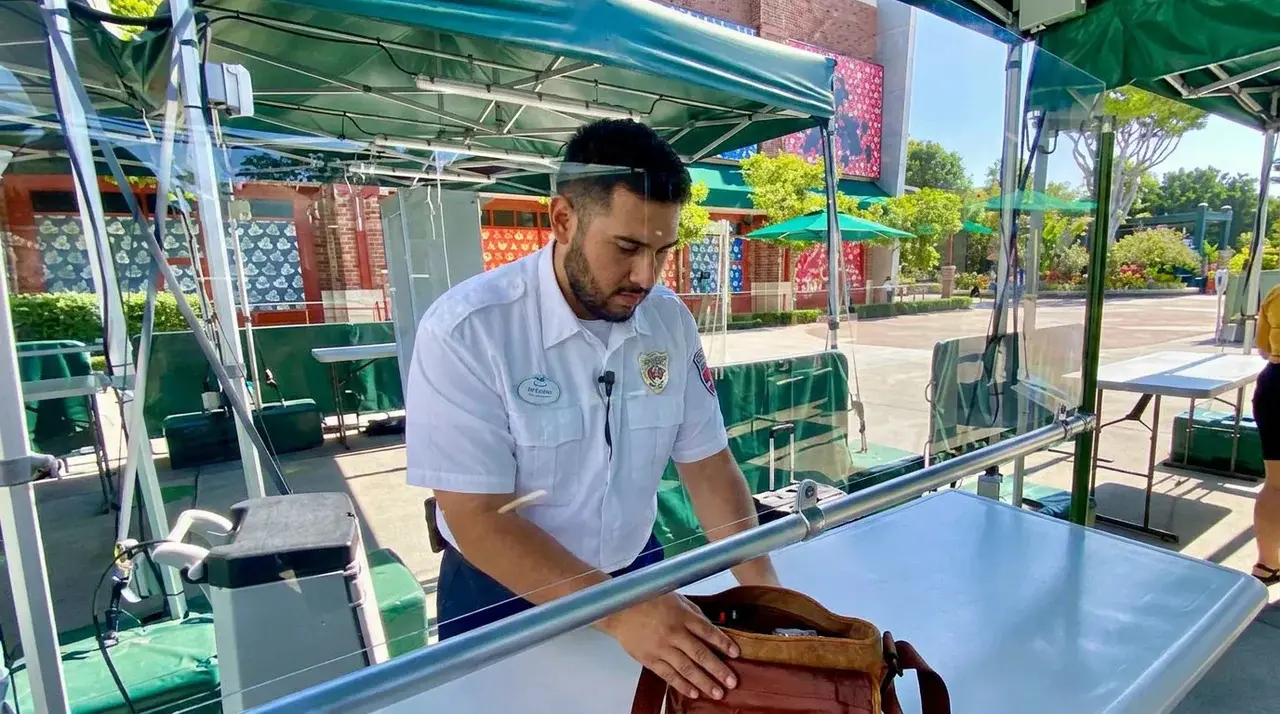
Disneyland Resort uses physical bag inspection with metal detection screening, not X-ray scanners the way airports do. Cast Members manually open and visually inspect bags at the security tables. This is important context because it means the process is inherently more variable than an X-ray line — a Cast Member looking into a messy bag full of loosely packed items takes longer than one looking into an organized bag with a clear top layer. Your packing organization directly affects how fast you move through.
Metal detection at the Esplanade entry points works through walk-through wand detection. You empty your pockets into a tray or your bag before walking through. Items that stay in pockets — keys, coins, metal buckles, phones — trigger the wand and require secondary screening. The single most common cause of slowdown in the metal detection portion is guests who do not empty their pockets until after they have already triggered the detector.
Facial recognition, which went fully live at both parks in April 2026, affects the gate scanning process after bag check but not bag check itself. The two processes are physically separate — bag check happens at the security tables in the Esplanade, and facial recognition happens at the individual park gate turnstiles. Getting through bag check faster does not affect facial recognition processing, but it does get you to the gate faster where facial recognition adds approximately one second to entry.
Which Entry Lines Move Fastest
Harbor Boulevard Security Entry
The Harbor Boulevard security entry consistently moves fastest in the morning, particularly before 9am. The approach from the Harbor Boulevard drop-off area funnels guests into a concentrated stream moving in one direction, and the security infrastructure at this entry is sized to handle the morning rope drop crowd efficiently. Multiple lanes operate simultaneously and Cast Members are at full staffing before park open.
At this entry, the leftmost lanes historically move slightly faster than the center and right lanes during peak morning hours because the crowd flow from Harbor Boulevard naturally gravitates toward the center and right. This varies by day and by crowd density but is worth knowing as a default lane selection when you have a choice.
Downtown Disney Security Entry
Downtown Disney has three separate security entry points depending on which part of the district you enter from. The main security hub at the east end of Downtown Disney, closest to the Esplanade, is the highest-volume entry and typically runs similarly to the Harbor Boulevard entry in terms of speed. The secondary entries on the south and west sides of Downtown Disney, closer to the hotels, are significantly less crowded because fewer guests use them. If you are approaching from the hotel side of Downtown Disney, the southwest security entry near the former ESPN Zone building is frequently nearly empty while the main east entry has a queue building.
The Grand Californian and Disneyland Hotel Entries
Guests entering through the Grand Californian Hotel’s Downtown Disney entrance or through the Disneyland Hotel use those properties’ dedicated security lanes before connecting to the Esplanade. These lanes are consistently less congested than the main public entries because the volume of guests using them is smaller. If you are staying at either hotel and entering through the hotel rather than going to the main security entry, you have a meaningful speed advantage over guests arriving at the public entry points during peak morning hours.
What Gets Flagged at Disneyland Bag Check in 2026
Enforcement at Disneyland security has tightened on several specific item categories in 2026. Some of these are items that were technically always prohibited but not consistently caught. Others represent new emphasis areas. All of them are worth knowing before you pack.
Loose Ice
Ice packs are permitted. Loose or dry ice is not. In 2026, enforcement on loose ice has become more consistent. Bags with ice cubes, bags filled with ice water, and larger soft coolers packed with loose ice are being flagged and guests are asked to dispose of the ice before entry. The issue is twofold: loose ice reduces scan visibility when Cast Members look into a bag, and spilled ice creates safety hazards in crowded walkways. Reusable ice packs that remain sealed are the right solution. Pack them rather than ice and you eliminate this flag entirely.
Glass Containers
Glass is not permitted inside Disneyland Resort with the exception of small baby food jars. This covers glass water bottles, glass soda bottles, homemade food in glass containers, and mason jars of any kind. Glass water bottles specifically have become more common as hydration culture has expanded and more guests are investing in quality glass drinkware for daily use. The rule applies regardless of how nice your water bottle is. If it is glass, leave it at the hotel and bring a stainless steel or plastic alternative.
Oversized Bags
The maximum bag size at Disneyland Resort is 24 inches long by 15 inches wide by 18 inches high. Rolling luggage, large hard-sided coolers, and oversized tote bags that exceed these dimensions are not permitted and will not be checked at security. Bags that are borderline on the dimension limit are being measured more consistently in 2026 than in previous years. If your bag is large, measure it before you leave the hotel.
Selfie Sticks, Monopods, and Large Tripods
Selfie sticks and handheld extension poles for cameras are not permitted inside either park or Downtown Disney. Tripods and monopod stands that extend over 6 feet or that cannot fit inside a standard backpack are also prohibited. This category has expanded in 2026 to include professional-looking audio equipment including shotgun microphones, extended boom-style audio setups, and large camera rigs. Small personal lapel microphones attached to clothing are generally fine. Any equipment that looks like part of a commercial production setup is likely to draw attention from security or Guest Relations.
Prop Weapons and Realistic-Looking Toy Blasters
Disney has enforced restrictions on toy weapons and prop blasters for years, but the threshold for what is considered too realistic has tightened in 2026. Lightsabers purchased inside Galaxy’s Edge are permitted. Toy blasters or prop weapons brought from outside the park that appear realistic, particularly those that resemble actual firearms in color, shape, or finish, are being flagged more frequently. Orange safety tips and obviously toy-like designs typically pass without issue. Anything that reads as potentially real from a visual scan is being stopped.
Folding Chairs
Folding chairs are not permitted inside either park or in Downtown Disney. This is often surprising to guests who bring compact camping chairs for parade viewing. The prohibition is absolute and cast members enforce it consistently. Portable stadium cushions are permitted. Folding chairs with legs are not.
Bags with Locks
Guests adding their own locks to bags or zippers have been stopped at security in recent months. Cast Members need to be able to open and inspect any bag and cannot use bolt cutters or other tools to access locked bags. A bag that cannot be opened by the guest on request will not enter the park.
Strollers That Exceed Size Limits
Strollers are permitted inside both parks provided they do not exceed 31 inches in width and 52 inches in length when fully open. Oversized strollers, wagon-style strollers that exceed these dimensions, and stroller wagons larger than the limit are being turned away more consistently in 2026. If your stroller is on the larger end of the size range, measure it before your visit. The enforcement is applied at the park entrance, not at bag check specifically, but knowing before you arrive saves a frustrating confrontation at the gate.
What Never Gets Flagged That Guests Worry About
Just as useful as knowing what gets flagged is knowing what does not, because a surprising number of guests leave perfectly legal items at the hotel out of an abundance of caution.
Outside food is permitted. Snacks, sandwiches, fruit, granola bars, and any reasonable quantity of personal food for your group can come in. Disneyland does not have a prohibition on bringing your own food and it does not restrict food beyond the glass container and alcohol rules. A bag full of snacks will not be questioned.
Umbrellas are permitted. Standard compact umbrellas, folding umbrellas, and full-size umbrellas all pass without issue. The only umbrella-adjacent item that causes problems is one that is so large it functions as a physical obstruction in the crowd.
Hydration packs and water bladder backpacks are permitted. The water reservoir itself is inspected but the item is not prohibited. Refillable water bottles of all sizes are permitted provided they are not glass.
Small personal tripods, such as a Joby GorillaPod that fits inside a standard backpack, are permitted. The prohibition is on tripods that cannot fit inside a backpack or that extend over 6 feet. A compact flexible tripod stored in your bag passes without issue.
Portable phone chargers and battery packs of any reasonable personal size are permitted. Full camera equipment, mirrorless cameras, and detachable lenses are permitted. The restriction is on commercial-level production equipment, not personal cameras.
Costumes are permitted for adults with specific rules: no full-face masks and no costumes that extend to the ground. Character-specific costumes for children are generally more permissive. Costumes with realistic-looking prop weapons attached are where the prop weapon rules apply.
How to Pack Your Bag for 90-Second Security
The physical organization of your bag is the primary variable you control in the security experience. A Cast Member who opens a bag and can see its contents clearly in one second moves you through. A Cast Member who has to move items around, ask you to unpack, or figure out what a buried item is adds time to every person behind you in the line.
Pack your bag so the top layer is the least suspicious and most clearly identifiable. Snacks, sunscreen, a water bottle, and a charger visible at the top of an open bag read immediately as a standard park bag. A bag where the top layer is a crumpled jacket with unknown shapes underneath requires more investigation.
Remove all items from your pockets before you reach the metal detection wand. Keys, coins, a phone, a thick wallet, and a metal belt buckle can all trigger the wand. Putting all of these into your bag before you reach the detector rather than emptying them into a tray at the detector saves time because the tray step takes longer than reaching into your bag. Walk through the detector with everything already in your bag and both hands free.
Open your bag before you reach the inspection table. Cast Members ask you to open your bag. Having it open when you step up removes that exchange and the physical time it takes to unzip in front of them. One step eliminated from the process.
If you are traveling with a group, have one person designated as the bag person. Groups slow security when multiple people each have a bag to check simultaneously and no one has cleared the lane before the next person is ready. Move through in sequence with the person carrying the smallest, simplest bag going first to establish the lane while others follow.
Do not bring anything you are unsure about. The consequence of bringing a borderline item is not just that it gets confiscated. It is that the conversation about it, the decision-making process for the Cast Member, and the potential trip back to your car or hotel all happen at the security table while everyone behind you waits. If you are not sure whether something is allowed, leave it behind. The Disneyland Resort’s full prohibited items list is on Disneyland.com and is the authoritative reference.
What Happens If Something Gets Flagged
When a prohibited or borderline item is found at bag check, Cast Members will present you with options depending on what the item is. For items that are simply prohibited without exception, such as selfie sticks or glass containers, you will be asked to return the item to your car, leave it with someone who is not entering the park, check it into a locker outside the entrance if the item fits, or dispose of it. For items that are borderline, Cast Members have discretion and can pass or hold the item.
The disposition of a flagged item is not always final. If you believe a Cast Member has made an error about a specific item, you can ask to speak with a security lead. The security lead has broader authority to make determination calls on borderline items. This is worth doing for genuinely ambiguous situations and not worth doing for items that are clearly on the prohibited list.
The bag check area has small courtesy lockers immediately outside the entrance for temporary item storage, but these are not official Disneyland lockers and space is limited. For longer-term storage of items that cannot enter the park, the official Disneyland locker facilities are located just inside both park entrances near the main entry points.
Bag Check at Different Times of Day
Morning bag check, in the 30 to 45 minutes before park opening, is the highest-volume window. This is when every rope drop guest arrives in a compressed time window and the security lanes are processing maximum volume. Despite the crowd, morning bag check at the Harbor Boulevard entry often moves faster per guest than mid-day entry because the lanes are fully staffed and Cast Members are at maximum efficiency for the highest-visibility entry window of the day.
Mid-day bag check, particularly between 10am and 2pm, is where re-entry guests and new arrivals are mixed. Volume is lower than rope drop but the mix of guests is more varied — some are returning from lunch at a nearby restaurant, some are first-arrivals who slept in, some are park hoppers coming from California Adventure. The lanes are less urgently staffed and individual processing can slow down more than at rope drop.
Evening bag check after 6pm is typically the most relaxed. Volume is lower, staffing remains present but the pressure is reduced, and guests who arrive for an evening visit tend to carry less than full-day guests. If you have the flexibility to choose your arrival time and minimizing security friction is a priority, an evening arrival produces the most relaxed bag check experience of the day.
Planning your full Disneyland arrival logistics? See the Enchanted Insider Harbor Boulevard Drop-Off Guide and the Disneyland Backpack Guide for what to carry and how to pack it. For hotel and ticket packages, check Get Away Today before you book.
FAQ
The most commonly flagged items at Disneyland security in 2026 are loose or dry ice, glass containers including glass water bottles, bags exceeding 24 by 15 by 18 inches, selfie sticks and extension poles, realistic-looking prop weapons or toy blasters, folding chairs, bags with locks on the zippers, and professional audio or camera equipment. All prohibited items are listed on the official Disneyland Park Rules page the official disneyland page.
Yes. Outside food is permitted at Disneyland Resort. Snacks, sandwiches, fruit, and a reasonable quantity of personal food for your group can be brought in. The restrictions that apply to food are no glass containers, no alcohol, and no loose or dry ice. Reusable ice packs are permitted. Food in plastic, silicone, or soft-sided containers passes without issue.
The Harbor Boulevard security entry generally moves fastest in the morning before 9am. Within the Harbor Boulevard lanes, the leftmost lanes tend to move slightly faster than center and right during peak morning hours because crowd flow from Harbor Boulevard naturally gravitates toward the center and right. Guests staying at Disney on-property hotels who enter through the Grand Californian or Disneyland Hotel’s dedicated security lanes experience the least congestion of any entry point.
Yes. Standard compact umbrellas, folding umbrellas, and full-size umbrellas are all permitted inside Disneyland Resort. There is no restriction on umbrella size or type. Umbrellas are commonly listed in guest concerns about bag check but they are not prohibited and are not flagged at security.
The fastest bag check experience comes from having your bag open before you reach the inspection table, emptying your pockets into your bag before the metal detection wand rather than at a tray, organizing your bag so its contents are clearly visible from the top, removing any prohibited items before you arrive, and moving through the lane in sequence if traveling with a group. Avoid bringing borderline items that require a Cast Member decision at the table, as those conversations slow the lane for every guest behind you.