
Last Updated on June 12, 2026
Updated April 2026. Choosing the right backpack for Disneyland is one of the most underrated trip decisions you will make. Here is what actually matters, the best options for every type of guest, and exactly what to put inside.
The wrong backpack will ruin your day at Disneyland faster than a two-hour line. That sounds dramatic but ask anyone who has done eight miles on their feet in 85-degree Anaheim heat with a bag that digs into their shoulders, soaks their back with sweat, and requires unpacking completely every time they need their sunscreen. The bag is not an afterthought. It is the thing you carry for ten or twelve hours. It deserves some actual thought.
This guide is written specifically for Disneyland, not theme parks in general. The two parks at Disneyland Resort have specific physical demands, security requirements, and ride considerations that change what the right bag actually looks like for your trip.
Disneyland Backpack Rules: What You Need to Know First
All bags entering Disneyland Resort are subject to security screening at the bag check stations outside both parks. There is no size restriction on bags, but bags cannot be checked at the security tent and left there — everything you bring in, you carry with you all day. That is the first reason size discipline matters. A massive rolling duffel is not an option. A bag you can carry comfortably for ten hours is.
On rides, bags go on the floor of the vehicle, in your lap, or on a hook if one is provided. Most Disneyland rides have no bag restriction — you keep it with you. A few rides, including Incredicoaster and occasionally Rise of the Resistance during peak operations, direct guests to place bags in a free cubbies or bins before boarding. No attraction at Disneyland requires paid locker storage the way Tron Lightcycle Run does at Disney World.
One specific Disneyland consideration: the compact park layout means you are walking shorter distances between lands than at Disney World but doing it more frequently and on a more compressed footprint. A bag that is easy to swing around quickly, access on the move, and repack without stopping is more valuable here than at a sprawling resort where you might walk in a straight line for ten minutes between stops.
What to Look for in a Disneyland Backpack
Size: The 20 to 30 Liter Sweet Spot
For a single-day Disneyland visit without kids, a 20-liter bag is usually sufficient. For a family with children or a multi-day trip where you are bringing extra layers, snacks, and camera equipment, 25 to 30 liters is more comfortable. Beyond 30 liters starts to feel like you are hauling gear rather than visiting a theme park, and anything that big will become a physical burden by afternoon.
For couples or solo adults visiting for a single day, a sling bag or a small 15 to 20 liter daypack is often the better choice over a full backpack. Less volume means less temptation to overpack, which means less weight on your back.
Looking for a park bag that doubles as a Disney accessory? Loungefly mini backpacks fit Disneyland’s bag rules and add real character-themed style to your outfit. See the five best Loungefly backpacks for Disneyland for honest picks across Minnie, Stitch, Pooh, Toy Story, and Tinker Bell designs.
Back Ventilation
This is non-negotiable at Disneyland specifically. Southern California summers mean 80 to 90 degree days in Anaheim. A bag with no airflow channel between the pack and your back will leave you with a completely soaked shirt by noon. Look for a bag with either a mesh back panel or a suspended mesh system that creates space between the bag and your spine. This single feature makes the difference between a comfortable afternoon and a miserable one.
Water Bottle Pockets
You will drink more water at Disneyland than you think. Both parks have free water stations and cup refill points, but you need a vessel to use them. A bag with at least one external water bottle pocket that you can access without taking the bag off is essential. Two side pockets are better because they keep weight balanced. Disneyland’s warm, dry climate combined with hours of walking means hydration is a genuine logistics issue, not a nice-to-have.
Hip Belt or Sternum Strap
Optional for light loads. Mandatory if you are carrying more than about 15 pounds. A hip belt transfers weight from your shoulders to your hips, which are structurally designed to carry loads. A sternum strap keeps the shoulder straps from splaying outward. If you are carrying snacks, water, a camera, a portable charger, sunscreen, and gear for two or more people, a bag with a hip belt will feel dramatically different by 6pm.
Water Resistance
Disneyland does not have the daily afternoon thunderstorms that make water resistance mandatory at Disney World. However, Grizzly River Run at California Adventure will soak you and your bag completely if you are not careful. If Grizzly River Run is on your itinerary, either use a bag with a water-resistant shell or bring a dry bag insert for your electronics. A poncho stored in your bag also handles most rain situations if you visit during the brief Southern California wet season from December through February.
External Access Pockets
The ability to grab your sunscreen, your phone, a snack, or your Lightning Lane screenshot without taking the bag off and opening the main compartment is something you will appreciate dozens of times throughout the day. At least one external zip pocket for small items is the baseline. Two or three is better. A front organizer panel with card slots and key clips is genuinely useful for keeping your park tickets, ID, and payment separate from the rest of the bag’s contents.
Best Backpacks for Disneyland in 2026
Best Overall: Osprey Daylite Plus (20L)
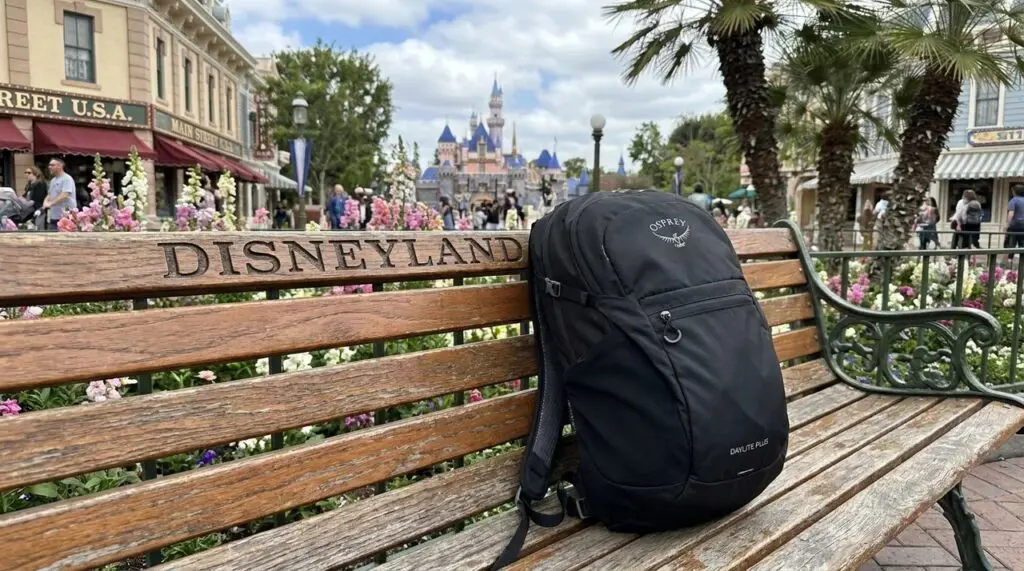
Osprey Daylite Plus 20L The best overall Disneyland backpack for adults and couples. Ventilated back panel, ideal 20L size, and built to last all day. Shop the Osprey Daylite Plus on Amazon
The Osprey Daylite Plus is the backpack most experienced theme park visitors end up recommending to everyone they know. It is 20 liters, which is the ideal size for a single-day Disneyland visit. The back panel is a suspended mesh system that creates a channel between the bag and your spine, which means airflow and dramatically less back sweat than a standard packed foam panel. The shoulder straps are padded well enough for a full day. There is an external water bottle pocket, a front zip pocket for quick-access items, and a secondary compartment for organization. It folds down small enough to pack in checked luggage and weighs almost nothing empty.
It is not a Disney-branded bag and it is not trying to be a statement piece. It is the bag that keeps you comfortable from 8am to midnight and costs around $80 to $95 depending on where you buy it. For couples and solo adults doing a full day at both parks, this is the recommendation.
Best for Families: Thule Chasm 26L
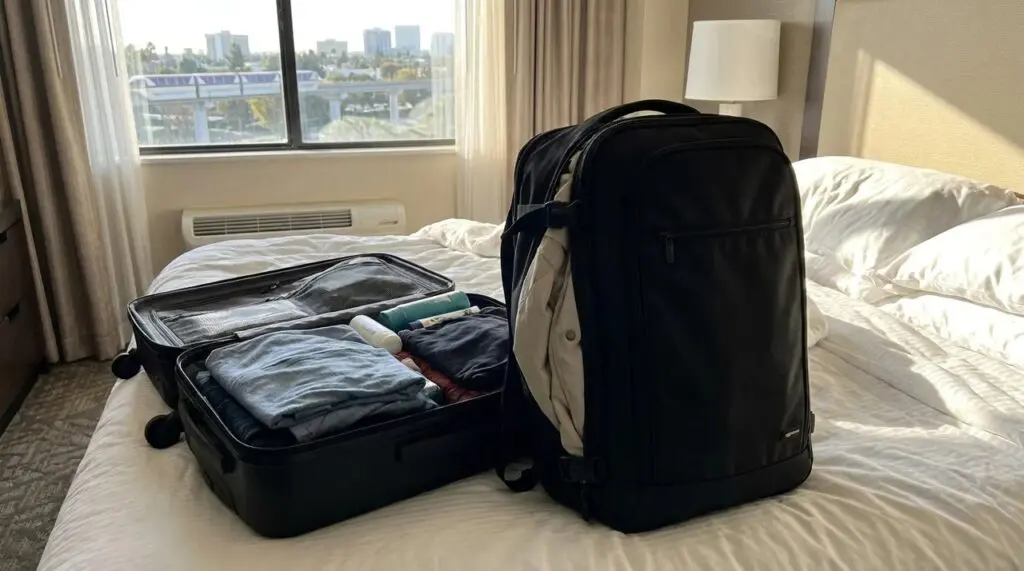
Thule Chasm 26L The best family backpack for Disneyland. Hip belt, clamshell opening, and enough room for the whole group’s essentials. Shop the Thule Chasm on Amazon
Families need more volume than solo guests. The Thule Chasm at 26 liters gives you room for snacks, extra layers, a change of clothes for a younger child, sunscreen, a first aid kit, and two water bottles without the bag looking stuffed. Thule’s back panel uses a ventilated design with a hip belt that actually transfers weight effectively, which matters enormously when you are carrying a loaded family bag for twelve hours. The main compartment opens like a clamshell rather than a top-load, which means you can see and access everything without unpacking from the top. Multiple external pockets handle the quick-access needs.
At around $120 it is more expensive than budget options but the hip belt alone justifies the price on a full family day. The bag is also built well enough to last multiple trips.
Best Sling Bag Option: Lululemon Everywhere Belt Bag (Oversized)
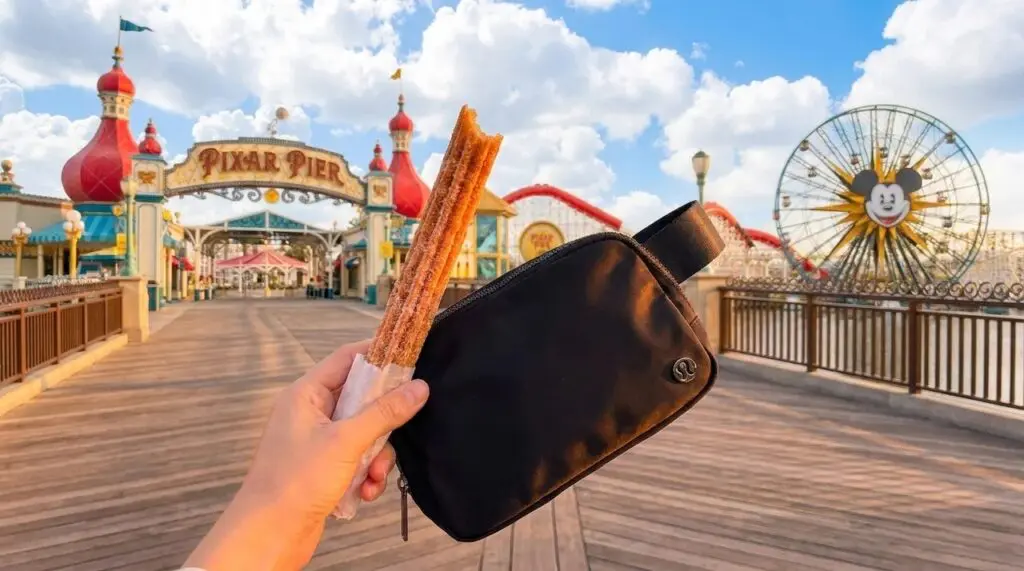
Lululemon Everywhere Belt Bag (Oversized) The best hands-free option for a light Disneyland day. Water-resistant, easy to access on the move, and fits everything you actually need. Shop the Lululemon Everywhere Belt Bag on Amazon
For guests who want minimal carry and maximum ease of access, the Lululemon Everywhere Belt Bag in the oversized version is the current best answer. It fits a phone, a wallet, a portable charger, sunscreen, and a few small essentials comfortably. It wears across the body, meaning you can swing it around to access it without taking it off and without slowing down. The material is water-resistant and the zippers are smooth and reliable. At around $48 it is the most affordable genuinely good bag on this list.
The limitation is volume. You will not fit a water bottle, snacks, extra layers, or camera gear. For couples who want to travel light and grab food and drinks in the park rather than packing them, or for solo adults doing an afternoon and evening visit, this works excellently. For families or full-day visits where you are carrying gear for multiple people, it is not enough bag.
Best Disney-Themed Option: Loungefly Mini Backpack
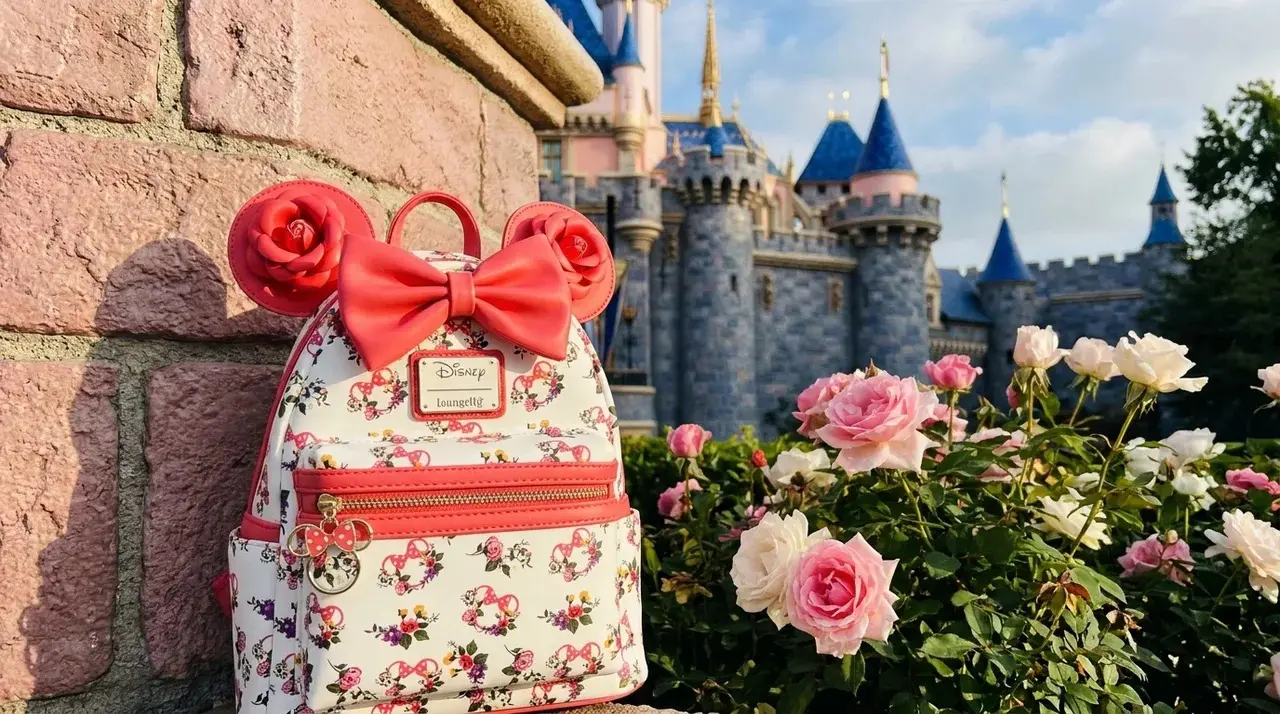
Loungefly Disney Mini Backpack The most popular bag in both Disneyland parks. Well-made, iconic Disney designs, and perfect as a statement piece or accent bag. Shop Loungefly Disney Backpacks on Amazon
Loungefly mini backpacks are the most visible bags in both Disneyland parks. They are everywhere, they are well-made for their size, and the range of Disney character designs means there is something for every fan. The mini backpack format carries a wallet, a phone, a small portable charger, and lip balm. That is genuinely about it.
The honest limitation of a Loungefly for a full Disneyland day is that it is a fashion item that functions as a bag, not a bag that also happens to look good. If you are planning to buy food and drinks in the park, carry no snacks, and want a Disney-themed look, a Loungefly mini works. If you want to pack efficiently, carry your own water and snacks, or bring gear for another person, you need a larger bag and the Loungefly becomes an accent piece to your main bag rather than your primary carry.
For the Disney-themed look in a more functional size, Loungefly also makes a standard backpack version in select designs that offers meaningfully more volume. That is the better choice for a full day if the aesthetic matters to you.
Best Budget Option: Amazon Basics Lightweight Packable Backpack
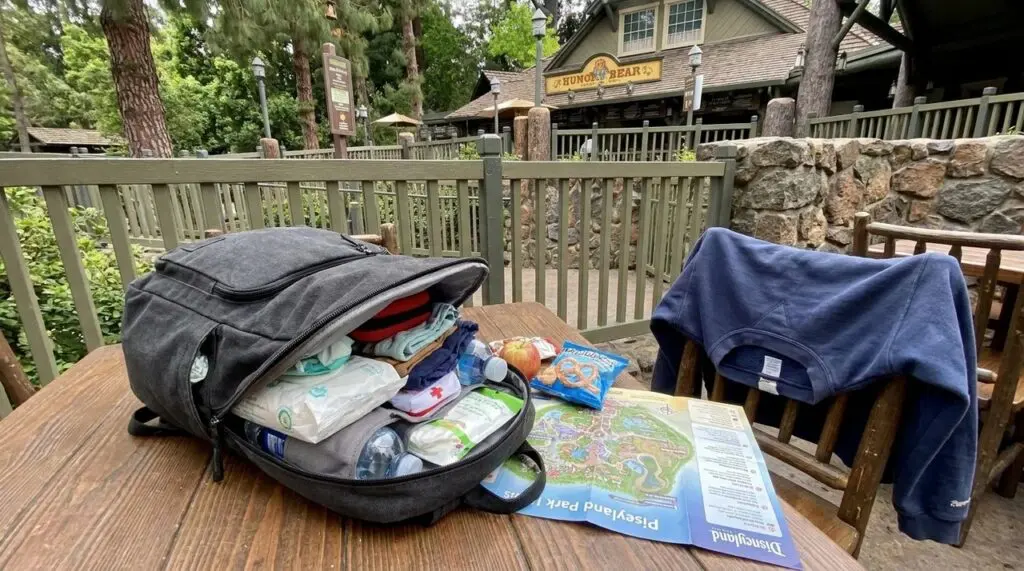
Amazon Basics Lightweight Packable Backpack The best budget backpack for Disneyland. Packs down flat for travel, holds all your essentials, and won’t break the bank. Shop the Amazon Basics Packable Backpack on Amazon
For guests who do not want to spend significant money on a bag, the Amazon Basics Lightweight Packable Backpack in the 18 to 22 liter size is a legitimate option that holds up for multiple trips. It is ultra-lightweight, packs down into its own pocket for easy packing in luggage, comes in multiple colors, and has the basics: a main compartment, external pockets, and side water bottle holders. The back panel does not ventilate the way Osprey’s does and the shoulder straps are thinner. At $25 to $35, it is a fair trade for guests who prioritize budget over comfort on a long day.
What to Actually Pack in Your Disneyland Backpack
The right bag packed wrong is still a problem. Here is what belongs in a Disneyland backpack for a full day at both parks.
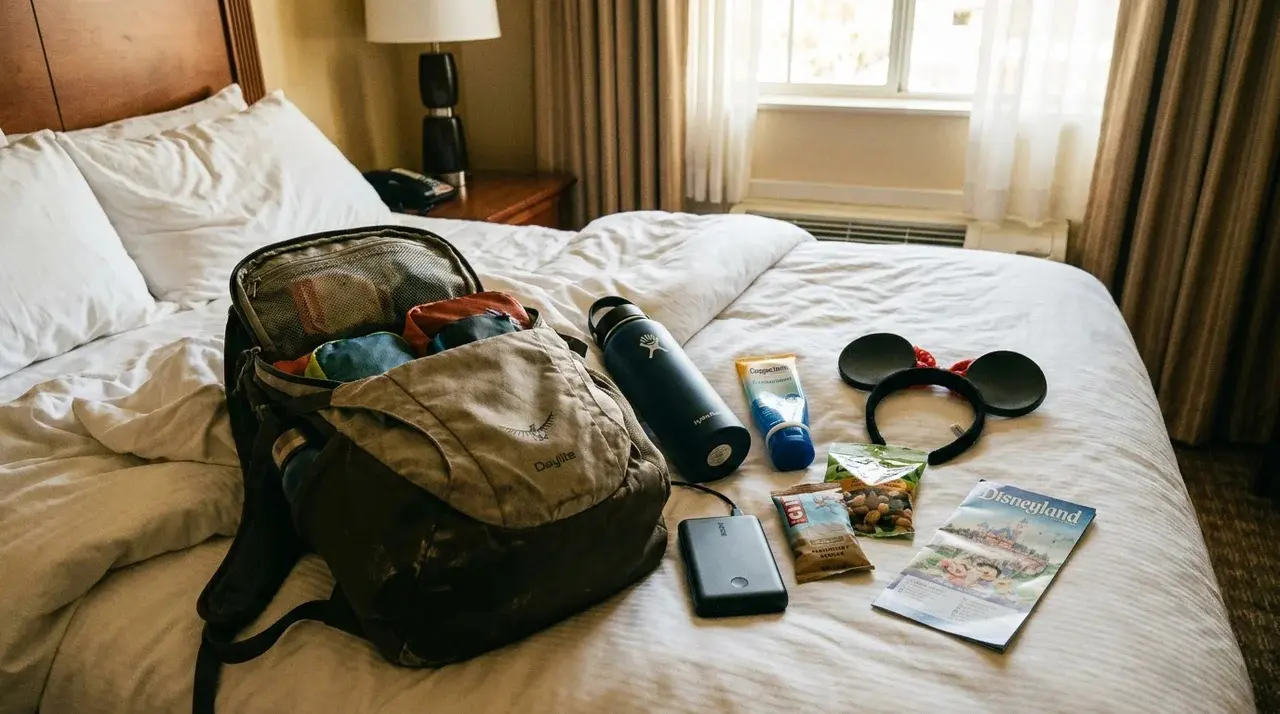
Refillable water bottle. A 20 to 24 ounce insulated bottle keeps water cold through Anaheim afternoons. Both parks have free water refill stations at any quick-service restaurant counter. Buying bottled water in the park at $4 to $5 per bottle adds up to a meaningful daily expense that a single $25 bottle eliminates entirely over any multi-day trip.
Sunscreen. Disneyland is an outdoor park in Southern California. Reapplication at midday is not optional if you burn easily. The small squeeze-size containers are sufficient and easy to access from an external pocket without opening the whole bag.
Portable phone charger. The Disneyland app is your operational tool for the day. Lightning Lane purchases, mobile ordering, wait times, show schedules, and park maps all live in the app. A drained phone by 2pm is a genuine problem. A 10,000 mAh portable charger keeps most smartphones charged through a full day. Compact versions fit easily in a front zip pocket.
Snacks. Outside food is allowed at Disneyland. A simple collection of granola bars, trail mix, or crackers in a zip bag takes up minimal space and provides a meaningful calorie buffer that keeps energy levels stable between meals. This is especially valuable for families with young children whose schedules do not always align with restaurant availability.
Light layers. Anaheim mornings can be cool, afternoons warm, and evenings cool again, particularly from September through May. A packable hoodie or a light long-sleeve layer takes up almost no volume in a 20-liter bag and becomes critical comfort gear as the evening cools down. Galaxy’s Edge and the area around the Haunted Mansion are particularly shaded and tend to run cooler than Main Street.
Rain poncho. A single-use poncho takes up the space of a deck of cards and costs around $3 on Amazon. If you visit during the winter wet season or want insurance against an unexpected shower, one per person in the group is worth carrying. Disney sells ponchos inside the park at a significant markup.
First aid basics. A small travel kit with band-aids, blister pads, pain reliever, and antacids in a zip bag handles the minor situations that otherwise derail a park day. Blisters specifically are a Disneyland reality for guests who underestimate how much walking the day involves. A blister pad applied at first discomfort rather than last resort makes an enormous practical difference.
External battery pack cable. Easy to forget. Useless without it.
A small dry bag or zip bag for valuables on water rides. Grizzly River Run at California Adventure gets your whole bag wet if you are not prepared. A simple gallon zip bag inside your backpack protects your phone, wallet, and portable charger during the ride without requiring a separate purchase.
What Not to Bring
Selfie sticks, monopods, and tripods are not permitted at Disneyland attractions and will be confiscated or asked to be removed before boarding rides. Large professional camera equipment with detachable lenses is technically permitted in the park but draws security attention at bag check and is cumbersome on rides. A mirrorless camera with a small zoom lens is a better fit than a DSLR with a full kit.
Hard-sided coolers are not permitted. Soft-sided coolers are allowed as long as they fit through bag check. Ice packs are permitted provided they are not exclusively liquid. Disney does not permit alcohol to be brought into the parks.
Unnecessary weight is the most common mistake guests make when packing for Disneyland. Every pound you carry at 8am you are also carrying at 11pm when your feet hurt and you are trying to get out of the parking structure. Ruthlessly cut anything you are not confident you will actually use. The park has stores, restaurants, and services for most situations that come up unexpectedly. You do not need to prepare for every possible scenario.
Backpack Quick Reference: Which Bag for Which Guest
Solo adult or couple, full day: Osprey Daylite Plus 20L
Family with young children, full day: Thule Chasm 26L
Afternoon and evening visit, light carry: Lululemon Everywhere Belt Bag (oversized)
Disney-themed look as priority: Loungefly standard backpack (not mini) for functional carry, Loungefly mini as accent bag
Budget-conscious, single trip: Amazon Basics Lightweight Packable Backpack 22L
Planning the rest of your Disneyland visit? The Enchanted Insider Disneyland Itinerary Guide is updated for 2026 with day-by-day plans for both parks including packing strategy and what to bring. For hotel and ticket packages, check Get Away Today before you book.
FAQ
For a single-day Disneyland visit as an adult or couple, a 20-liter backpack is the ideal size. Families with children or guests carrying gear for multiple people should look at 25 to 30 liters. Anything larger than 30 liters becomes physically burdensome over a ten to twelve hour park day and is more than you need given the food, merchandise, and services available inside both parks.
Yes. Backpacks and bags of all sizes are permitted at Disneyland Resort. All bags go through security screening at the bag check stations outside each park before entry.
There are no size restrictions, but bags must be carried with you throughout the day as there is no bag drop or storage at the security tents. On most rides, bags stay with you on the vehicle or on a hook provided at the boarding area.
For families with young children, the Thule Chasm 26L is the best option for a full Disneyland day. It has a ventilated back panel, a functional hip belt for weight transfer, a clamshell opening for easy access, and enough volume for snacks, extra layers, sunscreen, a change of clothes, and two water bottles without feeling overstuffed. For parents who want something smaller, the Osprey Daylite Plus 20L also works for families who pack efficiently.
Loungefly mini backpacks are well-made and extremely popular at Disneyland, but they are better suited as fashion accessories than functional park bags for a full day. The mini size carries a wallet, phone, and small charger but not much else.
For a full day with snacks, water, and sunscreen, the Loungefly standard backpack is a better choice. A Loungefly mini works well as an accent bag paired with a larger functional daypack.
The essential Disneyland backpack contents are a refillable water bottle, sunscreen with a mid-day reapplication, a portable phone charger and cable, light snacks, a packable layer for cooler evenings, a compact rain poncho, basic first aid items including blister pads, and a zip bag to protect electronics on Grizzly River Run.
Outside food including snacks and non-alcoholic beverages is permitted in both parks and saves meaningful money over buying everything inside.