
Last Updated on September 5, 2026
Updated April 2026. Everything families need to know about the Disneyland Disability Access Service — what it is, who qualifies, how to register, how to use it in the parks, and what other accommodations are available for guests with autism and developmental disabilities.
Disneyland can be an overwhelming sensory environment. Crowds, noise, long waits, bright lights, sudden sounds, and unpredictable changes in pace are part of what makes the park exciting for some guests and genuinely challenging for others. For families visiting with a child or adult with autism or a related developmental disability, knowing what accommodations are available before you arrive makes the difference between a difficult day and one that the whole family can genuinely enjoy.
The primary accommodation Disney offers for guests with developmental disabilities is the Disability Access Service, commonly called DAS or the Disneyland autism pass. This guide covers everything you need to know about how it works, who qualifies under the current 2026 policies, how to register, and what other tools are available to help make your visit successful.
Disneyland DAS at a Glance
What it is: Disability Access Service — a program that allows guests with developmental disabilities to receive attraction return times instead of waiting in a conventional standby queue
Who qualifies: Guests with a developmental disability such as autism or similar who are unable to wait in a conventional queue for an extended period of time
Cost: Free — there is no charge to register for or use DAS
How to register: Live video chat with a Disney Cast Member before your visit, available up to 60 days in advance
How many guests it covers: The registered guest plus up to three additional party members, for a total of four
How long it is valid: For the length of your ticket or up to one year, whichever is shorter
Is a doctor’s note required: No — Disney does not require documentation or proof of diagnosis
Is DAS from Disney World valid at Disneyland: No — DAS must be registered separately at each resort
Can you hold multiple return times: No — a party can only hold one active DAS return time at a time
What Is the Disneyland DAS Pass?
The Disneyland Disability Access Service is a program designed specifically for guests who, due to a developmental disability such as autism, are unable to tolerate waiting in a conventional standby queue for an extended period of time. It is not a front-of-line pass. It does not provide immediate access to attractions. What it does is allow the registered guest and their party to request a return time for a specific attraction that is comparable to the current standby wait, then spend that wait time anywhere in the park rather than physically standing in a queue.
When the return time arrives, the party enters through the Lightning Lane entrance for that attraction and proceeds with a minimal physical wait from that point. Every attraction at Disneyland Park and Disney California Adventure that has a standby queue is eligible for DAS return times. The registered guest must be present and actually experience the attraction when the return time is redeemed.
DAS is free to use. It does not require purchasing Lightning Lane Multi Pass or Lightning Lane Individual. If your party also uses Lightning Lane, DAS return times operate independently alongside those purchases.
Who Qualifies for Disneyland DAS in 2026?
DAS eligibility changed significantly in June 2024. Before that change, the program was available for a broader range of disabilities. Under the current policy, DAS at Disneyland is specifically intended for guests with a developmental disability such as autism or similar who are unable to wait in a conventional queue for an extended period of time. Physical disabilities, mobility limitations, chronic illness, and anxiety alone generally do not qualify under the current guidelines. For contemporary reaction when those eligibility changes rolled out, see our historical coverage of guest concerns about the updated Disability Access Service.
Eligibility is determined through a live video chat conversation with a Disney Cast Member, with health professionals from Inspire Health Alliance also available during the process to assist with accommodation decisions. Disney does not ask for documentation, a doctor’s note, or proof of diagnosis. Approval is based on the guest’s described needs and how those needs affect their ability to wait in a conventional queue, not on a diagnosis or a piece of paper.
Guests who were approved for DAS under the previous guidelines are not automatically approved under the current ones. Each registration involves a new conversation. Prior approval does not guarantee future approval.
Guests who apply and are not approved for DAS may be offered alternative accommodations depending on their specific needs. These may include Attraction Queue Re-Entry, which allows a guest to exit a queue and return to their place if needed, or other individual accommodations discussed during the registration conversation. Wheelchair and ECV users whose primary need is mobility typically do not qualify for DAS, as the resort’s accessible queue infrastructure is designed to accommodate mobility devices directly, but guests in wheelchairs with additional needs beyond mobility may qualify and should explain their full situation during the registration call.
How to Register for Disneyland DAS in 2026
All DAS registration at Disneyland is done through a live video chat before your visit. The registration window opens up to 60 days before the date of your first park visit. You cannot register for DAS by walking up to Guest Relations inside the park — the in-person registration process was eliminated as part of the 2024 changes. If you arrive at the park without having registered and attempt to do so at Guest Relations, Cast Members will direct you to register via video chat on your phone.
To register, go to the Disneyland Resort website and navigate to the Disability Access Service registration page. You will need a Disney account and valid park admission linked to your account for each member of your party before the call begins. The video chat connects you with a Disney Cast Member and, when relevant, a health professional from Inspire Health Alliance. American Sign Language interpretation is available for guests who are deaf or hard of hearing. The chat interface is screen reader-friendly for guests who are blind or have low vision.
During the call, you will be asked questions about what prevents the guest from waiting in a conventional standby queue. Be specific about the functional challenges rather than the diagnosis itself. Describing the specific behaviors, physical responses, or sensory challenges that make conventional queuing difficult gives the Cast Member the clearest picture of what accommodations are needed. The call itself, once connected, is typically less than ten minutes. Wait times to connect vary, so plan for a potential wait before the call begins.
The registered guest must be present and visible during the registration video call. For children, a parent or guardian may speak on their behalf, and if you do not wish to have the child’s image captured, a photo of the parent or guardian may be taken instead. The photo is used when redeeming return times to verify that the registered guest is present and experiencing the attraction.
DAS registration is valid for the length of your ticket or up to one year, whichever is shorter. If you are visiting for multiple days on a single ticket, you do not need to re-register each day. If your visit spans longer than the ticket validity, you will need to re-register for subsequent tickets.
How to Use DAS at Disneyland
Once registered, using DAS in the parks is straightforward. On the day of your visit, open the Disneyland app and navigate to the DAS section. Any member of your party can request a DAS return time for an attraction, but the registered guest must be present when that return time is redeemed. You can only hold one active DAS return time at a time. Once you redeem a return time, you can request another one ten minutes after redemption.
Return times are set to be comparable to the current standby wait for that attraction. If Indiana Jones Adventure is posting a 60-minute standby wait when you request your return time, your DAS return time will be approximately 60 minutes from that request. During that window, your party can explore the park, get food, visit other attractions with shorter waits, or do whatever works best for the group. When the return window opens, head to the Lightning Lane entrance for that attraction and let the Cast Member know you are using a DAS return time.
DAS return times are valid until the park closes or the attraction closes for the day. If your return time comes and goes and you were not able to use it, the time does not expire in a way that penalizes you — you simply request a new one.
If you need assistance obtaining a return time and cannot use the app, Guest Relations locations inside both parks and the Accessibility Services Kiosk can help. Cast Members at these locations can request return times on your behalf.
Additional Disneyland Accommodations for Guests with Autism
DAS is the primary accommodation but it is not the only one. Disneyland offers a range of additional services that are useful for guests with autism and sensory sensitivities, many of which do not require pre-registration.
Sensory Experience Details Guide
Disney publishes a detailed Sensory Experience Details guide for every attraction, entertainment experience, character dining venue, and guided tour at Disneyland Resort. The guide describes sensory elements including lighting effects, loud noises, sudden movements, periods of darkness, strong smells, wet elements, and high speeds for each experience. For families planning with a guest who has specific sensory sensitivities, reviewing this guide before your visit allows you to build a day around what works rather than discovering on the ride what does not. The guide is available on the Disneyland accessibility page and is worth downloading before your trip.
Attraction Queue Re-Entry
Attraction Queue Re-Entry is available to any guest, no pre-registration required. If a guest needs to step out of a standby queue for any reason, they can speak with a Cast Member at the attraction entrance about re-entering the queue at approximately the same position they left. This is useful for guests who may need to exit briefly due to sensory overwhelm, a medical need, or behavioral support, without losing their place entirely. The specifics of how this works can vary by attraction and by current queue conditions.
Stroller as a Wheelchair
For guests with autism or a developmental disability who use a stroller beyond the typical age range, Disneyland allows strollers to be used in attraction queues and designated areas where strollers would normally not be permitted. To access this accommodation, visit Guest Relations or the Accessibility Services Kiosk and request a Stroller as Wheelchair tag for the stroller. The tag allows the stroller to accompany the guest into queues and attraction boarding areas without needing to be parked at the stroller parking area outside the attraction. This is particularly useful for guests who may elope or who need the security of a familiar stroller environment throughout the day.
Handheld Assistive Devices
Disneyland offers a handheld device at select attractions that provides assistive listening, handheld captioning, and audio descriptions for guests with hearing or visual disabilities. The device is available from Guest Relations and is compatible with most attractions that have audio-based show elements. For guests with hearing sensitivities rather than hearing loss, this is not the intended use of the device, but families with guests who have both a developmental disability and a hearing impairment should know it exists.
Accessibility Planning Guide
Disneyland publishes a full Accessibility Planning Guide that covers pre-arrival preparation strategies, what to pack, how to navigate arrival at the resort, and a full breakdown of services available throughout both parks. It is worth reading before your first visit with a guest who has specific accessibility needs. The guide also covers accessible hotel room options at the Disney-operated hotels, which include roll-in showers, lowered beds, visual notification devices, and other accommodations relevant to guests staying on property.
Disability Parking
Accessible parking is available throughout Disneyland Resort including the Mickey and Friends Parking Structure, the Pixar Pals Parking Structure, and the Toy Story Parking Area. Wheelchair-accessible trams and shuttles connect parking areas to the resort entrance. A valid accessible parking placard or license plate is required to use designated accessible spaces.
Quiet Spaces At Disneyland
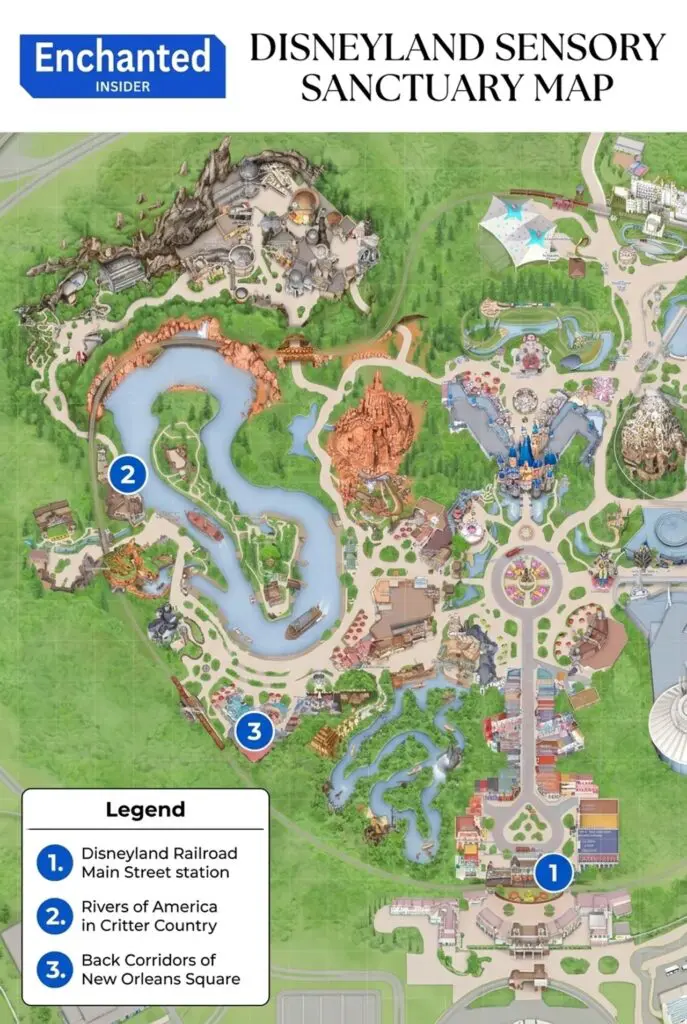
Pro Tip: Save this map to your phone’s camera roll before you enter the park. Cell service can be spotty in New Orleans Square and Critter Country, and having this available offline ensures you always know where your nearest ‘Reset Zone’ is.
Both parks have areas that are naturally quieter and lower-stimulation than others. The area around the Disneyland Railroad Main Street station in the early morning, the benches along the Rivers of America in Critter Country, and the quieter back corridors of New Orleans Square tend to offer lower ambient noise and crowd density compared to Fantasyland, Main Street, or Galaxy’s Edge on busy days. Knowing where to find these spaces before the day gets overstimulating gives your party a reset option without leaving the park.
Tips for Visiting Disneyland with Autism
Register for DAS as early as possible. The registration window opens 60 days before your visit. Registering early gives you flexibility to reschedule if technical issues arise and ensures the accommodation is in place before you arrive rather than having to manage it on the day.
Download the Sensory Experience Details guide before your trip. Planning your attraction list around what the guide tells you about each experience makes the day significantly more manageable. Ruling out attractions with sudden unexpected loud noises or prolonged darkness before you arrive at the queue prevents situations where a guest is mid-experience before realizing it is not going to work.
Visit on a weekday in a slower season. Crowd levels directly affect sensory load at Disneyland. Weekday visits in January through early March and September through early November offer the lowest crowd levels of the year. Smaller crowds mean shorter ambient noise levels, more personal space in walkways, shorter queues even with DAS, and a generally lower-stimulation environment throughout the day.
Arrive at rope drop. The first 60 to 90 minutes after park open is consistently the calmest period of the day . Crowd density is at its lowest, ambient noise is lower, and the park has not yet reached the sensory intensity of peak afternoon hours. Using that window to experience priority attractions before the day builds in intensity is a meaningful strategy for guests with sensory sensitivities.
Build in rest time deliberately. A full Disneyland day without breaks is difficult for most guests and more difficult for guests with sensory sensitivities. Identifying a mid-day break window, whether that is returning to the hotel, finding a quiet corner of the park, or timing a slower dining experience, prevents the end-of-day escalation that comes from running without recovery time.
Pack a sensory kit. Noise-canceling headphones, sunglasses, a comfort object, fidget tools, preferred snacks, and a visual schedule if your family uses one are all worth bringing in your park bag. Disneyland allows outside food and snacks. Having familiar, preferred items available gives a guest with sensory sensitivities reliable anchors throughout the day that do not depend on what the park provides.
Talk to Guest Relations on arrival. Even if you have registered for DAS in advance, checking in with Guest Relations or the Accessibility Services Kiosk when you arrive gives you an opportunity to ask questions, clarify how DAS works on that specific day, and learn about any accessibility-specific information relevant to your visit. Cast Members at these locations are trained to support guests with a range of needs and can flag accommodations that are not widely publicized.
Planning your Disneyland visit for a guest with autism or special accessibility needs? The Enchanted Insider Disneyland Itinerary Guide is updated for 2026 with day-by-day planning for both parks. For hotel and ticket packages, check Get Away Today before you book.
FAQ
The Disneyland autism pass is commonly used to refer to the Disability Access Service, or DAS. It is a free accommodation offered by Disneyland Resort for guests with a developmental disability such as autism who are unable to wait in a conventional standby queue.
DAS allows the registered guest and up to three party members to receive attraction return times comparable to the current standby wait, then enter through the Lightning Lane entrance when the return time is ready.
DAS at Disneyland is registered through a live video chat with a Disney Cast Member, available up to 60 days before your visit on the Disneyland Resort website.
You will need a Disney account and valid park admission linked for each party member. No doctor’s note or documentation is required.
Disney does not accept documentation but bases approval on the guest’s described needs during the video call. In-person registration at Guest Relations inside the park is no longer available.
No. Disneyland does not require a doctor’s note, a diagnosis letter, or any documentation of disability to register for DAS. Cast Members will not look at documentation if you bring it.
Approval is based on a conversation during the live video chat registration about the guest’s specific functional needs and what prevents them from waiting in a conventional standby queue.
The DAS pass at Disneyland covers the registered guest plus up to three additional party members, for a total of four guests per DAS registration. The registered guest must be present when any DAS return time is redeemed at an attraction.
Beyond DAS, Disneyland offers a Sensory Experience Details guide describing sensory elements of every attraction, Attraction Queue Re-Entry for guests who need to briefly exit a standby queue, a Stroller as Wheelchair tag allowing strollers in attraction queues for guests who need them, accessible parking throughout the resort, and a full Accessibility Planning Guide available on the Disneyland website.
Guests can also speak with Cast Members at Guest Relations or the Accessibility Services Kiosk for additional individualized accommodations on the day of their visit.