
Last Updated on May 7, 2026
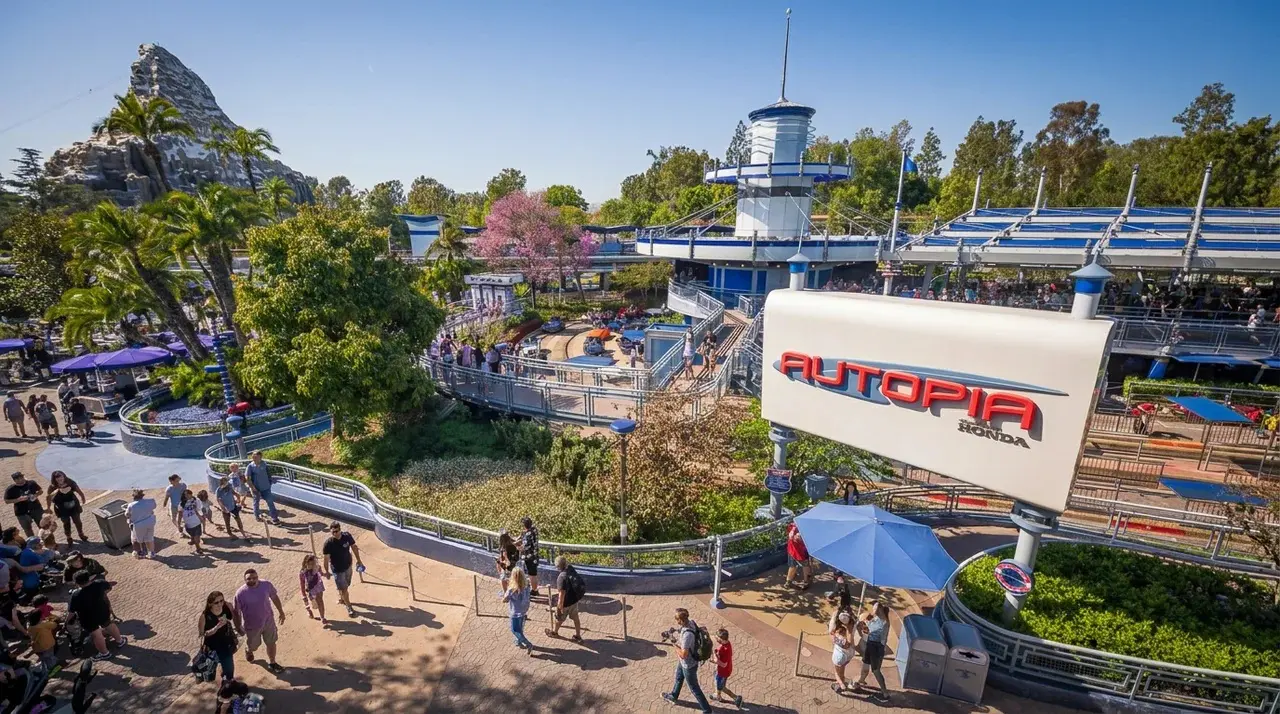
Something is happening backstage at Autopia, and the construction tells a much bigger story than a simple ride update. New concrete structures are going up behind the attraction. Land has been cleared. Infrastructure that did not exist six months ago is being built in areas that have not been touched in decades. And as of this week, Disney has officially confirmed that Autopia’s gas-powered engines will be retired in early 2027 and replaced with a fully electric fleet.
That confirmation, reported by the Orange County Register, is the headline. But the real story is what that decision tells us about Tomorrowland. Because if Disney is investing the kind of capital required to convert Autopia to electric, they are not tearing down Tomorrowland anytime soon. And that changes what every Disneyland fan should expect from this corner of the park for the next decade.
What Is Actually Being Built
The construction activity behind Autopia has been visible from the Disneyland Monorail since early 2026. Riders on the Tomorrowland side of the Monorail loop have spotted cleared dirt, new backstage structures, and what appears to be the early stages of a charging and maintenance facility for the new electric vehicles.
Converting Autopia to electric is not as simple as dropping a battery under the hood. These are not golf carts. The attraction operates up to 16 hours a day during peak season, which means the vehicles need a battery system and charging infrastructure that can sustain continuous high-volume operation far beyond what a standard electric vehicle battery would handle. That requires dedicated charging stations, a power distribution system to support them, and a maintenance facility built specifically for the new fleet.
The new concrete structure visible from the Monorail is not where guests will see anything. It is backstage infrastructure: think of it like a chiller plant or a power substation that serves a wide area of the park. It is not themed, not guest-facing, and not designed to be seen. But it is large, and the fact that Disney is building it tells you the scope of the investment.
Disney has confirmed that they are currently working on the design, engineering, and testing of a fully electric Autopia ride vehicle prototype. The original plan announced in 2024 targeted a fall 2026 conversion. The updated timeline now points to early 2027 for the retirement of the gas engines. Whether the attraction closes for a period during the transition or phases in new vehicles gradually has not been confirmed.
The Adalvice Snacks Connection
The construction activity near Autopia appears to be connected to work happening at the former Adobo and Salsa Vic snack stand (commonly called “Adalvice” by regulars) near the Tomorrowland walkway. The site has been under construction for months, and the prevailing theory supported by the backstage evidence is that Disney needed to access underground infrastructure in that area to support the Autopia electrical work.
Disneyland’s underground utility network is extensive and largely invisible to guests. When Disney needs to run new electrical capacity or modify existing systems, they sometimes have to dig up surface-level structures to reach what is below. The theory: since they had to tear up the Adalvice area for underground work anyway, they decided to rebuild it as a nicer guest-facing space. The result will likely be an upgraded seating and dining area, not because anyone asked for a fancier turkey leg spot, but because the ground had to come up regardless and Disney does not rebuild things worse than they were.
What This Means for Tomorrowland’s Future
This is the part that matters most, and it is the takeaway that most Disneyland fans are not going to want to hear.
If Disney is investing real capital in converting Autopia to electric, including new vehicles, a new charging facility, new backstage infrastructure, and potentially new show elements to give guests a reason to love the ride again, that investment extends the life of Autopia by at least 10 to 15 years. Disney does not make that kind of capital commitment on an attraction they plan to demolish for a new Tomorrowland in five years. It does not happen. The math does not work, and the company does not operate that way.
If there is a plan for Autopia, then there is a plan for Tomorrowland. The two go hand in hand. And that plan, based on the evidence, is not “tear everything down and start over.” It is “invest in what is here and extend its life.”
The same logic applies to Finding Nemo Submarine Voyage. After COVID, many observers (including the creator of the video that inspired this article) expected Disney to quietly let Finding Nemo stay closed. The ride has poor capacity, high operating costs, and occupies prime real estate in Tomorrowland. Instead, Disney put it through a months-long refurbishment and reopened it. That decision added decades to Finding Nemo’s life at the park. You do not spend that money on a ride you plan to remove.
Put the two investments together and the picture is clear. Autopia is staying. Finding Nemo is staying. The Tomorrowland lagoon is staying. The current layout of Tomorrowland is not going anywhere for a very long time.
Why This Is Actually Good News
The online Disneyland community has wanted a “new Tomorrowland” for years. Tear out Autopia. Fill in the lagoon. Build something from the ground up. It is an understandable wish. Tomorrowland has felt dated for a long time, and the gas-powered Autopia cars in particular have felt increasingly out of step with, well, tomorrow.
But consider what Disney is actually doing. They are taking a 1955 opening-day attraction, one that has been part of Disneyland longer than almost anything else in the park, and updating it with technology that is genuinely more aligned with Tomorrowland’s original vision than what has been there for decades. Walt Disney built Autopia to give guests a glimpse of the future of personal transportation. Gas-powered cars were that future in 1955. Electric vehicles are that future now. Converting Autopia to electric is not a compromise. It is the most Tomorrowland thing Disney could do with the attraction.
Autopia is as much a part of Disneyland’s history and landscape as Main Street, Sleeping Beauty Castle, or the Rivers of America. It is an original 1955 attraction. It has been here for over 70 years. In any other context, the Disneyland community would be fighting to preserve it. The electric conversion lets Disney preserve it and improve it at the same time.
The vintage aura of the gas engines, the particular sound they make, the smell (which some guests genuinely love and others genuinely hate), all of that will change. What replaces it is quieter, cleaner, zero-emission, and more forward-thinking. That is a trade worth making.
The Timeline
Here is what we know and what we can reasonably expect.
Disney originally announced plans in 2024 to convert Autopia from gas to electric by fall 2026. That timeline has been revised. The updated agreement with the California Air Resources Board now targets early 2027 for the retirement of the existing gas engines. Prototype electric vehicles are currently in design, engineering, and testing. The backstage charging infrastructure is under construction now and visible from the Monorail. No official closing date or reopening date for the attraction has been announced.
The most likely scenario: Autopia continues operating with gas vehicles through 2026 while the infrastructure is built and the new vehicles are finalized. A closure period of several months in late 2026 or early 2027 allows for the swap. The attraction reopens with the electric fleet in 2027, potentially with updated show elements or theming to mark the change. This is speculation based on the construction timeline and the CARB agreement, not an official Disney announcement.
What to Expect If You Visit in 2026
Autopia is currently open and operating with its existing gas-powered vehicles. You can ride it today. The backstage construction is visible from the Monorail if you are on the Tomorrowland side and looking toward the Autopia area. It is not visible from inside the park at ground level.
If you have young children who love Autopia, this is their last window to experience the gas-powered version of the ride before it changes permanently. The sound, the feel, and the (admittedly intense) smell of the current vehicles will not exist after the conversion. For families who have been riding Autopia with their kids for years, there is a bittersweet finality to that. The ride is not going away. But this version of it is.
Disneyland’s broader sustainability commitment is to reach net zero emissions by 2030. The Autopia conversion is part of that roadmap. When complete, it will eliminate one of the most visible sources of emissions in the park and bring Autopia into alignment with the rest of the resort’s environmental goals.
Plan the Rest of Your Trip
For the full Disneyland strategy including Tomorrowland rope drop tactics, ride priorities, and how to build your day around construction closures, the Enchanted Insider Disneyland Itinerary Guide covers everything. For the best rates on hotel and ticket packages near the resort, Get Away Today is the travel partner we use and recommend for Disneyland Resort vacations.
FAQ
Disney has confirmed an agreement with the California Air Resources Board to retire Autopia’s existing gas-powered engines by early 2027. The original 2024 announcement targeted fall 2026, but the timeline has been revised. Disney is currently designing, engineering, and testing fully electric ride vehicle prototypes. Backstage charging infrastructure is under construction and visible from the Monorail.
Disney has not announced official closing or reopening dates for the Autopia conversion. The most likely scenario based on the construction timeline is that Autopia continues operating with gas vehicles through most of 2026, closes for a period of several months in late 2026 or early 2027 for the vehicle and infrastructure swap, and reopens with the new electric fleet in 2027.
Based on the evidence from the Autopia electric conversion and the Finding Nemo Submarine Voyage refurbishment, Disney appears to be investing in extending the life of the current Tomorrowland layout rather than planning a complete teardown and rebuild. The capital investment required for new electric vehicles, backstage charging infrastructure, and the Nemo refurbishment suggests that the current Tomorrowland footprint will remain largely intact for at least the next 10 to 15 years.
Yes. Autopia is currently open and operating with its existing gas-powered vehicles as of May 2026. The electric conversion is expected to take place in late 2026 or early 2027. If you want to experience the original gas-powered Autopia before the change, 2026 is your last window. The sound, feel, and smell of the current vehicles will not exist after the conversion.
Disney’s decision to convert rather than replace Autopia signals a commitment to preserving the original 1955 attraction as part of Disneyland’s history. Autopia is one of the few remaining opening-day attractions. The electric conversion also aligns with Disneyland Resort’s sustainability goal of reaching net zero emissions by 2030 and brings the ride closer to Walt Disney’s original Tomorrowland vision of forward-thinking personal transportation.